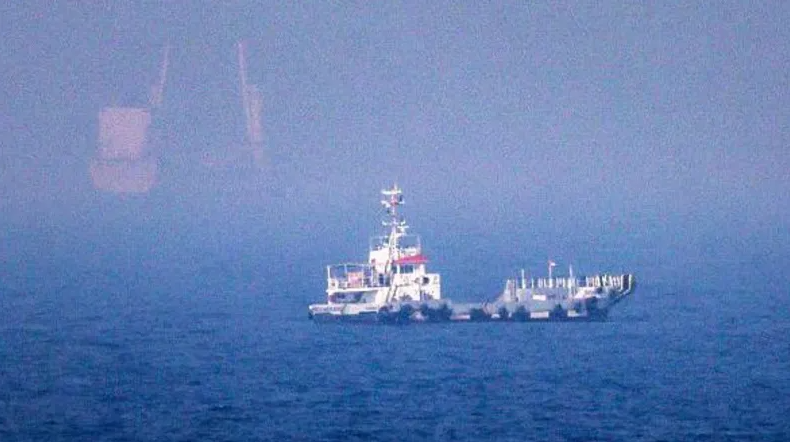
The Strait of Hormuz has become the epicenter of a rapidly escalating military confrontation after Iranian cruise missiles struck two United Arab Emirates oil tankers on Tuesday, killing one crew member and wounding eight others. The attack came hours after the United States resumed airstrikes on Iranian targets, marking a third consecutive night of American military action in the region.
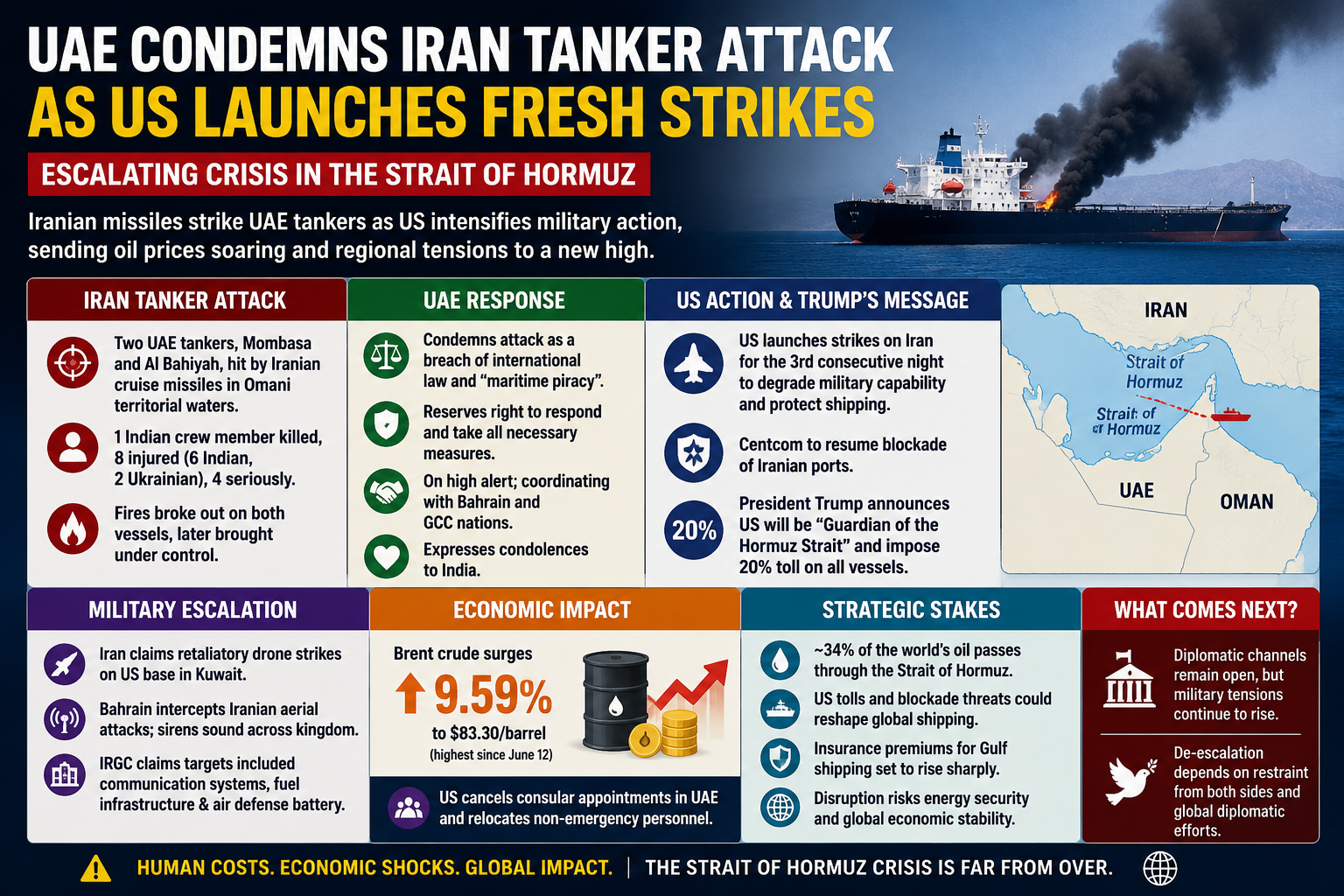
The UAE's Defense Ministry confirmed that the tankers Mombasa and Al Bahiyah were hit by two Iranian cruise missiles while transiting the southern lane of the strait in Omani territorial waters. Fires broke out on both vessels before being brought under control. The Indian crew member killed was aboard the Mombasa, while six Indian nationals and two Ukrainian nationals suffered injuries, four of them serious.
UAE Response and Regional Condemnation
Abu Dhabi wasted no time in framing the strikes as a direct threat to international law and maritime security. The Emirati Foreign Ministry condemned the attack as a serious breach of international law and said the UAE retained its full right to respond and take all necessary measures to protect its sovereignty and security, adding that it is on high alert.
The Defense Ministry echoed that posture, stating it remains on high alert and fully prepared to address any threats and is taking all necessary measures to respond firmly to any attempt to undermine the state's security and stability.
Abu Dhabi's language went further than routine diplomatic protest. Emirati officials described the targeting of commercial shipping as tantamount to piracy, a characterization designed to invoke international maritime law rather than treat the strikes as an isolated bilateral dispute between Tehran and Washington.
Key Elements of the UAE's Position
- Framing the strikes as violations of international maritime law rather than acts of war.
- Reserving the right to take independent protective measures.
- Expressing condolences to India over the crew member's death.
- Coordinating messaging with Bahrain and the Gulf Cooperation Council.
Bahrain also reported sirens sounding across the kingdom Tuesday morning, with officials stating that Bahraini air defenses intercepted and destroyed Iranian aerial attacks. The near simultaneous alerts in both Gulf states point to a broadened Iranian targeting pattern beyond direct US assets.
US Strikes Intensify as Trump Claims Strait Control
Washington's response has been unusually assertive in both military and rhetorical terms. US Central Command confirmed it launched strikes on Iran for a third straight night, stating the operations will continue imposing a heavy cost on Iranian forces and degrade their ability to attack innocent civilians and commercial shipping in the Strait of Hormuz.
President Trump used the moment to declare a new American role in the waterway. He wrote that all other countries will have fair and open use of the Strait and that the United States would from that point forward be known as the Guardian of the Hormuz Strait. He further announced that his administration would impose 20 percent tolls on ships transiting the waterway, through which nearly 34 percent of the world's oil passed in 2025, according to the International Energy Agency.
Military and Economic Fallout
Centcom said it would resume blockading maritime traffic entering and exiting Iranian ports. Iran, for its part, claimed retaliatory drone strikes on what it described as a US military base in Kuwait, targeting communication systems, fuel infrastructure and a Patriot air defense battery.
The economic shockwaves were immediate. Brent crude soared 9.59 percent to settle at 83.30 dollars per barrel, its highest settle level since June 12, marking its biggest single day percentage gain in over six years. The US also canceled consular appointments at its UAE embassy and relocated non-emergency personnel out of the country as a precaution.
Strategic Stakes for Global Energy and Shipping
The Strait of Hormuz carries roughly a third of the world's seaborne oil, making any disruption there a matter of immediate global concern rather than a regional dispute. Analysts covering the Gulf have long warned that Iran retains the capacity to threaten shipping lanes even without directly engaging US naval assets, using proxy forces or asymmetric strikes on commercial vessels instead.
The current escalation differs from earlier Gulf tanker incidents in scale and coordination. Previous attacks, including those in 2019 and earlier this year on ADNOC-linked vessels, were often described as suspected or unclaimed. This time, Iran's military has openly claimed responsibility for strikes, removing ambiguity but raising the diplomatic stakes considerably.
Why This Matters for Global Markets
- Nearly a third of global oil supply transits the strait daily.
- New US tolls on shipping could reshape freight and insurance costs.
- Sustained blockade threats may push importing nations toward alternative routes.
- Insurance premiums for Gulf shipping are expected to rise sharply.
Gulf states beyond the UAE, including Egypt and the broader GCC bloc, have historically responded to such incidents with unified condemnation. The Gulf Cooperation Council's leadership has previously called similar attacks a serious threat to the security of maritime routes and a violation of international law, a framing likely to recur in the coming days as regional bodies coordinate their response.
What Comes Next
Diplomatic channels remain open even as military operations continue. Whether de-escalation is possible will depend heavily on how far Iran is willing to push its retaliatory campaign against US and allied interests, and whether Washington's toll and blockade measures provoke further strikes rather than restraint.
For now, both the human and economic costs are mounting, with casualties among tanker crews, disrupted energy markets, and a diplomatic standoff that shows no immediate sign of cooling.



Comments (0)
Leave a Comment
No comments yet
Be the first to comment