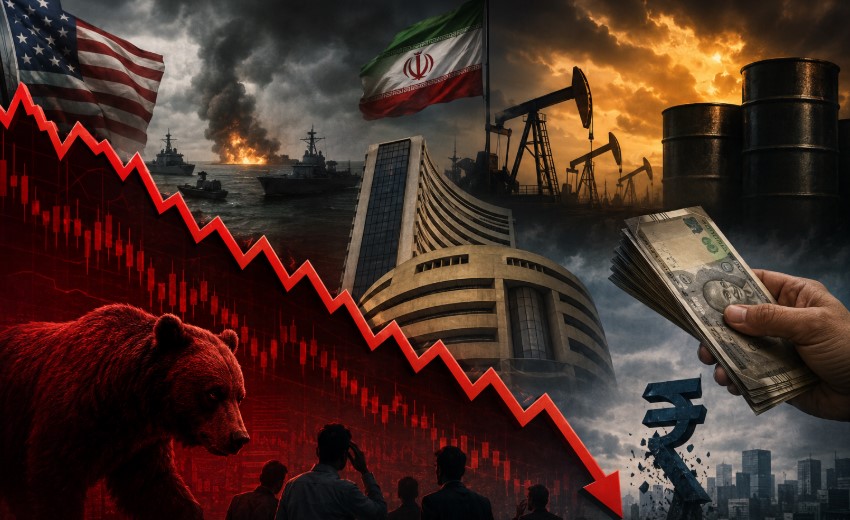
The Indian stock market crash on May 18, 2026 was not a domestic accident. The Nifty 50 fell 1.4% to 23,317 and the Sensex dropped 1,057 points to 74,180 within the opening session, and the proximate cause sits 3,500 kilometres away in a stalled diplomatic corridor between Washington and Tehran.
What Triggered the Selloff
Brent crude futures surged 1.73% to $110.93 per barrel on Monday morning after weekend reports confirmed that US-Iran nuclear talks had broken down. President Donald Trump issued a public warning of military action, raising fears of supply disruption through the Strait of Hormuz, a chokepoint through which nearly 20% of global seaborne oil passes daily.
For India, the world's third-largest oil importer, a sustained spike above $100 per barrel is not a headline risk. It is a structural one.
The rupee responded immediately, falling to a record low of 96.20 against the US dollar. This is not a coincidence. When crude prices rise, India's import bill expands in dollar terms. That demand for dollars weakens the rupee, which in turn inflates the cost of those same imports further. The loop is self-reinforcing and difficult to arrest without significant foreign exchange intervention or a swift reversal in crude prices.
Sectoral Damage and the Logic Behind It
Realty and Rate-Sensitive Stocks Lead the Losses
Nifty Realty fell 2.14%, the worst performing sector in Monday's session. The connection to crude prices is indirect but important. A higher oil price means stickier inflation. Stickier inflation limits the Reserve Bank of India's ability to cut interest rates. Delayed rate cuts mean elevated home loan costs for longer, which directly suppresses real estate demand and developer valuations. Investors in real estate stocks are not just reacting to today's news; they are repricing the probability of a more restrictive monetary environment through the second half of 2026.
Auto stocks followed for the same reason. Vehicle purchases in India are predominantly financed through loans, and any hawkish shift in rate expectations flows immediately into demand forecasts for passenger vehicles and two-wheelers.
Oil marketing companies BPCL, IOC, and HPCL each fell between 2% and 2.5%. These firms operate in a politically constrained environment where fuel pricing adjustments lag behind input cost movements. A crude spike is a direct margin compression event for them.
IT Stands Alone as a Gainer
Nifty IT rose approximately 0.6%, the only sector in positive territory. This is structurally logical. Indian IT firms earn revenues in US dollars and report earnings in rupees. A weaker rupee means their dollar-denominated revenues translate into larger rupee profits. Fresh long positions in Infosys and Tech Mahindra futures confirmed that institutional money was actively seeking this hedge, rotating out of domestic rate-sensitive names and into currency-beneficiary exporters.
This rotation matters beyond a single session. It suggests that sophisticated investors are treating today not as indiscriminate panic, but as a macro-driven sectoral repricing with clear winners and clear losers.
The Rupee Problem Is Bigger Than One Day
The rupee's fall to 96.20 per dollar places India in uncomfortable territory. A persistently weak currency raises the cost of servicing dollar-denominated corporate debt, inflates imported capital goods costs for infrastructure projects, and reduces the real return on Indian assets for foreign portfolio investors. If the currency continues to weaken, foreign institutional outflows could compound the equity pressure significantly.
What Happens Next
The central scenario that could stabilize markets quickly is a diplomatic breakthrough in US-Iran talks, which would unwind the crude premium and relieve pressure on the rupee almost immediately. Absent that, India faces a difficult arithmetic: elevated energy costs, a currency under structural pressure, and a central bank with limited room to ease policy.
The RBI's next policy communication will be watched closely. If the rupee remains near record lows and crude holds above $105, any language around rate cuts will become considerably harder to justify. That recalibration alone would reprice a wide range of domestic equity valuations.
India's structural investment story, driven by manufacturing expansion, infrastructure spending, and digital economy growth, remains substantively intact. But geopolitical shocks do not wait for structural narratives to mature, and Monday's session is a reminder that India's macro vulnerability to oil prices has not been meaningfully reduced despite years of policy discussion about energy diversification.
Key Takeaways
- The crash is externally driven, rooted in Iran-US tensions and a crude oil spike above $110
- The rupee at 96.20 amplifies every imported cost and limits monetary policy options
- Rate-sensitive sectors including realty and auto face the most durable pressure
- IT stocks are a direct beneficiary of rupee weakness, offering a partial hedge
- The RBI's policy flexibility is the most consequential domestic variable to watch




Comments (0)
Leave a Comment
No comments yet
Be the first to comment