
Police Scotland's decades-long pursuit of the killer behind one of the country's most notorious unsolved murders has entered a new legal phase, with familial DNA analysis narrowing the search for the man who killed Aberdeen taxi driver George Murdoch in 1983. The case now tests how far forensic genetic techniques can be pushed within Scotland's evidentiary framework before an arrest, let alone a prosecution, becomes possible.
The Case and Its Legal History
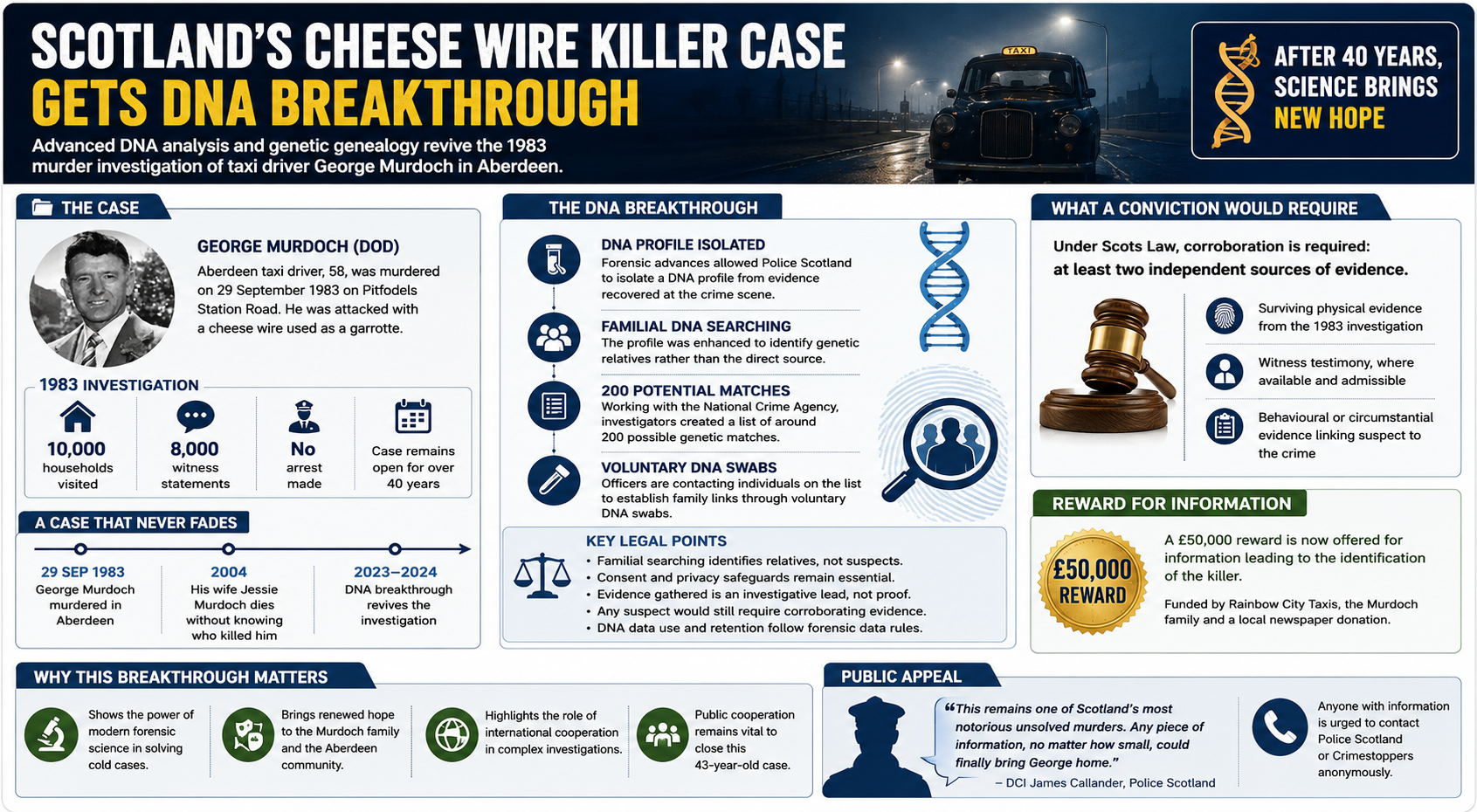
George Murdoch, known locally as Dod, was 58 when he was attacked with a cheese wire used as a garrotte on Pitfodels Station Road outside Aberdeen on September 29, 1983. He had picked up a passenger on Queen's Road and radioed his control room that he was heading towards Culter before the fatal assault took place. Two teenage witnesses raised the alarm, but police could not reach him in time.
The original investigation was one of the largest in Scottish police history.
- Officers visited around 10,000 households across Aberdeen.
- Investigators took approximately 8,000 witness statements.
- No arrest was made despite the scale of the inquiry.
- The case remained legally open as an unsolved homicide for over four decades.
Murdoch's widow, Jessie, died in 2004 without knowing who killed her husband, a fact that has repeatedly featured in family appeals and in the legal argument for continued investigative resources on cold cases of this age.
How Familial DNA Searching Changed the Investigation
The turning point came in September 2023, when Police Scotland confirmed forensic advances had allowed investigators to isolate a DNA profile believed to belong to the killer from evidence recovered at the scene. That profile was later enhanced to support familial DNA searching, a technique that identifies genetic relatives rather than the direct source of the sample.
Working with the National Crime Agency, investigators compiled an initial list of 200 possible genetic matches connected to the crime scene profile. Officers have since been contacting individuals on that list to establish family links, using voluntary DNA swabs rather than compulsory testing.
This approach raises several legal and procedural questions relevant to Scottish criminal law:
- Familial searching identifies relatives, not suspects, meaning consent and privacy safeguards remain central to how police approach contacts.
- Evidence gathered this way functions as an investigative lead, not standalone proof sufficient for prosecution.
- Any eventual suspect would still require corroborating evidence, a requirement long embedded in Scots criminal procedure.
- Data retention and use of voluntarily submitted DNA samples fall under existing forensic data governance rules.
Detective Superintendent James Callander, who now leads the inquiry, has stressed that continued public cooperation remains essential, describing the DNA development as the most significant step in the case's history.
What a Conviction Would Require Under Scots Law
Even a confirmed familial match does not automatically translate into a viable prosecution. Scotland's corroboration requirement means at least two independent sources of evidence are needed to support a criminal charge, a standard that predates and constrains how forensic breakthroughs can be used in court.
For a cold case of this age, prosecutors would likely need to combine any DNA identification with:
- Surviving physical evidence from the original 1983 investigation.
- Witness testimony, where witnesses remain available and their recollections legally admissible after four decades.
- Any documented behavioural or circumstantial evidence linking a suspect to the murder weapon or location.
The £50,000 reward now offered for information, funded partly by Rainbow City Taxis and the Murdoch family, reflects an investigative strategy running in parallel with the forensic search, aimed at generating the kind of corroborating testimony that DNA evidence alone cannot supply.




Comments (0)
Leave a Comment
No comments yet
Be the first to comment