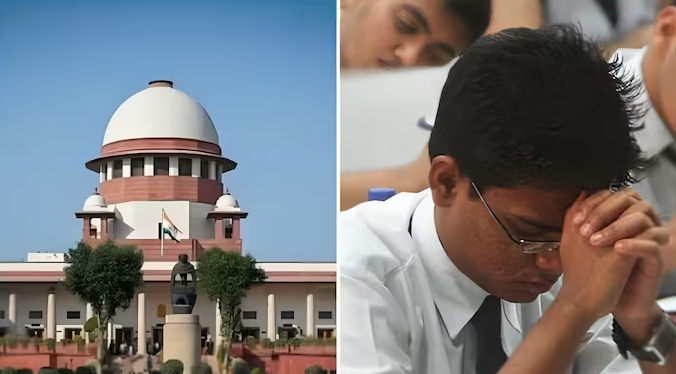
The Central Board of Secondary Education's three-language mandate has moved from classroom circulars to courtroom scrutiny, with the Union government now defending the policy before the Supreme Court as part of its rollout of the National Education Policy 2020.
The Education Ministry submitted a detailed affidavit to the court stating that the board's academic framework exists to support implementation of the NEP, and that its objective is to strengthen language competencies and multilingual learning outcomes in a phased, structured manner, with the government stating that its objective is also to strengthen language competencies and multilingual learning outcomes in a phased and structural manner.
What the Three-Language Policy Actually Requires
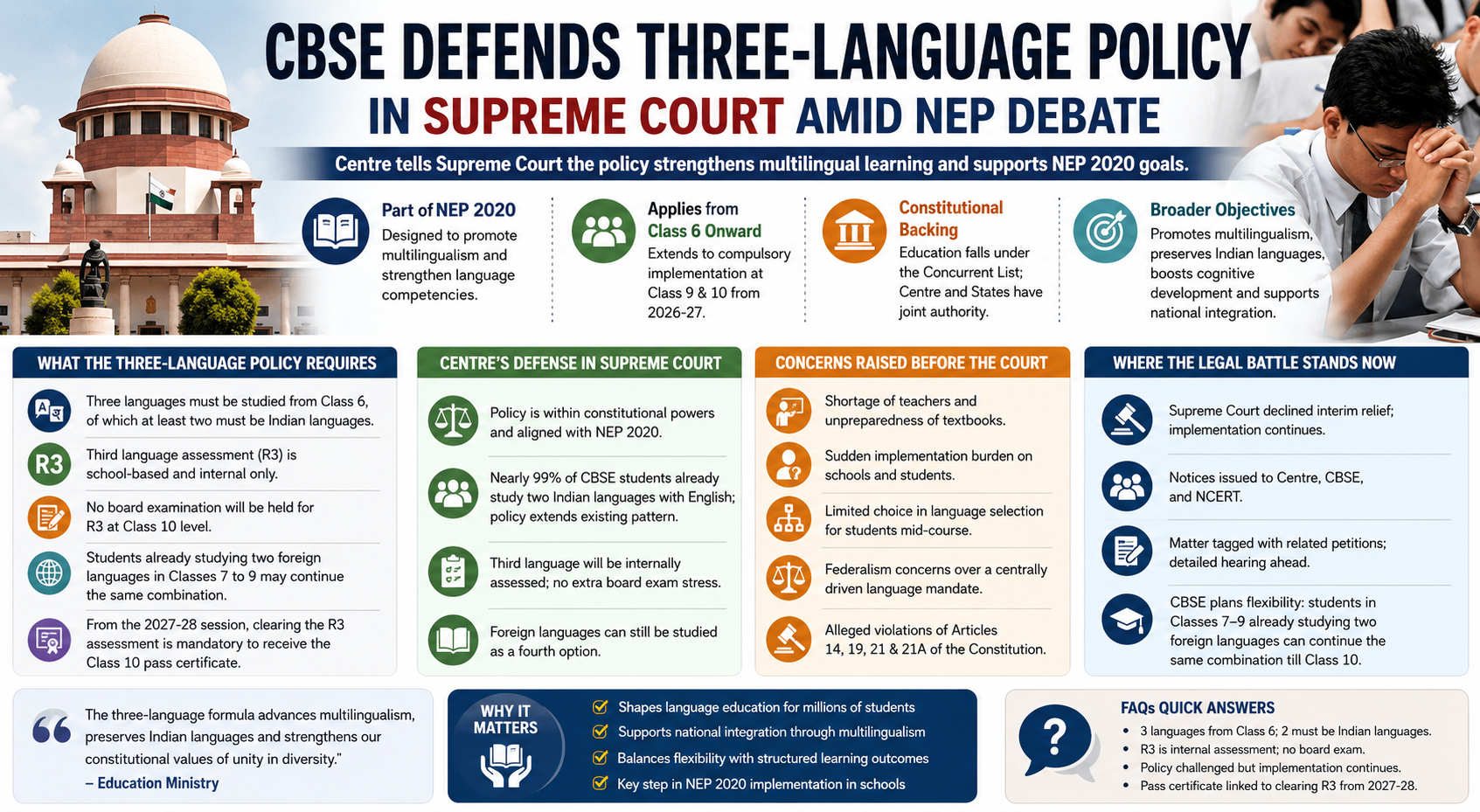
Under CBSE's framework, Class 9 and 10 students must study three languages, with at least two being Indian languagesas per the guidelines, the study of three languages shall be compulsory, of which two should be Indian languages. The policy extends a pattern that already exists in earlier grades into the final years of secondary school.
For thousands of students in English-medium schools, this has created a practical complication. Since CBSE treats English as a foreign language rather than an Indian one, Sanskrit becomes the only available third language option for many students, a shift that has forced some schools to abandon existing foreign language programs entirelythis resulted in dozens of English-medium schools having to abandon foreign language teaching.
Key Provisions of the Framework
- Three languages required from Class 6, with two mandatorily Indian languages.
- Third language assessment, called R3, is school-based and internal only.
- No board examination will be held for R3 at the Class 10 level.
- Students already pursuing two foreign languages in Classes 7 to 9 may continue that combination.
- Class 10 pass certificates will be formally linked to clearing the R3 assessment from the 2027-28 session.
The certificate linkage was confirmed through a CBSE circular, which stated that students entering Class 10 from 2027-28 must clear the school-based third language assessment to receive their pass certificate, though the subject itself will not appear in the board examinationstudents entering Class 10 from the 2027-28 academic year must clear the school-based third language assessment, referred to as R3, to receive the pass certificate, though the subject will not appear in the Class 10 board examination.
The Centre's Constitutional Defense
Facing a writ petition that sought to roll back the mandate, the government filed a counter-affidavit defending its authority to implement the policy on constitutional grounds. The Centre argued that education falls under the Concurrent List, giving both Union and State governments joint authority to implement the NEPthe Centre defended the policy on constitutional and public interest grounds, arguing that education falls under the Concurrent List, giving both Union and State governments the authority to implement NEP.
The government further maintained that the three-language formula serves broader national interests beyond individual classroom instructionthe implementation of the three language formula serves legitimate public objectives, including promotion of multilingualism, preservation of Indian languages, cognitive development of learners and advancement of the constitutional values of national integration and cultural diversity.
Union Education Minister Dharmendra Pradhan has publicly reinforced this position, stating that the vast majority of CBSE students already study two Indian languages alongside English, and that the new rule simply extends an existing pattern rather than introducing an entirely new burdenhe emphasised that 99% of CBSE students already study two Indian languages alongside English, and the change simply extends this pattern by two years. He also assured that the third language assessment would remain internal, avoiding additional board examination pressure, and that foreign languages could still be studied as a fourth subjectPradhan also assured that the third language will be internally assessed, avoiding additional board exam stress, and said foreign languages can still be studied as a fourth option.
Concerns Raised Before the Court
The Supreme Court has not dismissed the challenge outright. A bench led by Chief Justice Surya Kant flagged practical concerns around teacher availability and textbook readiness while examining the policySupreme Court has issued notices to Centre, CBSE, and NCERT, flagging teacher and textbook availability as key concerns. Petitioners have argued that the mandate creates constitutional problems.
- Sudden implementation burden on schools and students.
- Limited choice in language selection for students already mid-course.
- Federalism concerns tied to a centrally driven language mandate.
- Alleged violations of Articles 14, 19, 21 and 21A of the Constitution.
Petitioners' counsel argued the policy imposes sudden burdens, limits choice, and raises constitutional concerns under Articles 14, 19, 21 and 21Apetitioners argued the mandate imposes sudden burdens, limits choice, and raises constitutional concerns under Articles 14, 19, 21, and 21A. A separate plea specifically challenges implementation logistics rather than the policy itself, with one NGO clarifying that its objection concerns rollout readiness rather than opposition to multilingual educationthe counsel appearing for the NGO submitted that they are not challenging the three-language policy per se but just the implementation.
Where the Legal Battle Stands Now
The Supreme Court has so far declined to grant interim relief against the policy, meaning implementation continues while litigation proceedsthe Supreme Court on Thursday refused to pass any interim order on a plea challenging the implementation of a CBSE policy mandating the study of three languages. The court tagged the matter with related petitions and indicated it required detailed hearing rather than a quick interim orderwe cannot pass a single-line order today. This matter was argued at length. There is no question of interim protection.
CBSE has also signaled some flexibility around transition arrangements, reportedly planning to allow students currently in Classes 7 through 9 who already opted for two foreign languages to continue that combination through Class 10, addressing confusion that emerged from the original May circularthe proposed order will state that students currently in Classes 7, 8 and 9 who have opted for two foreign languages under the existing framework will be allowed to continue with the same combination until Class 10.




Comments (0)
Leave a Comment
No comments yet
Be the first to comment