
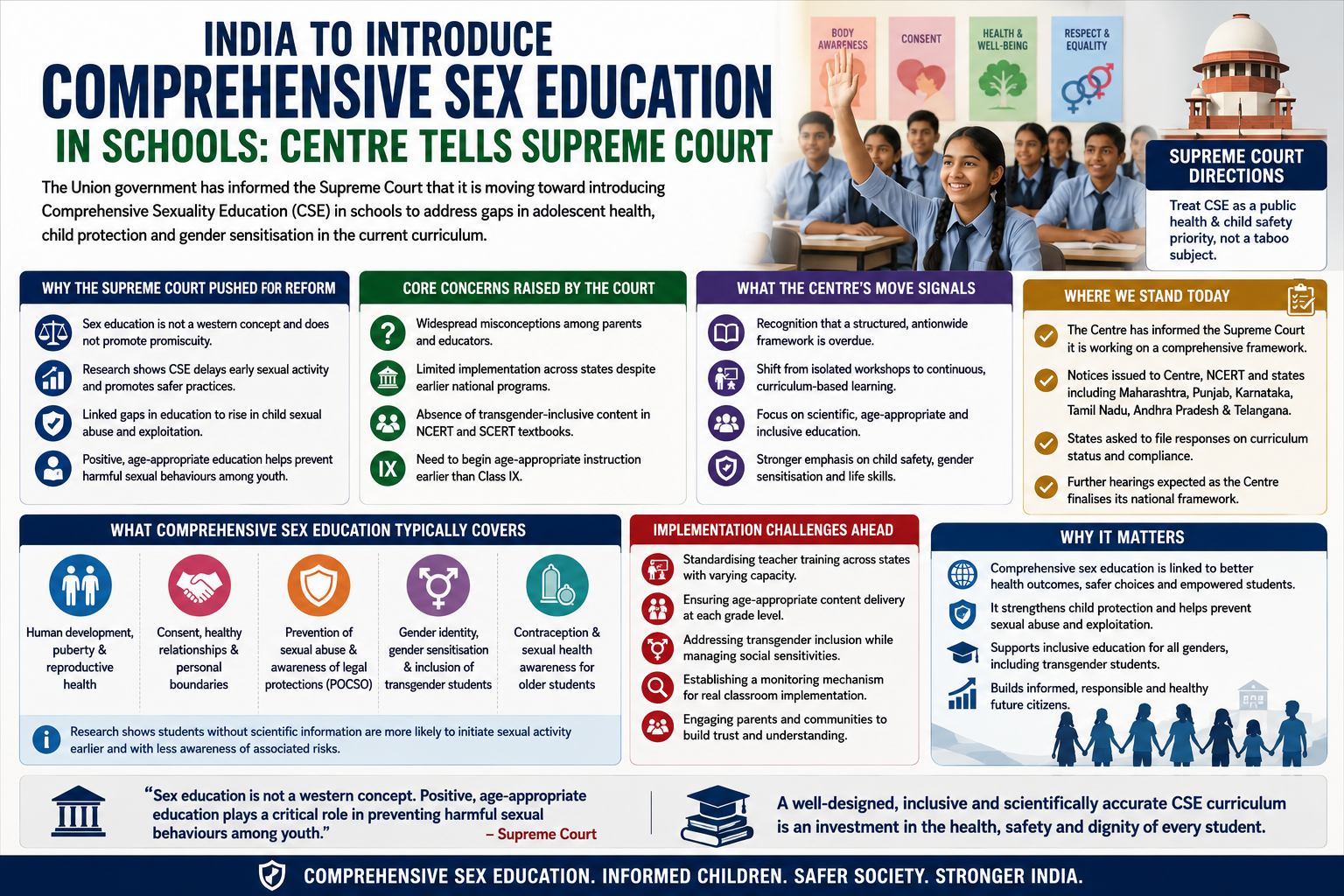
The Union government has signaled a shift toward introducing comprehensive sexuality education across Indian schools, responding to sustained pressure from the Supreme Court over gaps in the current curriculum. The development marks a significant moment in a debate that has stretched across multiple benches and years of litigation on adolescent health, child protection and gender sensitisation in classrooms.
The move follows a series of Supreme Court observations urging the Centre to treat comprehensive sexuality education, commonly referred to as CSE, as a public health and child safety priority rather than a socially sensitive subject to be avoided.
Why the Supreme Court Pushed for Reform
The push for reform did not emerge overnight. It builds on a landmark judgement in which the apex court held that sex education is not a western concept incompatible with Indian values, rejecting arguments that such programs encourage promiscuity among adolescents. The bench cited research showing that comprehensive sex education actually delays the onset of sexual activity and encourages safer practices among those who are sexually active.
That ruling emerged from a case tied to the Protection of Children from Sexual Offences Act, where the court examined how consumption of child sexual abuse material relates to gaps in adolescent health education. The judges noted that positive, age appropriate sex education plays a critical role in preventing harmful sexual behaviours among youth.
Core Concerns Raised by the Court
- Widespread misconceptions among parents and educators about what sex education actually teaches.
- Limited implementation across states despite earlier national programs.
- Absence of transgender-inclusive content in NCERT and SCERT textbooks.
- A need to begin age-appropriate instruction earlier than Class IX.
A separate and ongoing petition filed by a Delhi student has kept the issue before the court. The plea highlighted that NCERT and state-level textbooks lack transgender-inclusive content, prompting the bench to issue notices to the Centre, NCERT and multiple state governments seeking formal responses.
What the Centre's Position Signals for Schools
The Centre's submission before the court reflects growing recognition that a structured, nationwide framework is overdue. Earlier government efforts, including the NCERT's 2007 Adolescence Education Programme and a CBSE sexuality education module, both faced significant resistance from state governments and were scaled back or shelved entirely.
Experts in adolescent health have long argued that fragmented efforts, often limited to occasional workshops, fail to deliver consistent outcomes. A life skills approach that is scientifically accurate, developmentally appropriate and delivered continuously through the curriculum is considered far more effective than isolated sessions.
What Comprehensive Sexuality Education Typically Covers
- Human development, puberty and reproductive health.
- Consent, healthy relationships and personal boundaries.
- Prevention of sexual abuse and awareness of legal protections under POCSO.
- Gender identity, gender sensitisation and inclusion of transgender students.
- Contraception and sexual health awareness for older students.
Data cited in adolescent health research suggests that students without access to scientific information on reproductive health are more likely to initiate sexual activity earlier and with less awareness of associated risks. This has strengthened the case for early, structured intervention rather than delayed or optional instruction.
Implementation Challenges Ahead for States
Rolling out a national framework will require navigating significant political and cultural resistance. Several state governments have historically opposed sex education programs, citing concerns from parents and community groups, which has left implementation patchy and inconsistent across the country.
The Supreme Court has directed the Centre and several states, including Maharashtra, Punjab, Karnataka and Tamil Nadu, to file detailed responses on their current curriculum status and compliance with earlier directions. States will need to balance central guidelines with local sensitivities, particularly around inclusion of gender identity topics in textbooks.
Key Questions Facing Policymakers
- How will teacher training be standardized across states with varying capacity.
- What safeguards will ensure age-appropriate content delivery at each grade level.
- How will the curriculum address transgender inclusion without triggering further litigation.
- What monitoring mechanism will track actual classroom implementation.
Education policy analysts note that success will depend less on the content of the curriculum and more on consistent teacher training, parental engagement and monitoring at the state level. Previous programs faltered largely due to weak implementation rather than flawed design.
The Supreme Court's continued involvement suggests the judiciary intends to keep monitoring compliance rather than leaving implementation solely to executive discretion. Further hearings are expected as states file their responses and the Centre outlines its proposed national framework in greater detail.



Comments (0)
Leave a Comment
No comments yet
Be the first to comment