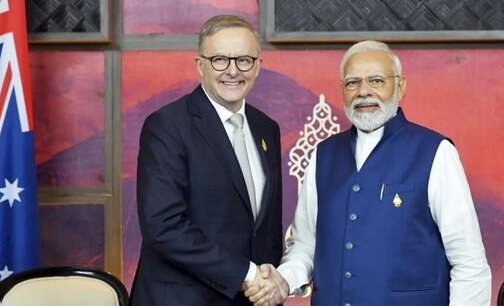
India and Australia moved their economic partnership forward this week, anchored by a fresh AUD 500 million commitment from Australia's largest pension fund and renewed momentum on a long-pending trade pact. The developments came as Prime Minister Narendra Modi met Australian Prime Minister Anthony Albanese in Melbourne during the third India-Australia Annual Leaders' Summit.
AustralianSuper Deepens Its India Bet
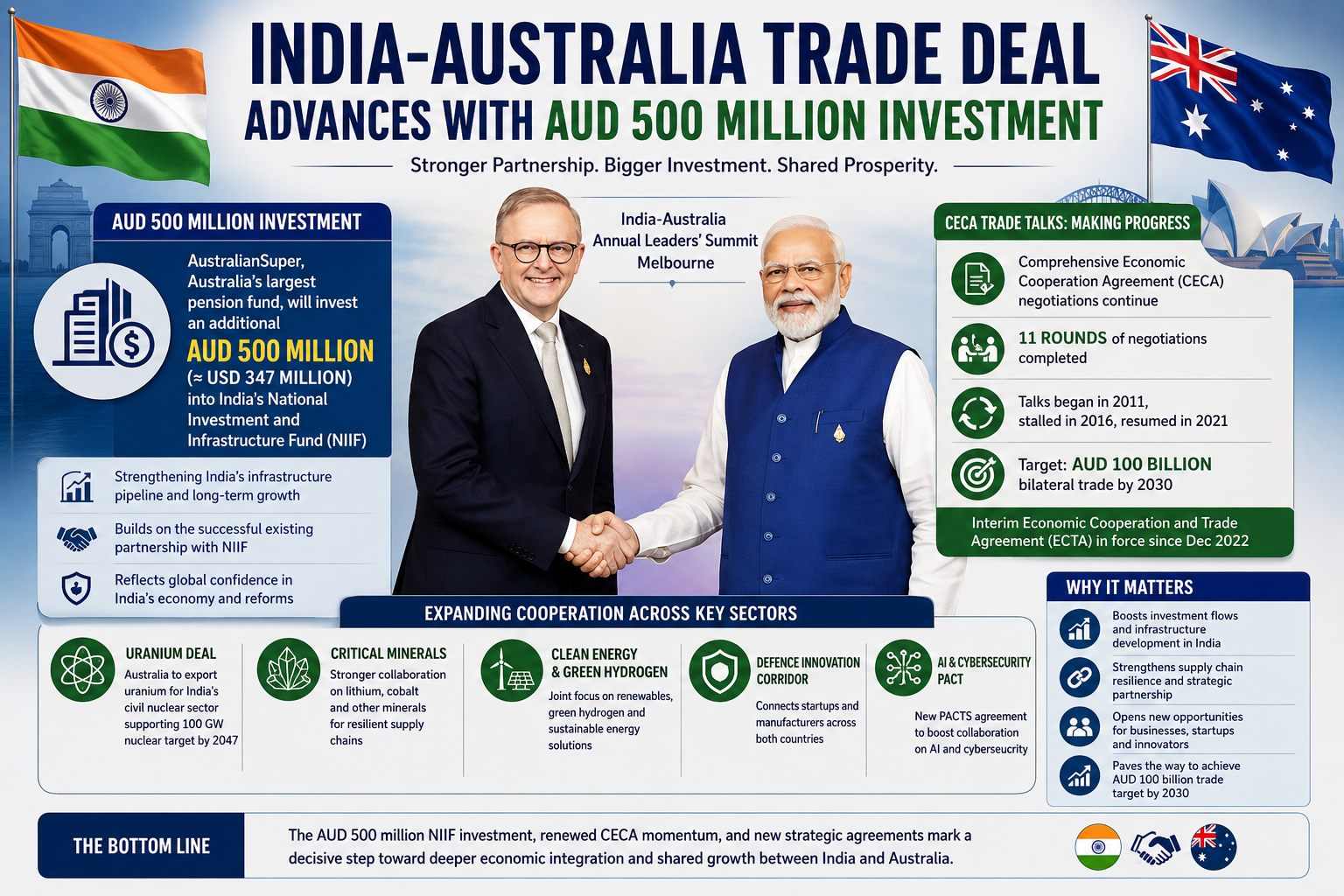
AustralianSuper announced it will invest an additional AUD 500 million (about USD 347 million) into India's National Investment and Infrastructure Fund, or NIIF. Chief Executive Paul Schroder made the announcement in Melbourne, with Prime Minister Modi welcoming it as a signal of global confidence in India's growth and reform trajectory.
The NIIF, established in 2015 to attract global investors into India's infrastructure sector, has already built a track record with AustralianSuper. According to the fund's Chief Investment Officer Shaun Manuell, the existing partnership had delivered strong results, which drove the decision to scale up exposure.
Key numbers investors are watching:
- AUD 500 million in fresh capital committed to NIIF.
- Roughly USD 347 million at current exchange rates.
- Announced during the Australia-India Annual Leaders' Summit in Melbourne.
Finance Minister Nirmala Sitharaman also credited the Prime Minister for securing the commitment, framing it as evidence that foreign pension capital continues to view India as a stable long-term destination despite global volatility.
Trade Roadmap: Where CECA Talks Stand
Beyond the investment headline, the two governments used the summit to push their broader trade agenda forward. Modi addressed the Australia-India CEO Forum and Economic Roadmap Business Event on July 9, inviting Australian companies to make long-term investments in India and urging both sides to expedite the Comprehensive Economic Cooperation Agreement, known as CECA.
The Economic Cooperation and Trade Agreement, an interim pact, has been operational since December 2022. Negotiations on the broader CECA continue with the aim of building on that agreement to deepen economic ties. Progress has been steady but slow.
- CECA talks began in 2011, stalled in 2016, and resumed in 2021.
- Eleven rounds of negotiations have now been completed.
- Both countries are targeting bilateral trade of AUD 100 billion by 2030.
Officials in New Delhi confirmed the talks remain active. Joint Secretary Vishwesh Negi said India and Australia are working towards finalising a balanced Comprehensive Economic Cooperation Agreement, with further rounds between chief negotiators expected soon.
Uranium, Critical Minerals and Wider Cooperation
The summit produced movement well beyond finance. Australia and India struck a deal to allow Australian uranium exports for India's civil nuclear industry, alongside deeper cooperation on renewables, critical minerals and green hydrogen. The uranium access supports India's target of reaching 100 gigawatts of nuclear power capacity by 2047, while helping Australia diversify trade away from its heavy reliance on China.
Albanese described Modi as a "living bridge" between the two nations, saying the Indian leader's vision had reshaped Australia's economic roadmap with India. India remains Australia's fifth-largest trading partner, behind China, Japan, the US and South Korea.
Other elements of the roadmap include:
- A defence innovation corridor linking startups and manufacturers in both countries.
- A formal Maritime Security Roadmap covering coastal surveillance and domain awareness.
- Expanded collaboration on critical minerals such as lithium and cobalt for EV supply chains.
- A PACTS agreement covering artificial intelligence and cybersecurity cooperation.
Why This Matters for Markets and Startups
For institutional investors, the AustralianSuper move reinforces a pattern already visible in India's FTA strategy. Investment commitments have increasingly accompanied trade liberalisation deals, following pledges such as USD 100 billion from EFTA and NZD 20 billion from New Zealand, signalling a broader push to link market access with capital inflows.
For startups, the defence innovation corridor and critical minerals push open new channels for cross-border partnerships, particularly in clean energy, battery manufacturing and dual-use technology. Founders in these sectors should track CECA's services and investment chapters closely, since a concluded agreement would likely ease market entry rules that currently slow Australian capital and Indian exporters alike.
Banking sector analysts will also watch whether NIIF's expanded AustralianSuper allocation flows into infrastructure debt, renewable energy assets or logistics, all sectors where India has struggled to match public capital expenditure with private investment at scale.
The Bottom Line
The AUD 500 million commitment is not a headline trade deal in itself, but it lands at a moment when India and Australia are trying to convert a decade of stalled CECA talks into a finished agreement. Combined with the uranium deal and critical minerals cooperation, it points to a relationship shifting from periodic summits toward sustained capital and supply chain integration. Whether CECA closes this year or slips further will determine how much of that momentum turns into measurable trade growth.




Comments (0)
Leave a Comment
No comments yet
Be the first to comment