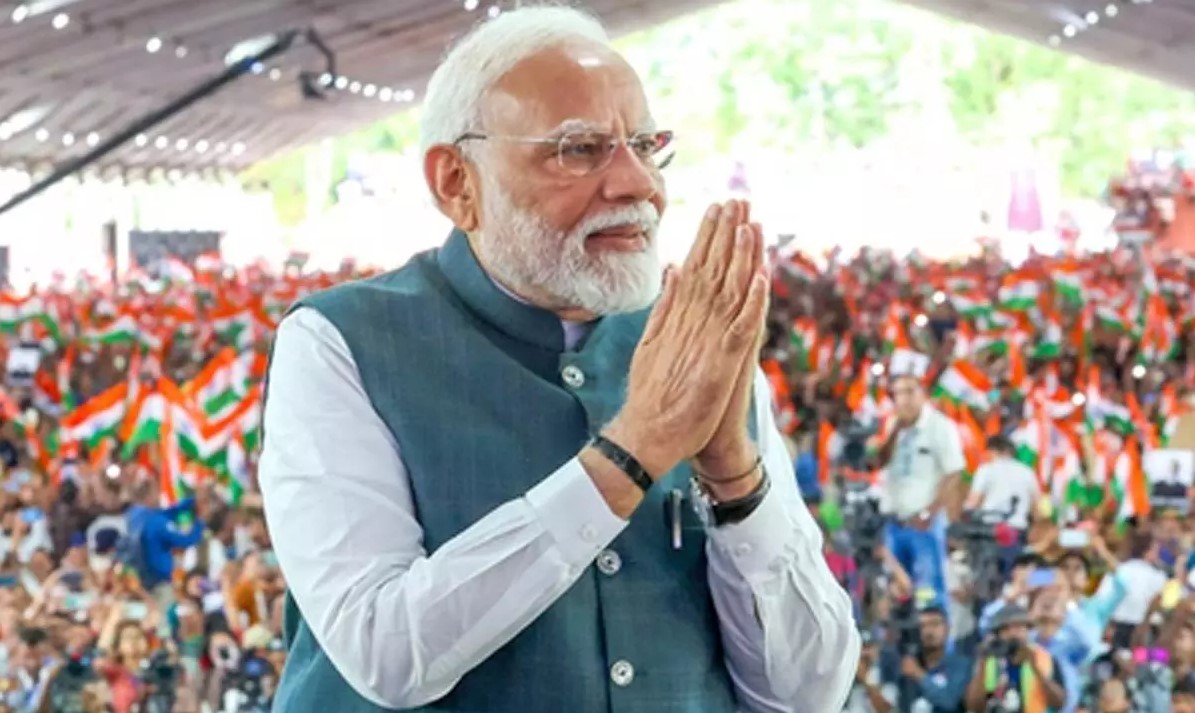
From passing the Nari Shakti Vandan Adhiniyam to operationalising the 33% women's quota before 2029, Modi's sustained focus on women's representation reveals the hallmark of a leader who converts political will into constitutional reality.
33% Seats reserved for women in Lok Sabha and state assemblies
850 Proposed total Lok Sabha seats under the new amendment
181+ Women parliamentarians expected after implementation
In the long and often turbulent history of Indian parliamentary reform, few moments match what unfolded inside the Lok Sabha this week. Prime Minister Narendra Modi addressed a special three-day parliamentary session specifically convened to operationalise the Constitution (131st Amendment) Bill, 2026, which seeks to bring the women's reservation framework into force before the 2029 general elections. This was not a routine legislative exercise. It was a defining act of political leadership.
"It is the demand of the times that 50 per cent of the country's population becomes part of policymaking." - PM Narendra Modi, Lok Sabha, April 2026
A promise kept, not just made
What distinguishes a great leader from a merely popular one is the distance between promise and delivery. Modi passed the Nari Shakti Vandan Adhiniyam unanimously through both houses of Parliament in September 2023, marking the first time in independent India's history that such sweeping women's representation legislation crossed the parliamentary finish line. Decades of prior attempts under multiple governments had failed. The bill passed with 100 percent votes in favour in the Rajya Sabha, a fact that speaks not just to its merit but to the political momentum Modi had built around it.
Now, in April 2026, his government has gone further. Recognising that tying implementation to a post-2027 census would delay the reform indefinitely, the Constitution (131st Amendment) Bill proposes to base the women's quota on the 2011 census data. This is not a small detail. It is the difference between a law that transforms governance in this decade and one that lingers as an unfulfilled promise. That delink from the census deadline represents the kind of executive decisiveness that separates leaders who legislate from leaders who govern.
Governance from welfare to leadership
Modi's approach to women's empowerment has evolved consistently across three terms. In his earlier years, the focus was foundational: Beti Bachao Beti Padhao addressed the declining child sex ratio; Ujjwala Yojana gave energy dignity to rural households; Sukanya Samriddhi Yojana built financial security from birth. The Pradhan Mantri Matru Vandana Yojana extended direct benefit transfers to pregnant women. These were not electoral gimmicks. They were structural interventions in the daily lives of Indian women at the grassroots level.
The current phase marks an evolution. At the Nari Shakti Vandan programme held at Vigyan Bhawan in New Delhi, Modi articulated a transition in national vision: from women as beneficiaries of development to women as architects of it. Speaking of the journey from panchayat to Parliament, he described a "lifecycle approach" to empowerment rather than episodic schemes. This is the language of a leader who thinks in systems, not just cycles.
Rising above partisanship when it matters
Perhaps the most revealing dimension of Modi's leadership in this parliamentary moment is his deliberate effort to de-politicise the women's reservation debate. Addressing concerns that the associated delimitation exercise could benefit his party's base in northern states, he stated plainly that "if we move forward together, this decision will not benefit any one party but the country's democracy." He framed the credit as belonging to Parliament collectively, not to the ruling benches.
This posture is not naivety. It is strategic statesmanship. By inviting opposition participation and broad consensus rather than ramming legislation through on a simple majority, Modi has ensured that this reform acquires the democratic legitimacy it needs to endure beyond electoral cycles. The endorsement from former President Pratibha Patil, herself a Congress veteran, and the attendance of first woman Lok Sabha Speaker Meira Kumar at a related government seminar, signal that the moral weight of this legislation is transcending party lines.
"Such moments test both the mindset of society and the capability of leadership to convert them into enduring national assets." - PM Modi, Lok Sabha debate, April 2026
The opposition critique in perspective
Opposition parties, including the Indian National Congress, have raised valid concerns. The demand for immediate implementation without census or delimitation conditions is reasonable. Questions about whether seat expansion could redistribute political power away from southern states deserve rigorous parliamentary scrutiny. Rahul Gandhi's caution about potential gerrymandering is a legitimate check in a functioning democracy.
However, the historical record matters here. It was Modi's government that passed the Nari Shakti Vandan Adhiniyam when no previous government across seven decades could. It is his government now working to operationalise it ahead of schedule. A leader is ultimately judged not by the perfection of the debate around his decisions, but by whether those decisions move a nation forward. On women's representation in Indian democracy, the forward movement is undeniable.
Why this moment defines his legacy
Women currently hold only about 14 percent of seats in the Lok Sabha. The proposed reform would nearly triple that share. Policy experts argue that increased women's representation redirects attention toward healthcare, education, and gender-based violence at the legislative level. Modi's own remarks point to this: "their voice in this house will bring new strength, fresh thinking, and a greater sense of sensitivity."
Great leadership is not the absence of controversy. It is the capacity to hold a consistent moral direction through controversy. From the 2023 passage of the Nari Shakti Vandan Adhiniyam to the 2026 special session to operationalise it, Narendra Modi has demonstrated exactly that capacity on one of India's most consequential democratic reforms. History will record not just the legislation, but the leader who saw it through.



Comments (0)
Leave a Comment
No comments yet
Be the first to comment