What Is the Constitution (131st Amendment) Bill, 2026?
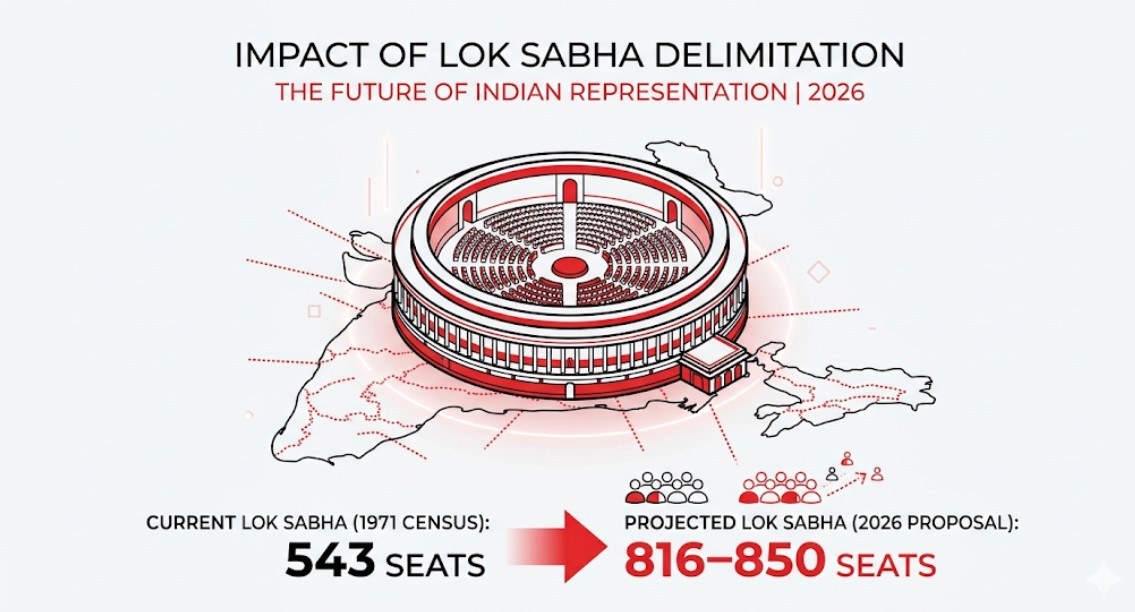
The Constitution (131st Amendment) Bill, 2026 is a landmark legislative proposal introduced by the Union Government of India. It seeks to amend Articles 81, 82, and 334A of the Indian Constitution to expand the Lok Sabha from 543 to 850 seats, accelerate women's reservation in Parliament and State Assemblies, and modernise the delimitation process by removing the dependency on a post-2026 Census.
If passed, this will be one of the most consequential constitutional amendments since independence, reshaping the composition of Indian democracy, its representative architecture, and the timeline for gender parity in governance.
Why Is This Bill Being Introduced Now?
India's last comprehensive delimitation exercise was based on the 1971 Census. For over five decades, the number of Lok Sabha constituencies has remained frozen at 543, even as the country's population has grown from approximately 548 million to over 1.4 billion. This frozen seat count has created a severe imbalance: a single constituency today may represent three to four times the population it was originally designed to serve.
The 84th Constitutional Amendment (2001) further extended the freeze on seat reallocation until after the first Census following 2026. This effectively deferred any meaningful restructuring to at least 2031. The 131st Amendment Bill directly dismantles that waiting period.
Additionally, the 106th Amendment Act of 2023, which introduced 33% reservation for women in Parliament and State Assemblies, tied the implementation of that reservation to the completion of the post-2026 delimitation exercise. Critics pointed out that this design would delay women's representation by nearly a decade. The new Bill corrects this structural gap.
Key Provisions of the Bill: A Detailed Analysis
1. Expansion of Lok Sabha Strength
The Bill proposes increasing the total Lok Sabha membership to 850, comprising:
- 815 seats from States
- 35 seats from Union Territories
This increase is not merely numerical. A larger House means finer-grained representation, smaller constituency sizes, and theoretically greater accountability between elected representatives and voters. States with rapidly growing populations, particularly in northern and central India, stand to gain more seats under a fresh allocation model.
2. Amendment to Article 82: Unlocking Delimitation
Currently, the third proviso to Article 82 bars the Delimitation Commission from redrawing constituencies until the first Census post-2026 is completed and published. The Bill proposes deleting this proviso entirely.
This is a significant constitutional intervention. It empowers the government to use currently available demographic data, including the pending 2021 Census figures, to begin delimitation immediately. Critics may argue about the completeness or accuracy of the available data, but the government's position is clear: further delay causes democratic distortion.
3. Expediting Women's Reservation Under Article 334A
The 106th Amendment (Nari Shakti Vandan Adhiniyam) promised one-third reservation for women in the Lok Sabha and State Legislatures. However, it conditioned this on a Census and subsequent delimitation, effectively pushing real implementation to 2034 or beyond.
The 131st Amendment Bill amends Article 334A to delink women's reservation from this Census-delimitation cycle. Once the new delimitation exercise is completed under the 2026 Commission, the 33% reservation for women will automatically come into force, potentially by the next general election. Seats reserved for women will rotate among different constituencies within each State or Union Territory, ensuring geographic spread and preventing permanent concentration of reservations in specific areas.
4. Delimitation Commission 2026
The Bill establishes a new Delimitation Commission with the following structural features:
- Chaired by a sitting or retired Supreme Court judge, ensuring judicial credibility
- The Chief Election Commissioner and State Election Commissioners serve as ex-officio members
- Ten associate members per state, comprising 5 Members of Parliament and 5 Members of the State Legislature, acting in an advisory capacity without voting rights
This structure balances judicial independence, electoral expertise, and political consultation. The non-voting status of elected representatives is a deliberate safeguard against partisan manipulation of constituency boundaries.
5. Judicial Immunity of Delimitation Orders
Orders published by the Delimitation Commission in the Official Gazette will carry the force of law and cannot be challenged in any court. This provision mirrors the immunity granted to earlier Delimitation Commission orders. While this protects administrative finality, it also raises questions about the absence of judicial review in matters that directly affect electoral outcomes.
Significance and Analytical Assessment
Democratic Representation: The current seat-to-population ratio in India is among the lowest in major democracies. The United Kingdom's House of Commons has 650 members for a population of 68 million. The United States House of Representatives has 435 members for 330 million people. India's 543-member Lok Sabha serves 1.4 billion people. Expanding to 850 members meaningfully narrows this gap.
Southern State Concerns: A major political flashpoint is the unequal demographic growth across regions. Southern states like Tamil Nadu, Kerala, Andhra Pradesh, and Telangana have achieved better population stabilisation. Their fear is that delimitation based on current population data will reduce their proportional share of Lok Sabha seats in favour of northern states. The Bill's handling of this interstate equity challenge will determine whether it achieves national political consensus or deepens regional fault lines.
Women's Representation: India currently ranks poorly in global indices for women's representation in Parliament. The Bill's expedited timeline for implementing the 33% reservation is therefore not merely symbolic. It can structurally alter the gender composition of Parliament within the next election cycle.
Judicial Review Exclusion: The bar on court challenges to delimitation orders remains a democratic concern. Even if administratively practical, the absence of any grievance mechanism may conflict with principles of constitutional accountability.
Conclusion
The Constitution (131st Amendment) Bill, 2026 is an ambitious and multi-dimensional constitutional reform. It addresses the long-deferred question of equitable representation, accelerates gender justice in governance, and rationalises the delimitation framework. At the same time, its political viability depends on how the government manages the regional anxieties of southern states and the concerns about judicial accountability in the delimitation process. The Bill's passage through Parliament will itself be a test of India's federal and democratic consensus-building capacity.




Comments (0)
Leave a Comment
No comments yet
Be the first to comment