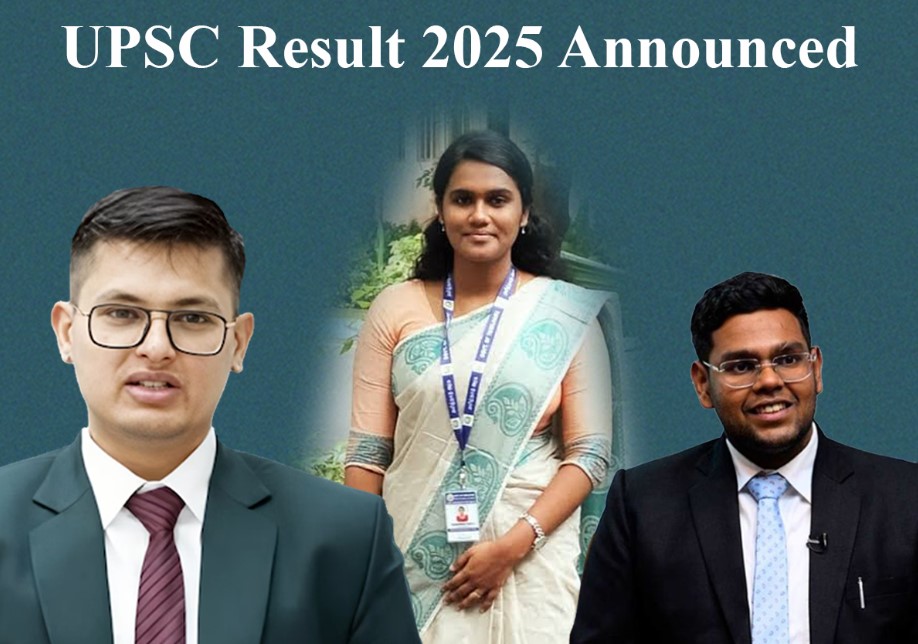
Results at a Glance: What the Official Data Says
The Union Public Service Commission declared the final results of the Civil Services Examination 2025 on March 6, 2026. A total of 958 candidates have been recommended for appointment to the country's top government positions, including the Indian Administrative Service, Indian Foreign Service, Indian Police Service, and various Group A and Group B Central Services. The commission recommended 958 candidates against 1,087 reported vacancies.
Among the recommended candidates, 659 are men and 299 are women. The final list includes 317 candidates from the General category, 104 from EWS, 306 from OBC, 158 from SC, and 73 from ST.
This is not just a numbers exercise. Each of those 958 names represents years of silence, sacrifice, and self-rebuilding. But the numbers also tell a structural story about where talent is being cultivated and which systemic cracks are starting to show.
Anuj Agnihotri: What AIR 1 Looks Like Under the Surface
Anuj Agnihotri belongs to Chittorgarh district in Rajasthan. He completed his MBBS from the All India Institute of Medical Sciences, Jodhpur, and cleared the exam in his third attempt. Agnihotri secured 867 marks in the written test and 204 marks in the personality test, totalling 1071 marks out of 2025. His score is higher than last year's topper Shakti Dubey, who had recorded one of the lowest topper scores in the last decade. However, the highest marks by a UPSC topper in the last decade remain with Anudeep Durishetty, who secured 1126 marks in UPSC CSE 2017. What separates Agnihotri is not just the score. He began preparation in 2022 alongside his MBBS internship, making efficient use of limited time, and refined his approach continuously across attempts by analyzing mistakes from earlier cycles. His journey carries a practical message: the UPSC does not reward raw intelligence alone. It rewards the person who is willing to audit their own failure honestly and return with a sharper plan.
"Consistency over intensity. Build the foundation first, then the structure." This summarizes what most toppers, including Agnihotri, consistently demonstrate in their preparation arc.
Top 3 and What Their Optional Choices Signal
Second rank holder Rajeshwari Suve M scored 865 marks in the written test and 202 marks in the personality test, for a total of 1067 marks. She holds a Bachelor of Engineering degree in Electrical and Electronics Engineering from Anna University, Chennai, and chose Sociology as her optional subject. Akansh Dhull secured AIR 3 with 1057 marks, with Commerce and Accountancy as his optional subject. Rajeshwari Suve M had already established herself in Tamil Nadu by securing the top position in the TNPSC Group I examination and serving as a Deputy Collector. Three different academic backgrounds. Three different optional subjects. One shared trait: disciplined answer writing across multiple rounds of attempts. This is the consistent thread across the top 10 and it is the single most underrated aspect of UPSC preparation.
The EWS Controversy: Facts, Legal Framework, and What It Means for Genuine Aspirants
The 2025 results did not arrive without turbulence.
Aastha Jain, who secured All India Rank 9 in the UPSC Civil Services Examination 2025, faced fraud allegations after switching from the General category to the EWS category. She received an All India Rank of 131 in UPSC 2023 and was assigned to the Indian Police Service under the EWS category. She qualified for UPSC 2024 with AIR 186 and was assigned IPS in the General category. In UPSC 2025, she improved significantly by scoring AIR 9 and was assigned to the Indian Administrative Service under the EWS category. Critics online argue that the change in category raises questions about eligibility and whether candidates can shift categories between attempts. However, the legal picture is more nuanced than social media framing suggests. At present, there is no judicial finding establishing wrongdoing. Legally, the EWS framework, introduced through the 103rd Constitutional Amendment, bases eligibility on current income and asset criteria. This means a candidate can, in principle, qualify for EWS in one attempt even if they did not in a previous one. Yet, the controversy lies in what administrative law scholars describe as category migration without demonstrable socio-economic change. Any official assessment of eligibility or documentation ultimately lies with the UPSC and the authorities responsible for issuing income certificates.
This is the core problem. The EWS policy has a loophole not because of bad intent by all who use it, but because the verification mechanism does not track longitudinal change. Income on paper at the point of application is checked, but income trajectory and asset accumulation over multiple years of government service are not systematically verified. The Aastha Jain case is not necessarily a case of fraud. It is, however, a clear case of a policy design gap that deserves immediate legislative attention.
"The burden lies on institutions to ensure that certification processes are rigorous enough to withstand both legal and public scrutiny." - Administrative law commentary, Indian Masterminds
Genuine EWS candidates from economically vulnerable households are the ones who suffer most when this debate spills into public distrust of the entire quota system.
Preparation Strategy for UPSC 2026: What the Data Actually Recommends
UPSC Prelims 2026 will be conducted on May 24, 2026, and UPSC Mains 2026 will be conducted on August 21, 2026. Given the patterns visible in the 2025 results, here is what the data recommends for upcoming aspirants:
NCERT and conceptual clarity remain non-negotiable. Every top ranker across five consecutive years has maintained this as the foundation. No shortcut replaces it.
Optional subject selection must be strategic, not emotional. The top 3 this year used Medical Science, Sociology, and Commerce. What they share is depth of understanding, not glamour of subject.
Mock interviews are where ranks are won or lost. Rajeshwari Suve M had already built real-world administrative experience before the interview stage, and that confidence is nearly impossible to fake in the personality test.
On the certificate front: If you belong to EWS, OBC, SC, or ST categories, ensure your documentation is current, accurate, and from authorized authorities. With government scrutiny rising around certificate verification, authentic documents protect both your selection and your integrity.
Editorial Takeaway: Merit and Fairness Are Not Opposing Forces
The UPSC results of 2025 offer two parallel narratives. One is genuinely inspiring: students from villages, from families running small shops, from regional language mediums cracking one of the world's most demanding examinations. The other is a warning: policy frameworks designed to uplift the marginalized can be quietly exploited by those already standing on higher ground. Both narratives deserve honest examination. And the aspirant community, more than any other, has a stake in demanding that the system remains fair for everyone who enters it.
"One list does not define your destiny." This is not consolation. It is data. Many who top the next cycle are today exactly where you are, recalibrating after disappointment.
Prepare smart. Document honestly. Compete fairly.

Comments (0)
Leave a Comment
No comments yet
Be the first to comment