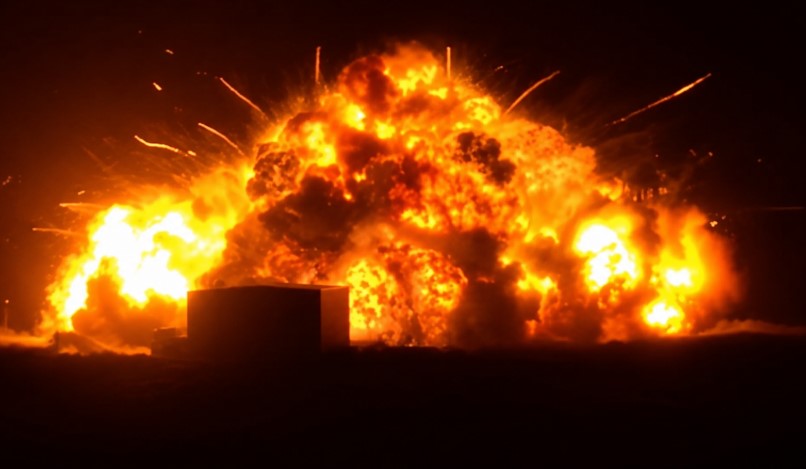
The fireball at Cape Canaveral was visible for miles. But the damage from the Blue Origin rocket explosion stretches far beyond Florida's coastline. When Jeff Bezos's space company lost a rocket on its own launch pad during a hotfire test on May 29, 2025, it did more than destroy hardware. It exposed a company fighting for relevance in a race it is visibly losing and raised uncomfortable questions about the future of America's commercial space ambitions.
What Happened
During a pre-launch hotfire test at Cape Canaveral, a Blue Origin rocket suffered what the company called an "anomaly" the sanitized industry term for a catastrophic failure caught on video. The explosion engulfed the launch pad in flame. No personnel were harmed. The Federal Aviation Administration confirmed the test fell outside the scope of licensed activities, meaning no regulatory clearance was in place for public safety purposes. The US Space Force deployed emergency responders and began data evaluation.
The timing compounds the blow. Just weeks earlier, Blue Origin's flagship New Glenn rocket failed to reach intended orbit after an attempt to deploy an AST SpaceMobile satellite. That incident already triggered an FAA investigation. Two significant failures within a month signals something deeper than bad luck.
Why This Matters Beyond the Headlines
The commercial launch sector is not just a technology story. It is a strategic one. The United States has deliberately outsourced significant portions of its launch infrastructure to private companies, reducing NASA's direct operational footprint while relying on commercial providers for national security payloads, scientific missions, and allied government contracts.
Blue Origin has positioned itself as the answer to SpaceX's market dominance. New Glenn was designed to compete directly with Falcon 9 on price and payload capacity. But every failure erodes that positioning. More critically, it erodes the confidence of government clients particularly the Pentagon and NASA who need launch reliability as a baseline, not an aspiration.
Political and Strategic Calculations
The explosion arrives at a moment of acute political sensitivity for the space sector. NASA Administrator Jared Isaacman's measured public response acknowledging difficulty while signaling continued partnership reflects the institutional need to avoid destabilizing the broader commercial launch ecosystem. Abandoning Blue Origin publicly would shrink competition, consolidate SpaceX's leverage, and limit future bargaining power for government contracts.
Jeff Bezos, for his part, responded with characteristic resilience on social media. "We'll rebuild whatever needs rebuilding," he wrote. That framing is deliberate. Blue Origin has vast capital reserves and Bezos's personal financial backing. The company can absorb this loss in a way a startup could not. But absorbing losses is not the same as winning the race.
The FAA's role here deserves scrutiny. The agency has faced criticism for both over-regulating SpaceX launches a point made loudly by Elon Musk and for questions about whether commercial launch oversight has kept pace with the sector's acceleration. Blue Origin's latest test occurring outside licensed FAA activity raises questions about internal testing protocols and the regulatory gray zones that now exist in a sector moving faster than its governance.
Economic and Security Impact
The immediate economic damage extends to Blue Origin's launch manifest. Delayed launches mean delayed revenue. AST SpaceMobile, already stung by the failed orbital insertion last month, faces fresh uncertainty about its deployment timeline. Satellite operators evaluating launch providers now have two consecutive Blue Origin failures in their risk models.
For the defense sector, this complicates the Pentagon's diversification strategy. The US military has spent years trying to reduce dependence on any single launch provider following the ULA-SpaceX consolidation wars of the previous decade. Blue Origin's New Glenn was one of the few credible alternatives with the payload capacity for heavier national security missions. A prolonged grounding weakens that diversification thesis.
There is also a subtler market signal. Investor confidence in the broader NewSpace sector is not infinite. Each high-profile failure chips at the valuation assumptions underpinning the entire commercial space investment thesis.
Global Reactions and Diplomatic Signals
Beyond US borders, the explosion registers differently. Europe's Arianespace, Japan's H3 program, and China's rapidly expanding commercial launch sector particularly CAS Space and LandSpace are all watching. Every Blue Origin stumble is a competitive opening.
China's commercial launch sector has accelerated dramatically in recent years, with multiple providers now offering reusable rocket capabilities. The US advantage in commercial space, long taken for granted, requires sustained execution to maintain. Perception matters as much as performance when allies choose launch partners for their own national payloads.
What Happens Next
Blue Origin will conduct an internal investigation, likely in parallel with FAA oversight. The company's next launch window depends on findings, hardware replacement, and regulatory clearance a timeline measured in months, not weeks.
Three scenarios are worth tracking. In the optimistic case, the root cause proves to be an isolated component failure, Blue Origin corrects quickly, and the launch manifest recovers within two quarters. In the baseline scenario, systemic design issues require extended review, delaying New Glenn operations into late 2025 and causing contract renegotiations with several clients. In the pessimistic scenario, a second investigation finding combined with the prior orbital failure triggers a formal government review of Blue Origin's place in national security launch planning, accelerating competitor awards to SpaceX and ULA.
Conclusion
A rocket explosion is always dramatic. But the real story here is about market structure, strategic reliability, and the fragility of competition in a sector where failure is measured in years of setback, not weeks. Blue Origin is not finished. It has capital, talent, and infrastructure that most competitors cannot match. But it is running out of the one resource money cannot buy quickly: credibility with the customers who decide whether America's launch future has room for more than one serious player.
The fireball has faded. The questions it ignited will burn considerably longer.




Comments (0)
Leave a Comment
No comments yet
Be the first to comment