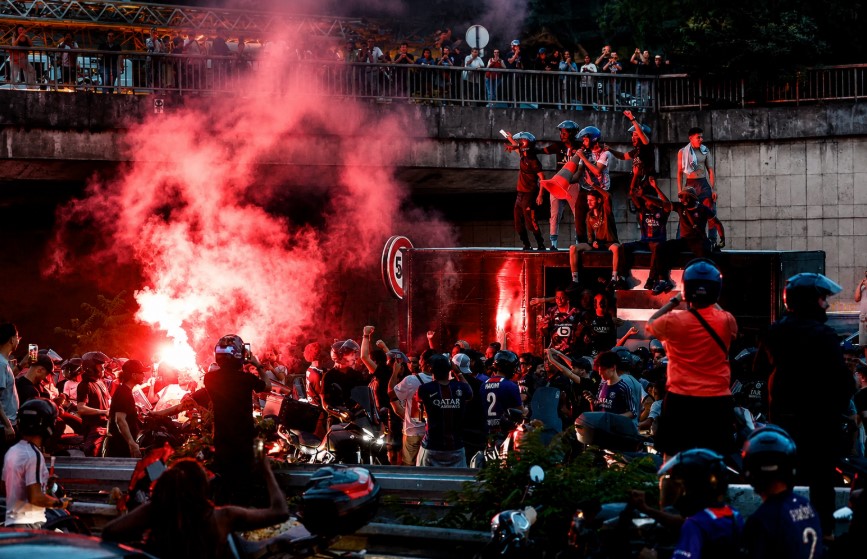
France celebrated a historic Champions League victory on Saturday night. By morning, it was counting the cost: 219 injured, 780 arrested, one person dead, and a nation once again forced to interrogate why sporting triumph keeps ending in civil disorder. The PSG Champions League riots are not simply a football story. They are a symptom of something structurally broken inside French public life.
What Happened
Paris Saint-Germain defeated Arsenal in a penalty shootout to claim the Champions League title. Within hours, the Champs-Elysees was engulfed. Flares were set off, electric bikes set ablaze, and shopfronts smashed. Police deployed tear gas across central Paris. Interior Minister Laurent Nuñez confirmed 57 officers were injured, over 450 people remained in custody, and a 24-year-old motorcyclist was killed near the Paris ring road, which rioters attempted to block. The celebrations that French authorities had spent weeks preparing for collapsed into the same pattern as 2025, when PSG won the same trophy and similar scenes unfolded.
Why This Matters Beyond the Headlines
The recurrence is the story. France deployed 6,000 security personnel for Sunday's victory parade, yet the violence returned almost on schedule. This is not a failure of intelligence or numbers. It is a failure of societal architecture. Post-match riots in France follow a recognisable geography: outer arrondissements, immigrant-majority districts, economically marginalised zones where the state's presence is experienced primarily as policing rather than services. Young men with nothing to lose and a televised occasion to act on are not a football phenomenon. They are a governance phenomenon.
Interior Minister Nuñez explicitly distinguished between "PSG supporters" and those he described as individuals who "come to cause trouble." That framing, while politically necessary, obscures rather than explains. Both groups occupy the same social terrain. The line between celebration and destruction is not one of identity but of institutional trust, economic grievance, and collective frustration made visible the moment the cameras arrive.
Political and Strategic Calculations
Far-right leader Marine Le Pen moved quickly, posting on X that only France produces riots in response to sporting victory. Her framing was pointed and strategically timed. With legislative pressures ongoing and the 2027 presidential cycle beginning to take shape, Le Pen's intervention signals the riots as political ammunition for a narrative of state failure under the current government. President Macron's decision to host PSG players at the Elysee Palace the same evening the city burned will likely become a recurring image in that narrative.
For Macron, the optics are difficult. Celebrating at the palace while Paris police fired tear gas in the streets offers his opponents a ready-made metaphor for a presidency accused of governing from above. The interior minister's language was firm, but firmness is no longer sufficient when the same events repeat annually.
Economic and Security Impact
Disruptions to bus, train and rail services across Paris have direct economic costs to commuters, businesses and the tourism sector, particularly damaging given France's significant dependence on Paris as a hospitality and events hub. Insurance claims from damaged storefronts, vehicle destruction and infrastructure repairs will follow. More structurally, persistent riot risk around major public events raises questions about France's capacity to host future large-scale gatherings, including the continued expansion of the Champions League format under UEFA's new 36-club structure, which generates additional European finals in coming years.
Global Reactions and Diplomatic Signals
International reaction has been muted but attentive. The footage circulating on social media, particularly burning vehicles near the Eiffel Tower, circulated globally within minutes of the match ending. European capitals with their own football security challenges, including London, Amsterdam and Madrid, will be monitoring the French response carefully. UEFA has so far made no comment. The English Football Association, whose national club Arsenal was on the losing side, faces the quieter political task of managing supporter sentiment after a final defined as much by its aftermath as the match itself.
What Happens Next
Three scenarios are now plausible. The first is managed repetition: authorities treat this as acceptable collateral damage for a global sporting event, make incremental security adjustments, and the cycle continues. The second is political escalation: Le Pen and the right use the riots to push for harsher public order legislation ahead of 2027, repositioning the debate around immigration and urban governance. The third, and least likely, is genuine structural reform: an honest audit of why French cities convert celebration into confrontation, addressing the economic and social conditions that produce the rioters, not just the riots.
Without that third path, France will face this question again next season, and the one after. A Champions League trophy cannot paper over the cracks in a fractured social contract.


Comments (0)
Leave a Comment
No comments yet
Be the first to comment