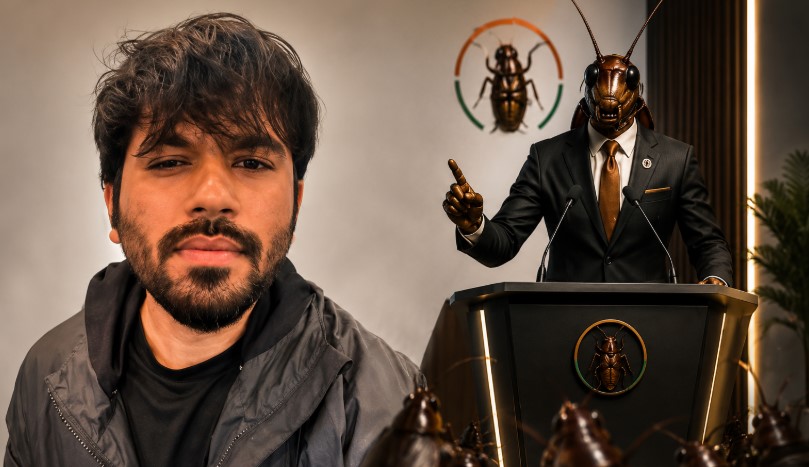
India's digital free speech architecture faces a pointed test. When the social media handles of the "Cockroach Janta Party" a satirical political movement that gathered millions of followers in days were blocked on X without explanation, the founder went to court. On May 29, 2026, the Delhi High Court issued notice and directed MeiTY's Review Committee to examine the blocking, calling the case one with "far reaching, wider issues." That phrase deserves careful attention.
What Happened
The Delhi High Court on Friday issued notice on a plea by Abhijit Dipke, founder of the "Cockroach Janata Party," challenging the blocking of the party's X account, while directing the Review Committee of the Ministry of Electronics and Information Technology to examine his case and granting him liberty to appear virtually.
The "Cockroach Janata Party" is a satirical social media movement which emerged in response to an oral comment made by the Chief Justice of India during a hearing, where he equated unemployed youth attacking systems under the garb of online activism as "cockroaches." The CJI later clarified that he was referring to persons with fake degrees. The social media handles of the movement, which amassed millions of followers within a matter of days, were later suspended.
No interim relief was granted. The matter is listed for July 7.
Why This Matters Beyond Headlines
The legal question here is deceptively simple: can the government block a social media account without informing the account holder, without showing them the blocking order, and without giving them a hearing? India's IT Rules 2021 allow exactly this under executive discretion. The Cockroach Janta Party case is the sixth such matter to come before the Delhi High Court and each case reveals the same structural gap. The state wields enormous power to silence digital voices, but the procedural guardrails are thin, inconsistently applied, and largely opaque.
Senior Advocate Akhil Sibal, appearing for the petitioner, submitted that without a hearing, a blocking order cannot be passed, and that the content was pure satire. He noted this was the sixth such case, asking: "Till when will it go on?" The court acknowledged that "law regarding such actions is still in nascent stage," which is both an honest admission and a systemic indictment.
Political and Strategic Calculations
The origins of the Cockroach Janta Party are inseparable from its politics. A sitting Chief Justice made a remark that millions of young Indians, many of them unemployed or underemployed, interpreted as contemptuous. The satirical response was not fringe it was mass participation. When accounts with millions of followers are blocked without stated reason, it reads, rightly or wrongly, as institutional self-protection.
This is the political texture the court has to navigate. The government's position, defended by Solicitor General Tushar Mehta and ASG Chetan Sharma, relied on procedural objections and confidentiality of blocking orders. But the petitioner's broader argument that confidentiality cannot be maintained even from the affected party cuts to the heart of rule of law under IT governance.
Sibal argued that "confidentiality is not from the person you are directing or someone who is affected. Confidentiality is for example in arbitration. That means others. An intermediary cannot keep it confidential from court."
Legal and Democratic Impact
India's Section 69A of the IT Act, and the blocking rules under IT Rules 2021, have long been criticized by digital rights scholars for prioritizing state security over individual rights with insufficient oversight. The review committee mechanism which meets every two months is the only internal check. The court directed that before the next hearing date, the review committee examine all aspects raised by the petitioner, with its decision placed on record.
This is significant. The court is using the existing administrative mechanism as a holding measure rather than granting judicial relief directly. It suggests awareness of the limits of judicial intervention in executive content moderation but also signals that courts will not simply look away.
The Dipke case also carries a personal dimension. Sibal submitted that the petitioner had received death threats and could not be in the country, requesting permission to appear before the review committee virtually or through an authorized representative.
Global Reactions and Diplomatic Signals
India's handling of social media censorship is increasingly watched internationally. The country has one of the largest user bases on X, and its record of invoking IT Act blocking orders has been a persistent concern for global digital rights organizations and tech companies. While no formal international response has emerged in this specific case, the broader pattern feeds into ongoing debates at the UN and among Western governments about internet governance, platform accountability, and press freedom indices where India's ranking has declined.
What Happens Next
Three scenarios are plausible. First, the review committee examines the matter, finds the blocking disproportionate, and orders restoration making this a quiet administrative resolution. Second, the committee upholds the blocking and the case escalates to a full judicial hearing, creating an opportunity for the Delhi High Court to lay down clearer procedural standards for blocking orders. Third, the matter drags, setting a precedent by delay rather than decision.
The July 7 hearing date will be a signal. If the government files a counter-affidavit with substantive reasons rather than procedural resistance, it suggests the case will be contested on merits. If it continues to shield the blocking order even from the court, the constitutional questions become unavoidable.
Conclusion
The Cockroach Janta Party case is not about one satirical account. It is about whether India's digital governance framework can withstand scrutiny when it is applied to suppress speech that is inconvenient to institutions rather than genuinely dangerous to public order. The court's instinct that this has "far reaching, wider issues" is correct. What India decides here will shape how millions of citizens understand the real limits of free expression in the country's digital public square.

Comments (0)
Leave a Comment
No comments yet
Be the first to comment