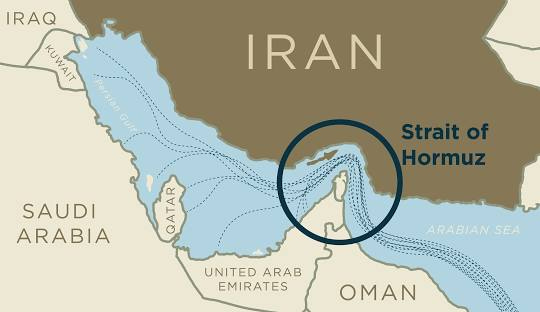
One narrow passage. Twenty million barrels a day. What the world's most dangerous chokepoint means for every economy on earth.
20M
Barrels per day in transit
27%
Of global seaborne oil trade
$119
WTI crude peak (USD/barrel)
There is a strip of water 33 kilometres wide at its narrowest point shorter than a motorway drive between two cities that the global economy cannot do without. The Strait of Hormuz, nestled between Iran to the north and Oman to the south, is not merely a shipping lane. It is the jugular vein of industrial civilisation. When it bleeds, every economy on the planet feels the pressure.
In late February 2026, following military strikes on Iran, the Islamic Revolutionary Guard Corps declared the strait closed to foreign vessels. Within days, tanker traffic had dropped by roughly 70 percent, over 150 ships were anchored outside the strait to avoid attack, and oil markets were convulsing. This report examines why this narrow waterway holds the world to ransom and the economic consequences of its disruption.
Why the Strait of Hormuz Is Irreplaceable
According to the U.S. Energy Information Administration, approximately 20 million barrels per day of crude oil and petroleum products moved through the Strait of Hormuz in 2024, equivalent to roughly 20 percent of global petroleum liquids consumption. The International Energy Agency estimates this represents around 25 percent of total world seaborne oil trade. Either figure points to the same sobering conclusion: no single stretch of water matters more to global energy supply.
The geography is unforgiving. Seven major oil-producing nations Saudi Arabia, Iran, Iraq, Kuwait, the UAE, Qatar, and Bahrain depend on this route to deliver the overwhelming majority of their exports. Most have no viable alternative. The IEA estimates that only Saudi Arabia and the UAE possess pipeline capacity to partially bypass the strait, offering a combined 3.5 to 5.5 million barrels per day of alternative routing. Against a baseline of 20 million barrels per day, the implied net shortfall in a full closure scenario exceeds 14 million barrels daily.
Key Fact: LNG Exposure
Beyond oil, approximately 20 percent of global liquefied natural gas trade also transits the Strait of Hormuz, primarily from Qatar, the world's second-largest LNG exporter. Qatar relies entirely on this route for its maritime LNG shipments. Any sustained disruption would strand vast volumes of gas with nowhere to go.
The Anatomy of a Shipping Disruption
When Iran declared the strait closed in March 2026, the maritime response was swift and severe. Data from vessel-tracking platforms showed tankers backed up on both sides of the narrow passage. War risk insurance was withdrawn for transiting vessels, making the economic cost of passage prohibitive for most ship owners. By early March, no tankers in the strait were broadcasting automatic identification system signals a chilling indicator of a near-total halt in traffic.
The ripple effects moved rapidly through supply chains. Freight rates surged. Insurance premiums on any vessel operating near the Persian Gulf spiked. Alternative routes, such as rounding the Cape of Good Hope, add weeks to delivery times and significantly increase fuel and operational costs. For an energy system calibrated to just-in-time delivery, even short delays translate to meaningful supply shortfalls.
Top Destinations for Hormuz Crude Oil & Condensate (Q1 2025)
- China: 37.7%
- India: 14.7%
- South Korea: 12.0%
- Japan: 10.9%
- Other Asia: 13.9%
- United States: 2.5%
Source: EIA / Energy Institute 2025
The Oil Price Spike and Its Cascade
Oil markets reacted to the closure with immediate and dramatic price moves. WTI crude, which had begun 2025 at approximately $57 per barrel, surged to $119 per barrel in the wake of the 2026 disruption, more than doubling in price. Brent crude breached $90 per barrel in the early weeks of the crisis, with analysts warning that a sustained closure could push prices significantly higher.
The consequences of such a price spike extend far beyond petrol station forecourts. Higher energy costs feed directly into manufacturing, logistics, agriculture, and food production. Fertiliser prices, already volatile since the Ukraine conflict, are particularly sensitive, as the strait also carries fertiliser shipments from Gulf producers. The UN trade body UNCTAD has warned that sustained disruption would intensify cost-of-living pressures, particularly for developing economies with limited fiscal headroom to absorb the shock.
Quote:
"Disruption in Hormuz is not a regional oil story. It is a global inflation, shipping and growth story."
- LSE Business Review, March 2026
The semiconductor and high-technology sectors face a less obvious but equally serious exposure. Taiwan, which produces the vast majority of the world's most advanced microchips, sources roughly 30 percent of its LNG through the strait. Qatar's LNG is a critical input for stable electricity supply across major East Asian manufacturing hubs. A prolonged disruption could raise energy costs for chipmakers at precisely the moment when global demand for semiconductors is intensifying.
Global Trade Risk: Who Is Most Exposed?
The burden of a Hormuz crisis falls unevenly. The United States, now the world's largest oil and gas producer, imports less than 1 million barrels per day from the region a small fraction of its total consumption. European nations, while not directly dependent on Gulf crude for most of their supply, are nonetheless exposed through global price linkages. Higher oil prices affect diesel, aviation fuel, and inflation expectations regardless of where the physical barrels originate.
Most Exposed Economies
- Japan sources approximately 95% of its crude oil needs from Gulf exporters.
- South Korea sources roughly 75%.
- China receives over a third of its supply through the strait.
- India is similarly reliant.
A sustained closure would represent an existential energy challenge for each of these economies.
The Al Jazeera Centre for Studies notes that the disruption's reach extends even to industrial metals. Gulf aluminium production represents 8 to 9 percent of global output. Any shutdown of Gulf smelters, whether from energy shortfall or port closures, tightens aluminium supply chains that feed into construction, automotive, and aerospace manufacturing worldwide.
Strategic Buffers and Their Limits
Two mechanisms exist to cushion a Hormuz disruption: strategic petroleum reserves and pipeline bypasses. The International Energy Agency coordinates emergency reserve releases among member nations. The United States Strategic Petroleum Reserve holds hundreds of millions of barrels, and coordinated IEA releases have been deployed in past crises. However, reserves are finite; they are designed to bridge short disruptions, not substitute indefinitely for 14 to 16 million missing barrels per day.
The bypass pipeline capacity, largely Saudi Arabia's East-West Petroline and the UAE's Abu Dhabi Crude Oil Pipeline, offers at most 5.5 million barrels per day of alternative routing. The arithmetic of a total closure remains deeply troubling.
Analytical Verdict
The 2026 Strait of Hormuz crisis represents a stress test that the global energy architecture was never designed to pass. Several conclusions emerge clearly from the available data:
- Short disruption = oil shock
A closure measured in days or weeks produces a sharp but manageable price spike, cushioned by strategic reserves and market substitution. Economies absorb the blow with pain but resilience. - Prolonged disruption = inflation and growth shock
A closure lasting months transforms an energy supply problem into a macroeconomic crisis. Inflation expectations become unanchored. Central banks face impossible trade-offs. Supply chain disruptions compound across sectors from agriculture to semiconductors. - Asia bears the primary burden
With 80–89% of Hormuz crude destined for Asian markets, and Japan, South Korea, China, and India holding the deepest exposure, the disruption is an Asian economic crisis first, with contagion spreading west through commodity prices and trade finance. - The alternative routes are insufficient
Pipeline bypasses, extended shipping detours, and reserve releases can bridge a gap, but they cannot replace the strait. Until the world has substantially diversified its energy geography, the Strait of Hormuz will remain the single point of failure at the heart of the global economy. - Structural vulnerability is deepening
The crisis exposes a broader truth: despite decades of rhetoric about energy diversification, the world's dependence on a 33-kilometre passage has not diminished. The geopolitical premium embedded in global energy prices is not an anomaly. It is a permanent feature of a system that has yet to build genuine resilience.



Comments (0)
Leave a Comment
No comments yet
Be the first to comment