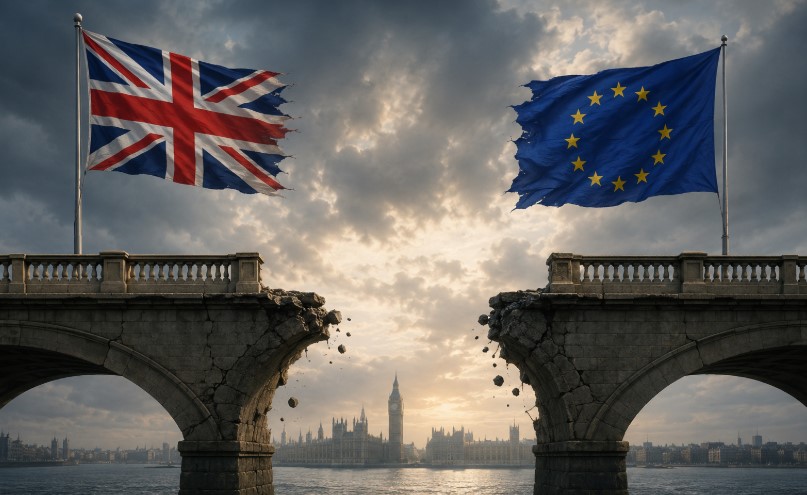
Britain may not be rejoining the European Union. But it appears to be systematically dismantling the logic that made leaving worthwhile. The UK's quiet exploration of rejoining the EU single market for goods is not a policy footnote. It is a strategic admission that the economic cost of full separation has become politically unsustainable, and that the Keir Starmer government is now willing to sacrifice ideological distance for measurable recovery.
What Happened
Senior UK officials have signalled interest in a bespoke arrangement that would align British goods standards with EU regulations, effectively granting UK exporters friction-free access to Europe's 450-million-consumer market. While Downing Street has carefully avoided the phrase "single market membership," the functional architecture being proposed closely mirrors the kind of regulatory harmonisation that characterises Norway's relationship with the EU under the European Economic Area. Brussels has responded cautiously, with key EU negotiators insisting that market access cannot be separated from broader obligations including budget contributions and accepting the jurisdiction of the European Court of Justice.
Why This Matters Beyond Headlines
The significance here is structural, not merely diplomatic. Since 2021, UK goods exports to the EU have faced non-tariff barriers that have quietly strangled supply chains in food, pharmaceuticals, manufacturing, and automotive sectors. Small and medium enterprises, which lack compliance infrastructure, have absorbed disproportionate losses. The Office for Budget Responsibility has consistently flagged Brexit-related trade friction as a long-run drag on UK productivity. This is not abstract modelling. It shows up in stagnant export volumes, reshored European operations, and declining foreign direct investment relative to pre-referendum trajectories.
Labour inherited this damage. It also inherited a political prohibition: no customs union, no single market, no freedom of movement. Starmer's team is now engineering what might be called a "functional soft Brexit," achieving single-market-adjacent outcomes through sectoral alignment agreements, veterinary accords, and mutual recognition frameworks, without triggering the constitutional language that would cause a parliamentary revolt.
Political and Strategic Calculations
For Starmer, the calculus is clear. His domestic narrative depends on economic growth. Growth depends partly on trade recovery. Trade recovery requires EU market access. Yet moving too visibly toward Brussels risks handing the Conservative opposition and Reform UK a "betrayal of Brexit" attack line ahead of the next electoral cycle. The strategy, therefore, is deliberate ambiguity: negotiate access, defer sovereignty questions, and present outcomes as pragmatic rather than ideological.
From Brussels' perspective, the incentive structure is mixed. EU member states with significant UK trade exposure, particularly Ireland, the Netherlands, and Germany, want frictionless access restored. But the institutional logic of the EU demands precedent discipline. Granting the UK bespoke goods-market access without full membership obligations could embolden other states to imagine partial participation as a sustainable model, threatening the coherence of the single market itself.
Economic and Security Impact
Markets have already begun pricing in a more cooperative UK-EU trajectory. Sterling has shown measured strength against the euro in periods when reset diplomacy generates positive headlines. The sectors watching most carefully are automotive manufacturing, agri-food exports, and life sciences, all of which have restructured supply chains around the post-Brexit reality and now face a second adjustment if regulatory alignment accelerates.
On security, the UK-EU relationship has recovered faster than the trade dimension, largely driven by shared concern over Russian aggression in Ukraine. Defence cooperation has become the unlikely lubricant for broader diplomatic rehabilitation. Security interdependence creates political goodwill that trade negotiators are now attempting to convert into economic concessions.
Global Reactions and Diplomatic Signals
Washington has watched this evolution with quiet approval. US strategic planners prefer a UK that functions as a bridge into Europe rather than a floating bilateral partner. A UK economically reintegrated with the EU strengthens the Western alliance architecture without requiring American diplomatic capital. China has noted the shift with strategic interest, aware that a UK less economically isolated from Europe reduces Beijing's leverage over London in trade and technology negotiations.
What Happens Next
Three scenarios are plausible. First, a narrow veterinary and goods standards agreement is concluded, delivering modest trade relief without politically radioactive language. Second, negotiations stall over ECJ jurisdiction, and Britain remains in the current liminal position. Third, a broader reset accelerates, driven by a future economic shock, and Britain enters an EEA-adjacent relationship within a decade.
The honest assessment is that trajectory, not destination, is what matters now. Britain is moving toward Europe. The pace is deliberately slow. But the direction has changed.
Conclusion
Brexit was never a singular event. It was a process, and processes can be partially reversed without formal acknowledgement. What Britain is now negotiating is not EU membership. It is the quiet retrieval of what membership provided, repackaged in sovereignty-compliant language. Whether that succeeds depends less on diplomacy than on whether British politics can sustain the strategic patience required to accept incremental gains over decisive gestures.



Comments (0)
Leave a Comment
No comments yet
Be the first to comment