INTRODUCTION
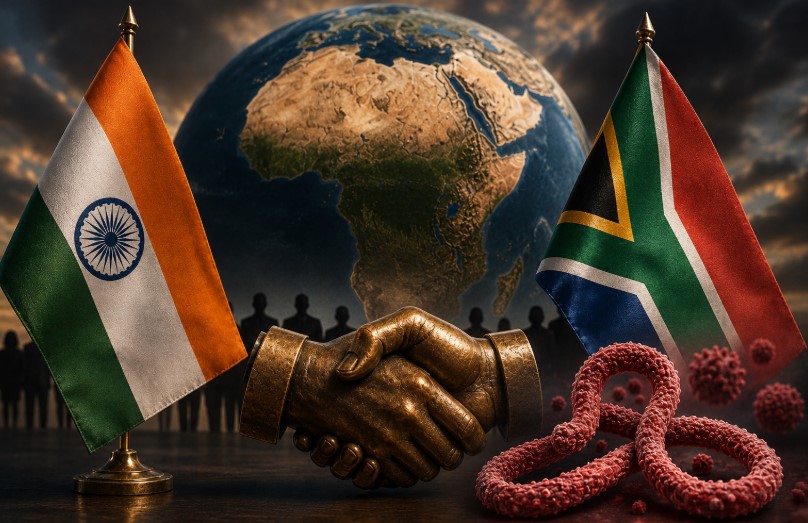
When a public health emergency forces a diplomatic postponement, the story is never just about the virus. The indefinite delay of the India-Africa Forum Summit, triggered by the Ebola outbreak spreading across parts of West and Central Africa, has arrived at a moment when India's Africa strategy can least afford interruption. India's attempt to consolidate Global South leadership, deepen trade relationships, and build durable political alliances across the continent now faces an involuntary pause while rival powers continue advancing their positions without hesitation.
What Happened
The India-Africa Forum Summit, held roughly every five years, functions as India's primary institutional vehicle for structured engagement with African governments. New Delhi had been preparing the next edition as a marquee diplomatic showcase following the G20 presidency. The Ebola resurgence in parts of sub-Saharan Africa, raising legitimate travel, logistics, and public health concerns, prompted an indefinite postponement. The delay is not indefinite in the existential sense, but in geopolitical terms, timing is everything.
Why This Matters Beyond Headlines
Africa is no longer a secondary theater in global power competition. The continent holds roughly 30 percent of the world's critical mineral reserves, including cobalt, lithium, and manganese essential to the global energy transition. It controls significant oil and gas reserves, commands 54 votes in the United Nations General Assembly, and represents one of the fastest-growing consumer markets globally. Every major power now understands this calculus clearly. China's Forum on China-Africa Cooperation has met six times since 2000, consistently delivering financing commitments, infrastructure pledges, and bilateral agreements within structured timelines. India's summit model, operating on a five-year cycle, already moved at a slower institutional pace. A forced delay compounds this structural disadvantage.
Political and Strategic Calculations
India's Africa engagement carries a dual strategic purpose. Domestically, it reinforces the government's narrative of India as a leading voice for the Global South, a positioning that gained significant momentum during the G20 New Delhi summit in 2023. Internationally, it serves as a counterweight to China's deep institutional presence across the continent. Russia has leveraged security cooperation and Wagner-era influence in the Sahel to embed itself politically. Turkey and Gulf states, particularly the UAE and Saudi Arabia, are aggressively deploying investment and soft power. India's relative advantage lies in technology partnerships, pharmaceutical exports, IT services, and diaspora connections. These strengths require consistent diplomatic cultivation, and gaps create openings for competitors to fill.
Economic and Security Impact
The postponement disrupts planned agreements in agriculture, digital infrastructure, energy cooperation, and defense. African nations seeking diversified partnerships now face uncertainty about India's commitment timeline. For Indian pharmaceutical companies, energy firms, and infrastructure developers eyeing the African market, the delay introduces deal uncertainty. On security, India has been building naval presence in the Indian Ocean to protect sea lanes connecting South Asia and East Africa. Diplomatic stagnation at the summit level can slow the defense cooperation frameworks that underpin this maritime strategy.
Global Reactions and Diplomatic Signals
Beijing has offered no similar pause in its Africa engagement calendar. Chinese state media has framed India's delay as evidence of institutional fragility. Western capitals, navigating their own Africa credibility deficit after years of transactional relationships, are watching India's stumble with quiet attention. African governments, pragmatic above all else, will not wait. Several are accelerating bilateral negotiations with Gulf sovereign wealth funds and Chinese state enterprises regardless of India's timeline.
What Happens Next
India has three realistic paths. First, it can pursue accelerated bilateral summits with key African nations, particularly in East Africa and the Sahel transition states, to maintain political momentum outside the multilateral format. Second, it can deploy the Indian Technical and Economic Cooperation program more aggressively as a visible bridge until the summit reconvenes. Third, and most importantly, it must invest in institutional capacity that reduces its dependence on episodic summitry. Africa's strategic importance will only intensify as the energy transition accelerates mineral demand. India cannot afford five-year windows when competitors operate on twelve-month engagement cycles.
Conclusion
The Ebola delay is a symptom, not the disease. India's Africa strategy carries genuine strengths: soft power, pharmaceutical credibility, digital infrastructure, and a non-colonial historical narrative. But those advantages require consistent institutional expression to translate into durable influence. A virus has exposed the structural thinness of an engagement model built around infrequent grand summits. The real geopolitical risk is not the postponement itself, but whether New Delhi uses this interruption to fundamentally redesign how it engages a continent that will shape the twenty-first century's balance of power.



Comments (0)
Leave a Comment
No comments yet
Be the first to comment