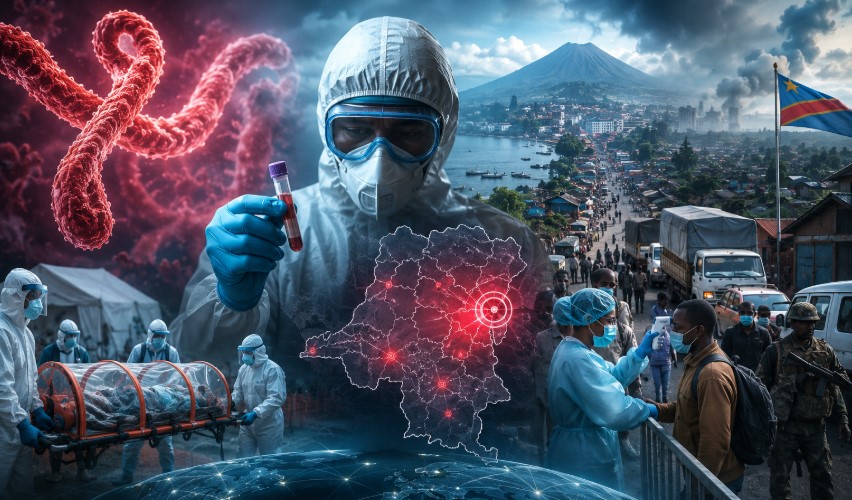
The World Health Organization has declared the Ebola outbreak in the Democratic Republic of the Congo and Uganda a public health emergency of international concern, marking one of the most serious global health alerts since the COVID-19 pandemic era. With more than 300 suspected cases, 88 confirmed deaths, and a confirmed spread to the major city of Goma, the Ebola outbreak in DR Congo and Uganda now demands immediate, coordinated global response.
A Rare and Dangerous Strain at the Centre
The outbreak is caused by Bundibugyo virus disease, a rare subtype of Ebola with no approved vaccines or therapeutics. Of the more than 20 Ebola outbreaks recorded across the DRC and Uganda, BVD has only appeared three times in history. This rarity makes containment significantly more complex. Without validated treatment options, health systems in conflict-affected eastern DRC face near-impossible odds without external medical and logistical support.
The WHO has flagged that the true scale of the outbreak may far exceed reported numbers. High positivity rates among initial samples and a rapidly growing case count suggest significant under-detection in communities with limited access to laboratory infrastructure.
Why Goma Changes Everything
The confirmation of an Ebola case in Goma represents a serious escalation. Goma sits at a critical intersection: it is the largest city in eastern DRC, a major humanitarian and commercial hub, and it currently operates under the control of the Rwanda-backed M23 armed group. Its porous border with Rwanda and access to international airports raises the probability of cross-border and international spread.
The infected patient in Goma is the wife of a man who died from Ebola in Bunia. She travelled to Goma after her husband's death while already infected, a chain of exposure that illustrates the catastrophic role of undetected transmission in mobile, conflict-affected populations.
Uganda: Border Risk and Imported Cases
Uganda has confirmed two imported cases, both originating in the DRC. Critically, these cases appear to be unlinked, suggesting at least two independent entry points rather than a single cluster. One patient died in Kampala. Ugandan health authorities have initiated contact tracing, hospital screening, and fever surveillance at the affected facility. President Yoweri Museveni stated the situation is under control, and the Uganda-DRC border remains open as of this report.
Regional Alert Level
The WHO has elevated risk assessments for all neighbouring countries, including South Sudan, Rwanda, Burundi, and the Republic of Congo. It has called on governments to activate national emergency health mechanisms and enforce cross-border screening. Rwanda's border closure measures have drawn attention as a preventive step, though the WHO continues to advise against broad travel or trade restrictions, warning these measures push movement underground and create unmonitored exposure channels.
Policy Gaps and the No-Vaccine Problem
The lack of approved therapeutics for BVD is a structural failure of global health preparedness. Existing Ebola vaccines and experimental treatments developed after the 2014 West Africa outbreak and the subsequent DRC outbreaks were designed around the Zaire strain. None are cleared for Bundibugyo. This leaves frontline workers and affected communities exposed without the pharmacological tools that have proved effective in recent Zaire strain outbreaks.
What Comes Next
The WHO's PHEIC designation unlocks emergency funding mechanisms and compels member states to report and coordinate response activities. It also activates the International Health Regulations framework, creating legal obligations for governments to respond.
- Immediate isolation of confirmed and suspected cases is now WHO protocol.
- Restricted national travel within affected zones is advised for at least 21 days after last exposure.
- International travel restrictions are not recommended, but health screening at all major entry points is essential.
- Accelerated clinical trials for BVD-specific treatments must be initiated with urgent global research coordination.
The situation in eastern DRC, where active armed conflict disrupts health infrastructure and population movement, makes this among the most operationally complex Ebola responses in history. The global health community has weeks, not months, to contain this outbreak before Goma's connectivity transforms a regional crisis into an international emergency.



Comments (0)
Leave a Comment
No comments yet
Be the first to comment