When a Population Speaks, Strategy Listens
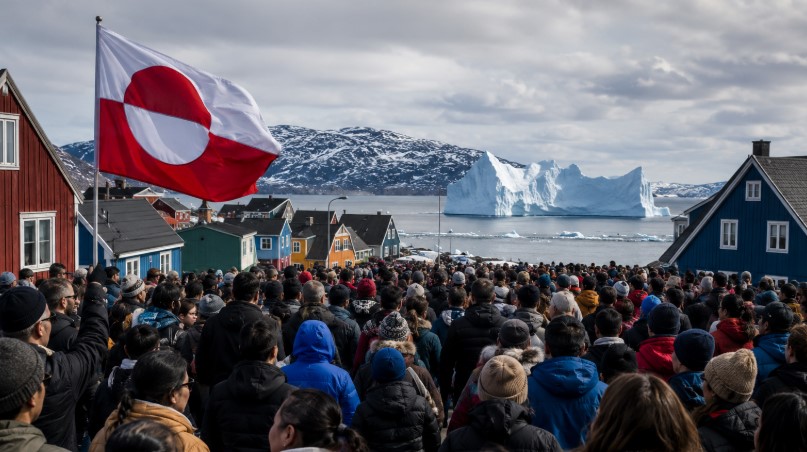
The Greenland protest against Trump was not a local demonstration. It was a geopolitical statement from 56,000 people sitting atop one of the most strategically valuable territories on the planet. When Greenlanders marched with signs reading "No Means No," they were not simply rejecting one American president. They were asserting that their future belongs to them, not to whoever currently occupies the White House or Washington's strategic planning offices.
What Happened
Thousands of Greenlanders took to the streets in the island's largest cities following renewed pressure from the Trump administration regarding US acquisition of Greenland. The protests, organized by civil society groups and endorsed by local political figures, reflected deep public opposition to any form of annexation or forced alignment with American foreign policy objectives. The demonstrations were coordinated, peaceful, and unmistakably political.
Why This Matters Beyond Headlines
Greenland is not simply a large cold island. It is the geographic keystone of Arctic security, home to significant deposits of rare earth minerals, and a territory whose thawing ice sheet is opening new shipping lanes and resource corridors that did not exist a generation ago. Washington's renewed interest in Greenland is not sentimental. It is strategic.
The US already operates Pituffik Space Base on Greenlandic soil under agreements with Denmark. But the Trump administration's framing of Greenland as a necessary acquisition reflects a broader anxiety: that China and Russia are rapidly expanding Arctic capabilities while the US lags in icebreaker capacity, Arctic basing, and regional partnerships. Greenland, in that calculus, becomes irreplaceable real estate.
The problem is that Greenlanders are watching this conversation happen about them, not with them.
Political and Strategic Calculations
For Trump, Greenland rhetoric serves multiple functions. It energizes a base that responds to muscular foreign policy language. It signals to Beijing and Moscow that Washington takes Arctic competition seriously. And it pressures Copenhagen into accelerating defense cooperation agreements.
For Denmark, the situation is genuinely uncomfortable. Denmark funds roughly half of Greenland's annual budget and retains control over foreign policy and defense. Any path toward Greenlandic independence runs through Copenhagen, and American pressure complicates that relationship significantly.
For Greenland's government, the protests are politically useful. The Inatsisartut, Greenland's parliament, has independence as a long-term goal, but economic self-sufficiency remains elusive. Playing the sovereignty card against Washington builds domestic political capital while signaling to international investors that Greenland intends to chart its own course.
Economic and Security Impact
Greenland holds an estimated 25 percent of the world's undiscovered rare earth deposits. As global demand for lithium, neodymium, and other critical minerals accelerates due to the clean energy transition, Greenland's mineral wealth becomes increasingly central to supply chain security debates in both Washington and Brussels.
Any instability in Greenland's political environment creates investor hesitation. Mining licenses, infrastructure partnerships, and joint ventures require stable governance frameworks. Coercive external pressure from the United States ironically increases political uncertainty, making commercial agreements harder to finalize.
On the security side, increased US pressure may push Greenland and Denmark closer to European defense frameworks rather than deeper into American military structures, complicating NATO's Arctic coherence.
Global Reactions and Diplomatic Signals
The European Union responded cautiously but clearly, reaffirming Greenland's right to self-determination under international law. Canada, itself an Arctic power, expressed quiet concern about precedent-setting territorial rhetoric from Washington. Russia and China said little publicly but watched closely. Both have cultivated relationships with Arctic stakeholders and benefit from any erosion of American soft power in the region.
What Happens Next
Three scenarios are plausible. First, the pressure campaign subsides as other geopolitical crises consume Washington's attention, leaving Greenland's status unchanged in the near term. Second, Denmark accelerates defense spending and bilateral cooperation with the US, offering Washington strategic access without formal annexation. Third, Greenland's independence movement gains momentum, supported by EU investment in critical mineral extraction, gradually reducing Danish fiscal dependence and positioning Greenland as a sovereign partner rather than a dependent territory.
The most likely near-term outcome is the second scenario: functional strategic concessions without territorial transfer. But Greenland's population has now demonstrated that public opinion will be a variable in any calculation, not an afterthought.
The Bigger Picture
Small nations deliver large strategic signals when they refuse to be silent. Greenland's "No Means No" protest is a reminder that Arctic governance will not be settled by great powers alone. It will be shaped by the people who live there, and by whether the international community respects that the era of territories being traded like strategic assets is over.



Comments (0)
Leave a Comment
No comments yet
Be the first to comment