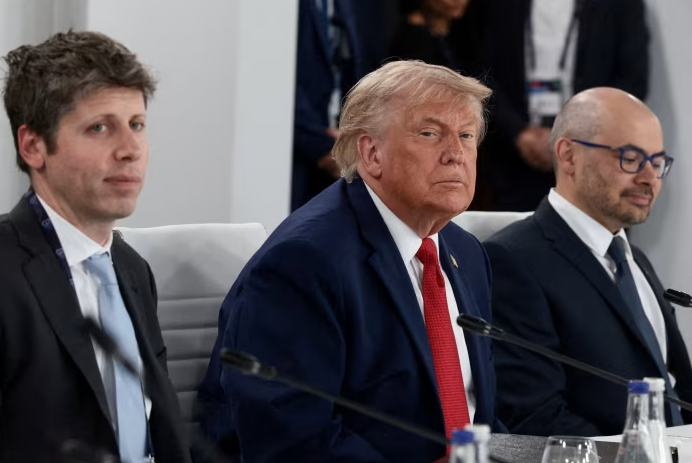
A working lunch on artificial intelligence at the G7 summit in Évian-les-Bains drew roughly a dozen tech executives alongside President Donald Trump and other heads of state on Wednesday. The session, framed around AI innovation and infrastructure, signaled how deeply private AI companies have embedded themselves in international economic policy this year.
OpenAI's Sam Altman, Anthropic's Dario Amodei, and Google DeepMind's Demis Hassabis sat at the center of the meeting, alongside Treasury Secretary Scott Bessent, Commerce Secretary Howard Lutnick, and Secretary of State Marco Rubio representing the United States.
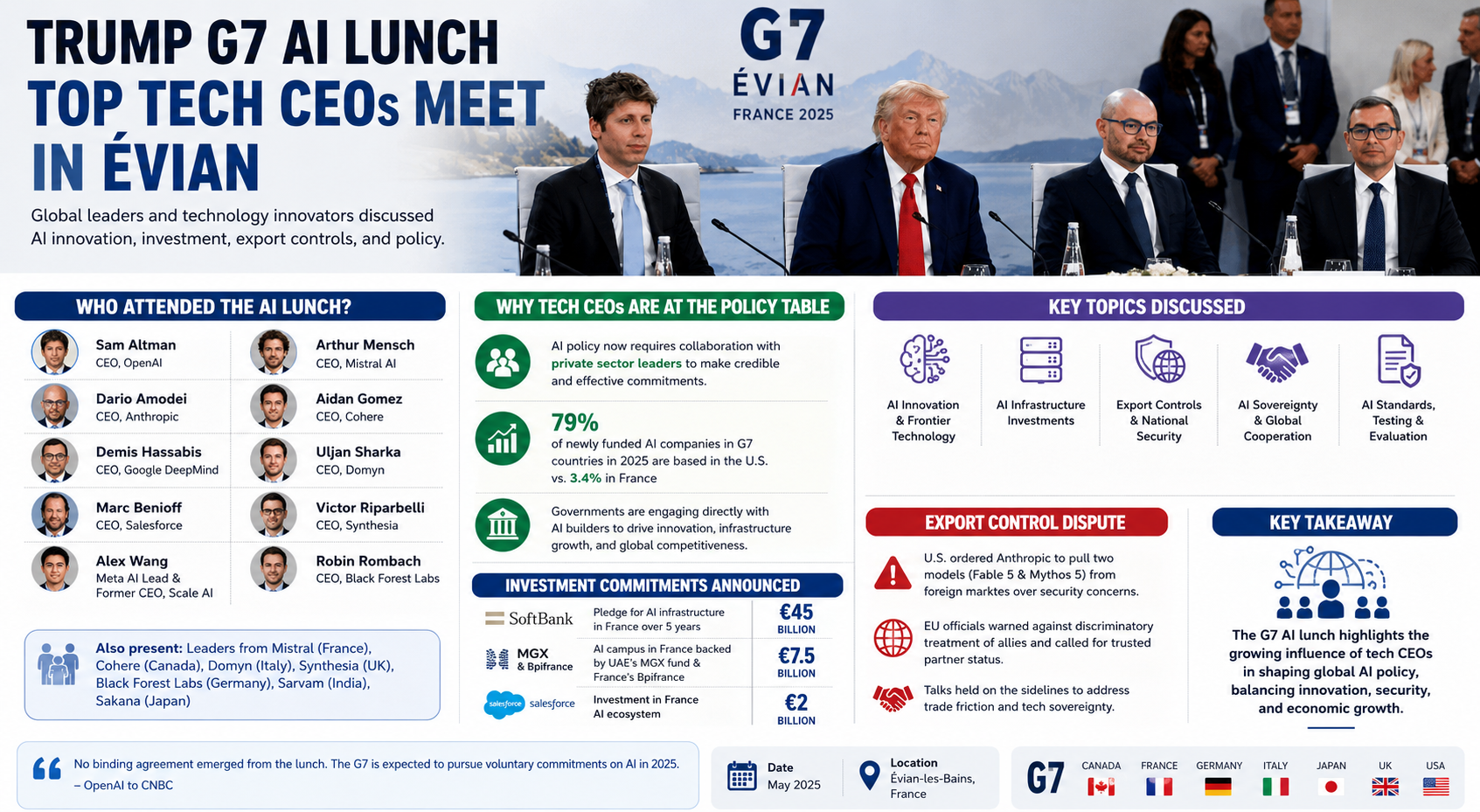
Who Joined the AI Lunch in Évian
The guest list reflected a broad mix of frontier AI labs and regional champions rather than a single national bloc. Attendees included:
- Sam Altman, CEO of OpenAI
- Dario Amodei, CEO of Anthropic
- Demis Hassabis, CEO of Google DeepMind
- Marc Benioff, CEO of Salesforce
- Alex Wang, Meta's AI lead and former Scale AI founder
- Arthur Mensch, CEO of France's Mistral
- Aidan Gomez, CEO of Canada's Cohere
- Uljan Sharka, CEO of Italy's Domyn
- Victor Riparbelli, CEO of the UK's Synthesia
- Robin Rombach, CEO of Germany's Black Forest Labs
- Founders representing India's Sarvam and Japan's Sakana
Nvidia CEO Jensen Huang was not in attendance. He spent the day opening a new factory in Dallas instead.
Why CEOs Now Sit at the Policy Table
Analysts framed the lunch as evidence that governments can no longer set AI policy without direct input from the companies building the technology. Jessica Brandt, a senior fellow at the Council on Foreign Relations, told CNBC that credible AI commitments now require cooperation from private-sector executives rather than government mandates alone.
The economics support that shift. According to Atlantic Council data, nearly 79 percent of newly funded AI companies across G7 countries in 2025 were based in the United States, compared with 3.4 percent in France. That imbalance has pushed European governments, particularly the summit's French hosts, to court tech investment directly rather than rely on regulation alone.
Recent capital commitments tied to the broader G7 push include:
- SoftBank's pledge of 45 billion euros over five years for AI infrastructure in France
- A 7.5 billion euro AI campus backed by the UAE's MGX fund and France's Bpifrance
- A 2 billion euro investment from Salesforce tied to France's AI buildout
Export Controls and Trade Friction Shadow the Talks
The lunch took place against a backdrop of trade tension between Washington and its allies. Anthropic was ordered to pull two of its models, Fable 5 and Mythos 5, from foreign markets under a U.S. export control directive citing national security concerns. European officials, including the EU's tech chief Henna Virkkunen, warned against what they called discriminatory treatment of allied markets and called for Europe to be treated as a trusted partner rather than a restricted one.
Commerce Secretary Lutnick met European officials on the sidelines of the summit to address those concerns directly, according to the Financial Times. The dispute has reinforced European interest in technology sovereignty, with the European Commission's recently published Tech Sovereignty package proposing investment in EU-owned chip manufacturing and cloud infrastructure to reduce dependence on U.S. providers.
Canada has taken a similar path. Prime Minister Mark Carney unveiled a national AI strategy earlier this month centered on public investment in domestic AI infrastructure and stronger international alliances on AI governance.
What the Lunch Means for Markets and Trade Policy
For investors and trade-watchers, the G7 AI session points to a widening split between U.S. industrial policy on AI exports and allied efforts to build independent capacity. Amodei and Hassabis reportedly called for a U.S.-led coalition on AI standards during the meeting, including coordinated rules on chip access that would exclude China, while Altman pushed for an international testing and evaluation forum.
No binding agreement emerged from the lunch itself. OpenAI had told CNBC ahead of the summit that it expected only voluntary commitments from the gathering, consistent with the G7's broader shift this year toward framing AI in economic rather than regulatory terms.

Comments (0)
Leave a Comment
No comments yet
Be the first to comment