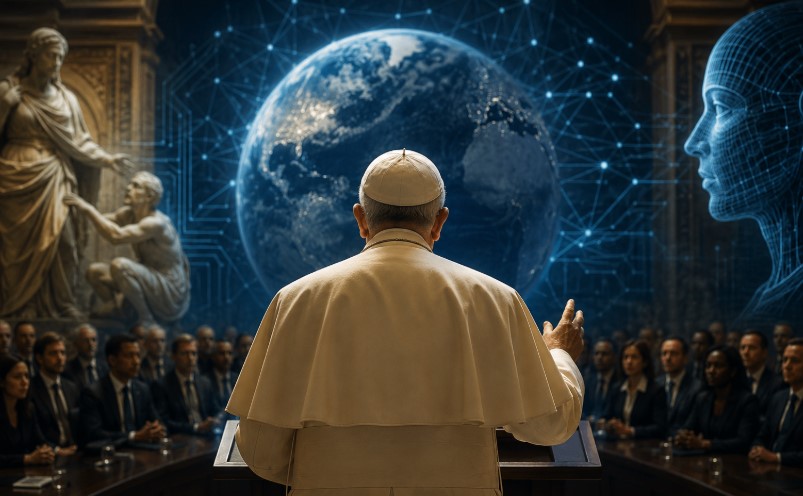
Pope Leo's debut encyclical on artificial intelligence is not a theological curiosity. It is a political intervention dressed in spiritual language, and understanding it that way is the only way to grasp its significance. The document, titled Magnifica Humanitas, arrives at a moment when AI governance is fragmented, corporate self-regulation has proven inadequate, and democratic institutions are scrambling to keep pace. The Catholic Church, representing over 1.4 billion people globally, just inserted itself into that vacuum with unusual precision.
What Happened
Pope Leo formally presented his first major teaching document at the Vatican, calling for artificial intelligence to be "disarmed." The encyclical condemned AI's role in warfare, political manipulation, and labor exploitation. It also issued one of the most direct Vatican apologies for the Church's historical role in slavery, connecting that legacy to emerging threats of what the Pope called "new digital slaveries." Notably, Christopher Olah, co-founder of Anthropic, shared the stage, acknowledging that even leading AI labs operate under incentives that can conflict with doing what is right.
Why This Matters Beyond the Headlines
The framing of AI through the lens of slavery is not rhetorical excess. It is a deliberate structural argument. The Pope draws a parallel between how societies historically normalized the exploitation of human bodies for economic efficiency and how they are now normalizing the exploitation of human attention, data, and labor through algorithmic systems. The warning about "digital colonialism" extends this further, pointing at how concentrated AI development in a handful of Western and East Asian corporations recreates colonial dependency patterns for the Global South.
What separates this document from previous Vatican technology commentary is its institutional seriousness. The Pope has convened a formal commission to operationalize the encyclical's principles. That signals an intent to engage policy processes, not merely inspire reflection.
Political and Strategic Calculations
The choice to present the encyclical alongside an Anthropic co-founder was not accidental. It signals that the Vatican is not positioning itself against the technology industry but seeking to influence it from within the conversation. Olah's admission that AI labs face structural incentive problems gave the Pope's warnings a rare form of inside validation.
For governments, particularly in Europe, where AI regulation remains contested, the encyclical provides political cover to push harder on governance frameworks. The Vatican's moral authority does not translate into legislative power, but it shapes public consent, which ultimately shapes political will. In Catholic-majority democracies across Latin America, the Philippines, and parts of Africa, this document will carry real political weight.
The condemnation of AI in warfare is its most strategically charged section. By arguing that algorithmic weapons systems make it harder to satisfy classical "just war" criteria, the Pope is entering a live debate in NATO capitals, the UN, and defense ministries. That debate has until now been dominated almost entirely by defense contractors and military strategists.
Economic and Security Impact
The encyclical's critique of AI labor exploitation intersects directly with current anxieties about automation-driven unemployment and the working conditions of data labelers, content moderators, and gig economy workers whose invisible labor trains the systems the world calls intelligent. Naming this as a moral concern rather than merely a market externality shifts the ethical baseline for corporate accountability discussions.
On security, the Pope's warning against lowering the threshold for violence through AI-assisted threat prediction systems is well-supported by existing research. Autonomous systems that compress decision timelines increase the risk of escalation in ways that human deliberation is specifically designed to prevent.
Global Reactions and Diplomatic Signals
The presence of a senior AI researcher at the encyclical's presentation drew immediate attention from the tech policy community. Reactions from major AI companies have been cautiously respectful. Governments in the European Union, already advancing the AI Act, cited the document as aligned with their regulatory direction. The United States government has not responded formally, reflecting the current administration's lighter-touch posture on AI oversight.
What Happens Next
The Vatican commission is the real test. If it produces concrete policy recommendations that feed into UN processes or national regulatory consultations, the encyclical gains institutional traction. If it remains deliberative, it risks the fate of Pope Francis's climate encyclical Laudato Si, widely praised and minimally acted upon.
The deeper risk is that moral frameworks, however sophisticated, move slower than deployment cycles. By the time consensus forms around the principles outlined in Magnifica Humanitas, the systems they seek to govern may already be embedded too deeply to redesign.
The longer arc of this document is not theological. It is about who gets to define the ethics of systems that are reshaping power itself. The Vatican is not the most powerful voice in that debate. But it may be one of the few speaking without a financial stake in the outcome. That alone makes it worth taking seriously.




Comments (0)
Leave a Comment
No comments yet
Be the first to comment