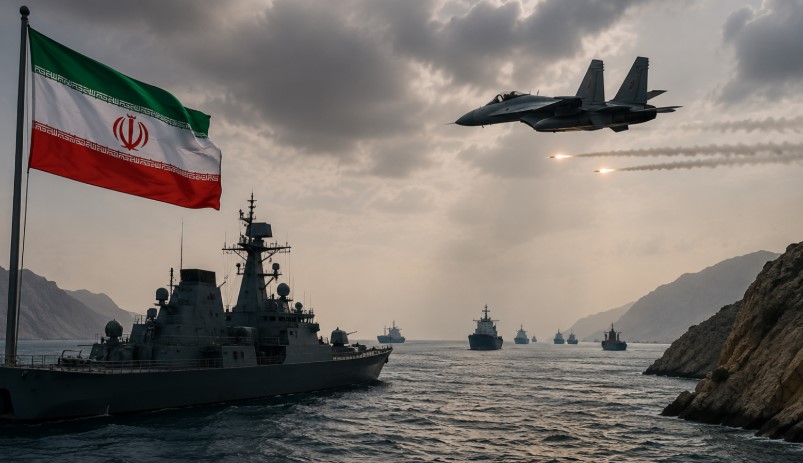
The US strikes near Bandar Abbas on Monday were not simply a military action. They were a negotiating instrument delivered through explosive ordnance. Understanding why the United States chose to escalate during an active ceasefire, while its own Secretary of State was simultaneously signaling deal optimism from New Delhi, reveals the architecture of coercive diplomacy at its most calculated.
What Happened
US Central Command confirmed strikes on Iranian missile sites and naval assets attempting to lay mines near the Strait of Hormuz, the narrow waterway through which roughly 20 percent of global oil supply flows. The target area sits near Bandar Abbas, a major Iranian naval base. Washington framed the action as self-defense under an ongoing ceasefire that has technically held since April 8. Iran has not yet issued a formal military response, though its foreign ministry described a deal as "not imminent."
Why This Matters Beyond Headlines
The Strait of Hormuz is not just a shipping lane. It is the world's most consequential chokepoint, and Iran has effectively weaponized it since the conflict began in late February. Closing the strait sent oil prices surging globally, delivering an immediate economic shock that neither Europe nor Asia could absorb quietly.
Washington's willingness to strike during a ceasefire signals a core strategic calculation: the United States is not willing to negotiate with a loaded gun pointed at global energy markets. The mining activity near Bandar Abbas was less a military offensive than a leverage play by Tehran, an attempt to preserve its most valuable bargaining chip. The US strikes were a direct message that this chip will not be allowed to remain on the table indefinitely.
Political and Strategic Calculations
For the Trump administration, the optics of restraint have limits. The reported memorandum of understanding under discussion involves a 60-day ceasefire extension, Hormuz reopening, and future nuclear negotiations. But with Iran's Supreme Leader reportedly injured, in hiding, and communicating with envoys at reduced capacity, the pace of concessions from Tehran has slowed.
The US response to that slowdown is kinetic pressure wrapped in diplomatic language. Secretary Rubio's comment that "the straits have to be open one way or the other" is less a negotiating statement than a policy ultimatum. Trump's parallel demand that Iran's enriched uranium be surrendered or destroyed reinforces that Washington is negotiating toward a structural outcome, not a temporary pause.
Economic and Security Impact
Global oil markets are watching the Hormuz situation with acute anxiety. Any prolonged disruption to Gulf shipping routes affects crude flows to Asia, particularly India, Japan, and South Korea. Indian refineries have partially rerouted supply, but cost premiums remain elevated.
The security dimension extends beyond oil. The presence of Iranian mines in international shipping lanes introduces liability and insurance risk for commercial shipping that will persist even after a ceasefire, deterring commercial traffic and adding friction to global trade recovery.
Global Reactions and Diplomatic Signals
Qatar's role as a back-channel intermediary between Iran and the US continues to be central. Iran's top negotiator met Qatar's prime minister on Tuesday, a signal that indirect communication is still functioning despite the military exchange. Regional Gulf states, notably Saudi Arabia and the UAE, are watching carefully. Their own security architecture depends on Hormuz remaining open and on Washington's willingness to enforce that.
China, as the largest buyer of Iranian crude, has an economic interest in a negotiated reopening but limited appetite to publicly pressure Tehran. Russia, managing its own war-related isolation, lacks the leverage it once held over Iranian decision-making.
What Happens Next
Three scenarios are plausible. First, Iran accepts the memorandum framework under sustained military pressure, reopens Hormuz, and enters a 60-day negotiation window on its nuclear program. Second, hardliners in Tehran use the latest strikes as justification to walk away, deepening the stalemate. Third, talks continue in fragments, with the ceasefire technically holding while both sides apply pressure through asymmetric means.
The nuclear question is the longest shadow. Iran's stockpile of uranium enriched to 60 percent purity sits dangerously close to weapons-grade threshold. Trump's demand for immediate surrender or destruction of that material is unprecedented in its directness, and Tehran's response to that demand will define whether a durable agreement is even achievable.
Conclusion
What is unfolding near the Strait of Hormuz is not a conventional military campaign. It is a high-stakes, multi-domain negotiation where bombs and diplomacy are deployed simultaneously. The world's energy infrastructure, Iran's nuclear future, and the credibility of American coercive power are all being tested within the same narrow body of water. The outcome will shape Gulf security architecture for a generation.



Comments (0)
Leave a Comment
No comments yet
Be the first to comment