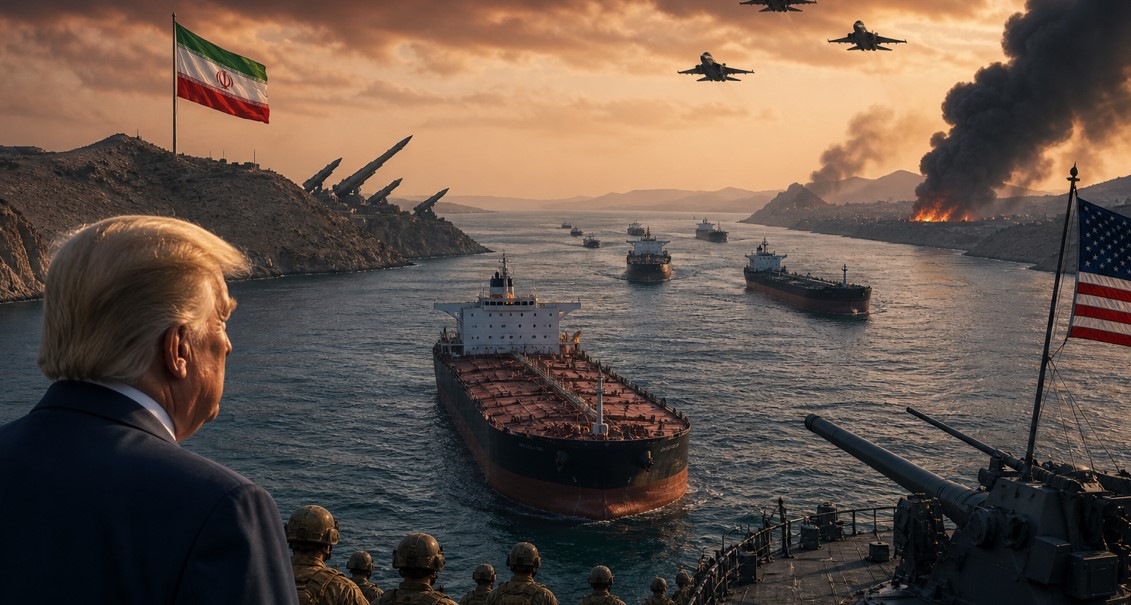
Nine hundred ships are trapped. Global oil supplies are hemorrhaging. A dramatic U.S. military operation called "Project Freedom" has been announced with fanfare, yet almost no vessels have moved. This is the Strait of Hormuz crisis 2026, and the world is watching with bated breath.
Ships Crossing Daily
12 vs 138 avg before conflict
Brent Crude
$108 per barrel, near steady
U.S. Crude (WTI)
$102 per barrel
Ships Trapped
~900 inside the Strait
U.S. Troops Deployed
15,000 per CentCom release
Aircraft (Land + Sea)
100+ multi-domain platforms
A 33-Mile Chokepoint That Controls the World's Energy
Imagine a corridor barely 33 miles wide at its narrowest point, flanked on one side by the sun-scorched coast of Iran and on the other by the mountains of Oman. Through this thin sliver of salt water passes roughly one-fifth of the world's total oil supply on any given day: about 21 million barrels. Close this passage and you do not merely inconvenience shipping companies. You send shockwaves through every economy on earth, raising fuel prices, inflating food delivery costs, squeezing airline margins, and slowing factory output. This is the Strait of Hormuz, and in the spring of 2026 it has become the most dangerous stretch of water on the planet.
Before the current conflict ignited, an average of 138 vessels made the crossing each day, threading carefully through the designated shipping lanes. As of May 2, that number had collapsed to just 12. Five ships heading inward, seven heading out. The rest, nearly 900 trapped vessels representing billions of dollars in goods, fuel, and cargo, are sitting idle. Their crews are anxious. Their owners are watching market tickers with dread.
Project Freedom: Trump's Bold Announcement and Its Uncertain Reality
On the morning of May 4, President Donald Trump announced "Project Freedom," a U.S.-led initiative to escort the stranded merchant vessels safely out of the Strait. The announcement arrived with characteristic drama: a social media post, a grand name, and the promise of immediate action. U.S. Central Command (CentCom) quickly followed with a media release outlining the assets committed to the mission. Guided-missile destroyers, more than 100 land- and sea-based aircraft, unmanned multi-domain platforms, and 15,000 service members were all listed.
On paper, it reads like an overwhelming show of force. In practice, the picture is murkier and considerably more dangerous.
"Running a convoy system through such a narrow waterway, with Iranian forces holding the entire northern shore of the Gulf, would be extraordinarily difficult and deeply dangerous."
A subsequent report from Axios cast doubt on whether the Navy would actually escort private vessels at all. The fine print matters enormously: announcing an operation and executing one are very different things. Ship tracking websites, scoured by anxious analysts and journalists around the globe, showed no evidence of vessels lining up to test the new corridor. Since Sunday, at least two ships have reportedly been attacked, a sobering reminder that bravado and bullets are not the same thing.
The Tactical Nightmare in a Narrow Sea
Military analysts have long considered the Strait of Hormuz one of the most challenging environments for naval operations in the world. Iran controls the entire northern coastline of the Persian Gulf and has spent years preparing asymmetric defenses: fast attack boats, shore-based anti-ship missiles, drone swarms, and underwater mines. A convoy system, where warships shepherd civilian tankers through the lane, sounds logical. Executing it under fire in a space narrower than many river estuaries is an entirely different proposition.
There are also serious questions about whether the U.S. Navy has enough of the right types of vessels available for sustained convoy escort duty. Guided-missile destroyers are powerful but designed for blue-water, open-ocean combat rather than the cramped, mine-threatened shallows of the Strait. Matching the right asset to the right threat is the essential art of naval warfare, and the current setup may not yet be calibrated for it.
Analyst perspective
The gap between a military announcement and a military achievement should not be underestimated. Iran has had decades to prepare denial tactics in the Strait. Even a partial U.S. escort operation could quickly escalate into a direct naval confrontation, something no one in the White House or Pentagon is publicly acknowledging yet.
What It Means for Your Fuel Bill, Your Economy, and Your Job
The effects of the Strait of Hormuz crisis 2026 are not abstract. Every $10 increase in the price of Brent crude translates into roughly $0.25 added per gallon at the fuel pump in the United States, and proportionally more in fuel-import-dependent nations across Asia and Europe. At $108 a barrel, global energy markets are already operating under severe stress. Airlines are quietly revisiting ticket pricing. Shipping companies are rerouting cargo around the Cape of Good Hope, adding two to three weeks to delivery times and thousands of dollars per voyage in extra fuel costs.
Manufacturing hubs from South Korea to Germany are watching feedstock costs rise. Farmers who rely on fertiliser made from petrochemicals are getting squeezed. Central banks, already wrestling with sticky inflation, now face a new supply-side shock that monetary policy cannot easily fix. The crisis in the Strait is not a distant geopolitical drama. It is arriving in grocery aisles, on electricity bills, and in quarterly earnings reports.
Markets on Monday reflected this anxious uncertainty. After falling more than 2% on the initial news, Brent crude clawed back almost all its losses to trade near steady at $108. European and U.S. stock futures edged fractionally higher: not a vote of confidence, but a pause while investors wait for more information. The dollar moved barely at all. That stillness is itself a form of tension. The market is not celebrating; it is holding its breath.
The Bigger Economic Picture: Earnings, Jobs Data, and a Fragile Fed
The Strait crisis is landing in the middle of a week already dense with market-moving events. More than 100 major companies are due to report earnings, including AMD, Walt Disney, McDonald's, and Palantir. AMD in particular faces a high bar: its share price has climbed roughly 80% in recent weeks, and investors will demand not just solid numbers but confident guidance about the road ahead.
On the macroeconomic front, U.S. jobs data, including the crucial monthly payrolls figure due Friday, will help clarify whether the American economy is truly slowing or merely pausing. The median forecast calls for 60,000 new jobs and an unemployment rate of 4.3%, but the range of estimates runs from a loss of 15,000 all the way up to a gain of 135,000. That kind of uncertainty tells its own story about how difficult it is to read an economy under simultaneous trade and geopolitical pressure.
The Federal Reserve, meanwhile, is in a delicate position. Three of its members dissented against any easing bias at last week's meeting. New York Fed President John Williams is scheduled to speak on Monday, and his words will be parsed for any hint that a rate cut remains on the table. It almost certainly does not, unless the jobs data is truly shocking. Australia's central bank meets Tuesday and is widely expected to raise interest rates for a third consecutive time, adding another layer of global monetary tightening to an already stressed financial environment.
What Happens Next? Three Scenarios for the Strait of Hormuz Crisis 2026
Diplomatic resolution: Iran and the U.S. reach a backchannel agreement. Ships begin moving under a tacit ceasefire. Oil pulls back toward $90, markets rally, and the crisis is de-escalated without a direct military confrontation.
Partial convoy operation: The U.S. escorts a limited number of vessels in a show of resolve. Iran harasses but does not directly attack American warships. Oil stays elevated above $100 for weeks. Tensions simmer without boiling over.
Escalation: An incident in the Strait, such as a mine strike, a drone attack, or a dangerous miscalculation, triggers a direct U.S.-Iran exchange. Oil spikes above $130. Global markets enter a sharp correction. Emergency G7 consultations begin, and the crisis becomes a full geopolitical emergency.



Comments (0)
Leave a Comment
No comments yet
Be the first to comment