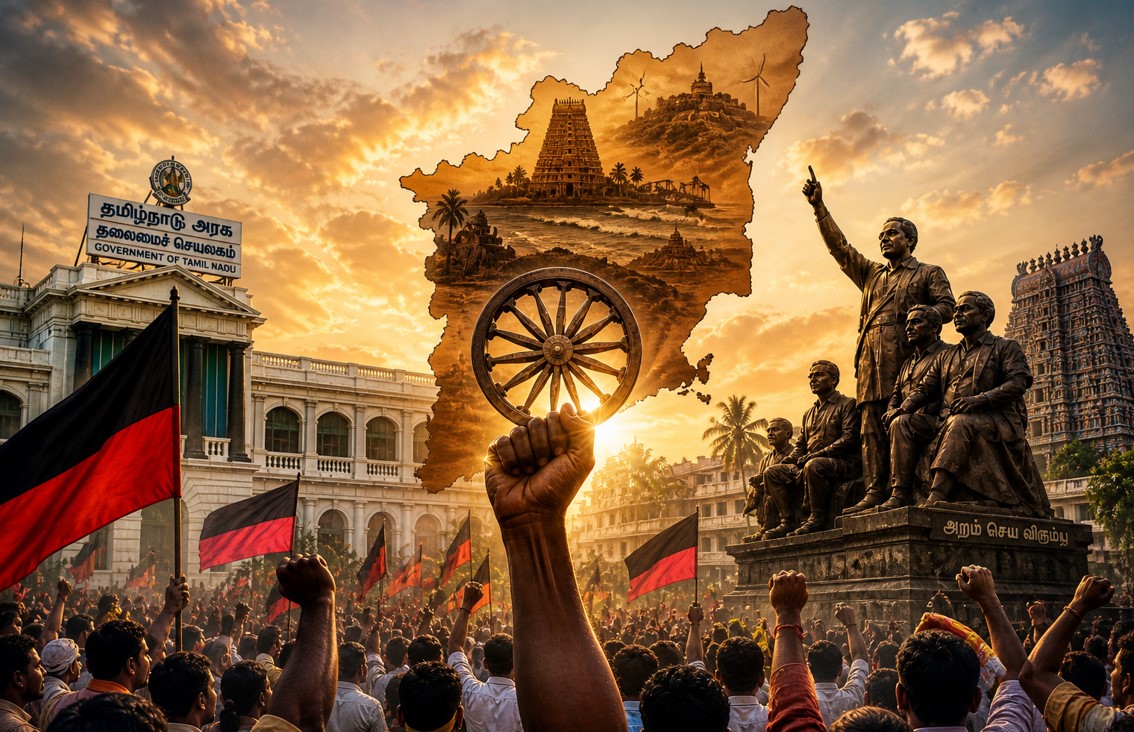
In a historic political earthquake, TVK sweeps to power in its debut election, CM M.K. Stalin loses his own seat, and the DMK falls to third place. Tamil Nadu's voters have spoken with remarkable clarity.
TVK (Vijay)
107+ Seats (leading/won)
AIADMK
58 Seats (leading/won)
DMK
48 Seats (leading/won)
Tamil Nadu's voters delivered a political verdict on Monday that defied every major exit poll, toppled a sitting Chief Minister in his own fortress, and handed power to a party that did not exist five years ago. The Tamilaga Vettri Kazhagam (TVK), led by actor-turned-politician Vijay, surged to over 107 seats in a 234-seat assembly, comfortably crossing the majority mark of 118 as counting continued. The Dravida Munnetra Kazhagam (DMK), which had governed with a decisive mandate since 2021, was relegated to a distant third place, winning or leading in only around 48 seats.
Most striking of all: Chief Minister M.K. Stalin, who had won the Kolathur constituency in three consecutive elections since 2011, lost his seat to TVK's V.S. Babu by a margin of over 9,000 votes. The loss marks the most dramatic personal reversal in Tamil Nadu's recent political history and signals that the DMK's grip on the state, once considered near-unshakeable, has been decisively broken.
A Mandate Built on Discontent
The scale of the TVK victory cannot be explained by enthusiasm alone. Political analysts across the ideological spectrum have pointed to a convergence of grievances that built quietly over the DMK's five-year tenure. Concerns over law and order, allegations of selective legal action against critics and journalists, and a perceived culture of intolerance toward dissent created a reservoir of public frustration that exit pollsters and party strategists alike appear to have significantly underestimated. Voter turnout, recorded at 85.1 percent, the highest in the state's history, was itself a signal that something extraordinary was in motion.
"When a government responds to satire with sedition, and to criticism with contempt, democracy ceases to function as a safety valve. Today, Tamil Nadu's voters found another outlet." — Political analyst, Chennai-based think tank
TVK's Meteoric Rise
Vijay's party, which held its first major public convention only in late 2024, has achieved something without clear precedent in Indian state politics: a first-election majority. TVK won not just in symbolic constituencies but broadly, across Chennai, Coimbatore, and deep into districts traditionally dominated by the two Dravidian parties. In Anna Nagar, TVK candidate V.K. Ramkumar won by over 21,000 votes. In Saidapet, TVK's Arul Prakasam defeated the sitting Health Minister. Assembly Speaker M. Appavu also fell to TVK in Radhapuram. The breadth of the sweep suggests an organised, ground-level political operation rather than a mere celebrity wave.
DMK's Collapse and Its Causes
For the DMK, the scale of defeat will require honest self-examination. The party retained pockets of strength, including wins in constituencies such as Palayamkottai, Dindigul, Nagapattinam, and Ramanathapuram, and notably, Udhayanidhi Stalin secured his Chepauk-Triplicane seat. But the collapse in urban Chennai and the swing in semi-urban constituencies point to a government that lost the confidence of voters who had originally placed enormous hope in it. Critics had long argued that governance under Stalin prioritised optics over accountability, and that the administration's response to media criticism was frequently disproportionate. The results suggest those criticisms resonated more deeply than the party acknowledged.
AIADMK's Partial Recovery
The AIADMK, under Edappadi K. Palaniswami, recorded a partial recovery, finishing second with around 58 seats, better than the near-decimation many had predicted. However, the party has now lost the narrative of being the natural opposition to the DMK. With TVK as the new governing force, the traditional Dravidian binary that defined Tamil politics for over five decades has been consigned, at least for now, to history.
Democracy is not a joke, and Tamil Nadu's voters proved it today. In a single day of counting, they removed a Chief Minister from his own seat, denied a ruling party its second term, and entrusted governance to a debutant party with no prior legislative record. That verdict carries a profound responsibility for TVK and Vijay. Tamil Nadu has not voted for a personality; it has voted for accountability, transparency, and change. Whether the new government can deliver on those expectations, while navigating the complexities of governing a large, plural state, will be the defining political question of the next five years. For now, the message from the ballot box is unambiguous: in a democracy, no seat is safe and no mandate is permanent.


Comments (0)
Leave a Comment
No comments yet
Be the first to comment