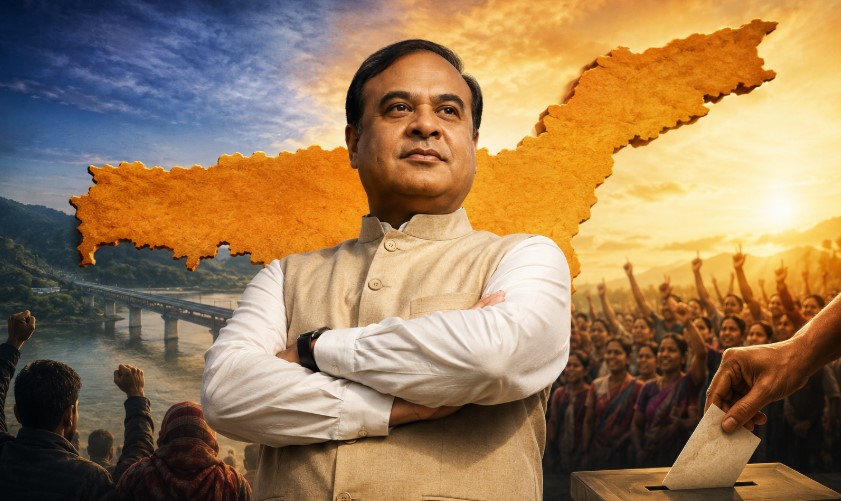
When a state elects the same political formation to power for the third consecutive time, by a margin that cannot be explained away as luck, it is no longer a result. It is a declaration.
The Signal No One Should Ignore
There is a temptation, after every Indian state election, to reduce the outcome to a simple headline. BJP wins again. Congress fails again. Move on. But the Assam verdict of May 2026 demands a different treatment. It demands to be read not as a news event but as a political document, one that reveals with uncomfortable clarity how power is being constructed, how opposition continues to be dismantled, and how the map of Indian politics is being quietly redrawn from its northeastern corner outward.
When the Election Commission declared results on May 4, 2026, the National Democratic Alliance had retained power in Assam for the third consecutive time, winning 75 of the 126 seats in the state assembly, with Himanta Biswa Sarma set to return as Chief Minister. The number alone does not capture the scale of what happened. The context does.
This was not a wave election in the traditional sense. It was a consolidation, the kind that tells you a political establishment has not merely won an election but has embedded itself into the landscape of a state. To understand why this matters far beyond the Brahmaputra valley, one must go beyond the scoreboard and into the soil.
The Numbers That Speak Volumes
Overall voter turnout touched approximately 85.17 percent, surpassing the 2016 record of 84.67 percent. Female participation hit a record 86.50 percent. These numbers are not incidental. They are politically loaded. A high turnout that still delivers a comfortable majority to the ruling alliance means the electorate was engaged and, on balance, satisfied. Anti-incumbency, in classic political theory, typically expresses itself through either abstention or consolidation of opposition votes. Neither happened at scale in Assam 2026.
In the 2021 Assam Assembly Elections, the BJP with 60 seats emerged as the single largest party with 33.2 percent vote share. The NDA coalition, consisting of BJP, Asom Gana Parishad, and UPPL, enjoyed a total vote share of 44.8 percent, while the Congress bagged 29.7 percent. In 2026, the NDA's combined seat tally grew while the opposition shrank further into irrelevance. NDA secured over 50 percent of the votes cast, a threshold that, in India's first-past-the-post system, is the clearest possible expression of a dominant mandate.
Congress leader Gaurav Gogoi, contesting from Jorhat, lost to BJP's Hitendra Nath Goswami by a margin of over 23,000 votes. That single defeat carries enormous symbolic weight. The state unit chief of Congress, the man who was supposed to be the face of renewal, was routed on his home turf. Himanta Biswa Sarma, meanwhile, was leading in Jalukbari by a margin of over 41,000 votes against his Congress opponent. The contrast between these two numbers is not just electoral arithmetic. It is a statement about personal authority, local credibility, and the gap between aspiration and execution in Indian politics.
Core Lessons from the Assam Verdict
Lesson One: The Chief Minister as the Campaign, Personalisation of Power Has Become Total
Himanta Biswa Sarma did not merely lead the BJP's campaign in 2026. He was the campaign. From the aggressive push on welfare delivery to the muscular posture on immigration and identity, every message was authored in his register and bore his unmistakable imprint. This is a significant evolution in Indian state politics. Where once parties contested elections and leaders emerged from outcomes, today leaders design the political terrain and parties follow. The BJP focused heavily on its development track record and the double-engine growth story, but the translation of that narrative into voter language was entirely Sarma's work.
This lesson has national resonance. The BJP's strategic formula is to find a dominant regional leader, build governance credibility around them, and fuse administrative achievement with cultural messaging. This is increasingly the template for state-level dominance. What Yogi Adityanath did in Uttar Pradesh, what Mohan Yadav is attempting in Madhya Pradesh, and what Sarma has perfected in Assam follows the same architectural logic: the party provides the ideology and logistics, the leader provides the emotional connection with the electorate. Where this formula has been applied with discipline, the BJP has been nearly unbeatable.
Lesson Two: Development Narratives Win When They Are Felt, Not Just Reported
The BJP's victory in Assam is also a validation of the governance-as-campaign model. Welfare schemes, from housing under Pradhan Mantri Awas Yojana to electricity connections and direct cash transfers, were not simply policy deliverables between elections. They were converted into a political idiom. Beneficiaries were reminded, repeatedly and through multiple channels, that the government had changed their material conditions. When 86.5 percent of women turned out to vote and the ruling alliance secured a majority, it was not coincidental.
This is an important corrective to a reductive argument often made in opposition circles, that welfare is populism and eventually backfires. The Assam verdict, like the Bihar elections before it, demonstrates that welfare is only called populism by those who lose on its back. When schemes are implemented with visible speed, when beneficiaries experience real change, and when political communication links gratitude to voting behaviour, welfare becomes governance capital. The opposition that dismisses this dynamic is doomed to lose to it repeatedly.
Lesson Three: The Collapse of the Congress's Structural Imagination
While the BJP focused on its development track record, the opposition built its campaign around local identity and jobs. This is not wrong as a strategy, but the execution was incoherent and the messenger was unconvincing. Gaurav Gogoi is a parliamentarian of ability and a communicator of some skill. But contesting a state assembly election on the premise that you represent the aspirations of a complex, multi-ethnic, multi-religious society requires more than sloganeering about employment. It requires a ground organisation, a credible alliance arithmetic, and a leader who is viscerally present in the state's emotional conversation.
In August 2021, the Indian National Congress ended its alliance with the All India United Democratic Front and Bodoland People's Front, effectively ending the opposition bloc Mahajot. That decision, taken in the name of electoral hygiene and to avoid being painted as a party that appeases minorities, was a strategic miscalculation of the first order. The Congress chose ideological optics over vote arithmetic and paid for it with organisational collapse. The Asom Sonmilito Morcha of 2026 was an attempt to rebuild alliance politics, but it arrived too late, with too little internal cohesion, and against a ruling apparatus that had five years to settle into the bureaucratic and social infrastructure of the state.
Lesson Four: Regional Identity Politics Is Neutralised Only by Governance Identity
Assam is one of the most politically volatile states in terms of ethnic and community identities, spanning Assamese, Bengali Hindu, Bengali Muslim, Bodo, tea garden communities, and hill tribes. Historically, the party that could manage this volatile coalition earned power. What the BJP under Sarma has done, with considerable political cunning, is to replace the language of ethnic negotiation with the language of Assamese pride fused with national security. The NRC exercise, the Citizenship Amendment Act, and the robust posture on illegal immigration all served to reorganise voter identity along a new axis, that of the authentic, settled Assamese citizen versus the perceived outsider threat.
AIUDF chief Badruddin Ajmal remained a key player in the identity politics of the state, but his influence was contained and, in certain constituencies, actively weaponised against the Congress by the BJP. Every time the BJP framed the opposition's alliance as one that accommodated Ajmal's party, it pulled fence-sitting Hindu voters back into the NDA column. The opposition never found a language to counter this effectively, partly because the framing was not entirely false, and partly because they had no counter-narrative that connected emotionally with the Assamese middle class.
Lesson Five: High Turnout Favoured the Incumbents, Disrupting Classic Wisdom
Political scientists and psephologists have long argued that high voter turnout signals dissatisfaction with incumbents. The logic runs that satisfied voters stay home while angry voters mobilise. The 2026 election's high turnout of over 85 percent was interpreted differently by both camps. The BJP saw it as a mandate; the opposition saw it as a sign of mobilisation against the ruling party. The results settled the argument definitively. The BJP read the turnout correctly. The opposition read the map they wished existed.
What this suggests is that the high-turnout-means-anti-incumbency theory is increasingly unreliable in states where the ruling party has strong booth-level infrastructure. When the ruling party can both mobilise its own voters and benefit from the mobilisation of new voters, including women, first-time voters, and rural poor who received direct benefits, turnout becomes an amplifier of incumbency rather than a corrective to it. The BJP's booth management system, borrowed from the RSS's organisational culture and refined over a decade, is arguably the most underappreciated factor in its electoral dominance.
Lesson Six: The Opposition Alliance Arithmetic Was Broken Before Polling Day
The Asom Sonmilito Morcha, despite bringing together Congress, Raijor Dal, AJP, and CPI(M), failed to produce the arithmetic coherence that an alliance requires. In November 2025, the Asom Sonmilito Morcha was revived when eight political parties led by Congress formed an alliance against BJP and its allies. But revival and rejuvenation are different things. An alliance assembled in haste, without vote-transfer discipline, without a unified ground organisation, and without a compelling shared narrative, merely adds numbers on paper without adding voters in booths.
Akhil Gogoi's Raijor Dal, with its strong anti-establishment credentials and leftist identity, has a natural voter base that does not translate easily into the Congress column. Lurinjyoti Gogoi's Assam Jatiya Parishad drew from Assamese sub-nationalist sentiment that was, in many respects, as suspicious of Congress's historical record as it was of the BJP's current policies. The attempt to park these contradictions under a single tent produced internal tensions that NDA campaigners expertly amplified. The coalition looked more like an anti-BJP agreement than a pro-Assam vision, and voters saw the difference.
Lesson Seven: The Bodoland Factor and the Cost of Intra-Alliance Fractures
On 17 March 2026, the United People's Party Liberal left the National Democratic Alliance over seat-sharing disputes. This internal fissure in the NDA, though potentially damaging, was absorbed because the BJP's alliance with the Bodoland People's Front compensated for it in the Bodoland Territorial Region constituencies. BPF's Charan Boro won from Mazbat by a massive 55,546-vote margin, marking his third assembly election win. The BPF's absorption into the NDA ecosystem, following years of adversarial politics, demonstrated how the BJP has developed the ability to manage internal regional tensions without catastrophic electoral consequences. It is a skill the opposition has conspicuously failed to develop.
Strategic Takeaways for Political Parties
For the BJP, the 2026 Assam verdict contains a powerful validation but also a hidden warning. The party's model of fusing welfare delivery with cultural nationalism, and packaging both through a dominant, charismatic chief ministerial figure, continues to work with near-mechanical efficiency in friendly terrain. What the party must guard against is the temptation of overconfidence. The NDA's seat count, while comfortable, is not an impenetrable majority. The opposition, though broken, still received a significant proportion of votes. Any slippage in welfare delivery, any governance scandal, or any mismanagement of the complex ethnic arithmetic could trigger a consolidation against the ruling alliance in constituencies where margins are thin.
For the Congress, the verdict is existential in its urgency. The party has now been on the wrong side of the Assam story for fifteen years. What ails the Congress in Assam is not unique to the state. It is the same organisational atrophy, the same absence of credible state-level leadership depth, and the same tendency to fight elections with national-level rhetoric and Delhi-drawn strategies. The loss of Gaurav Gogoi from his own state battlefield is not just a personal defeat. It is a symbol of a party that has lost the ability to translate parliamentary strength into assembly credibility.
For regional parties, including Raijor Dal, AJP, and AIUDF, the election has clarified the limits of their influence. They can shape narratives, hold specific seats, and complicate the arithmetic in select constituencies. But none of them has the organisational depth or geographic spread to constitute a genuine alternative government. Their future lies in negotiating from within alliances rather than standing outside them, but that requires ideological flexibility that each of them has historically resisted.
The Bigger National Picture
The Assam result carries implications that extend well beyond the state's 126 assembly constituencies. It reinforces the Northeast's emergence as a BJP stronghold, a transformation that would have seemed improbable a decade ago, when the region was largely a Congress dominion. The NDA formed the state government again after winning 75 out of 126 seats, marking the third consecutive mandate in a state that the Congress once considered its hereditary property. This consolidation in the Northeast reduces the Congress's electoral geography further and adds to the BJP's structural advantage in any future Lok Sabha calculation.
More broadly, the Assam verdict is the latest evidence that India's political centre of gravity has shifted. The BJP is no longer merely a party that wins elections. It is a party that manufactures political permanence. By investing in state governments as governance laboratories, by tying welfare delivery to party identity, and by selecting chief ministers who function as regional sovereigns rather than Delhi's representatives, the BJP has built a federal politics of dominance that is structurally different from what the Congress built in its heyday. The Congress built loyalty through patronage networks. The BJP is building it through a combination of direct benefit transfers, cultural mobilisation, and institutional consolidation.
For the 2029 Lok Sabha elections, Assam's 14 parliamentary seats will be contested in a landscape where the BJP has entrenched itself at the grass-roots level across five consecutive years of governance. The opposition will need to produce something more compelling than an electoral coalition assembled three months before polling if it hopes to dent that advantage.
Ground Reality vs Media Narrative
There was a narrative, circulated in parts of the political media in the weeks before polling, that the Congress under Gaurav Gogoi had found its voice, that the Asom Sonmilito Morcha represented a genuine mobilisation of anti-BJP sentiment, and that the high female turnout might signal a revolt against the incumbent government over issues like unemployment and price rise. This narrative was not entirely fabricated. There were constituencies where local anger was real. But it was disproportionate to the organisational reality on the ground.
Exit polls correctly predicted a comfortable NDA win. As per the Matrize exit poll projections, the BJP-led alliance was expected to win 85 to 95 seats, which broadly aligned with the final result trajectory. The media tendency to manufacture a competitive narrative where none authentically existed did a disservice to the genuine analysis of why the Congress is failing systematically. Instead of diagnosing the patient, the narrative dressed it up as healthier than it was.
The lesson for political journalism is uncomfortable but necessary: high turnout does not equal anti-incumbency; a vocal opposition social media presence does not equal votes; and the absence of a dominant counter-narrative from the ruling side does not mean the counter-narrative is winning in the streets. Ground reporting from booths and villages, not trending hashtags or press conference optics, remains the most reliable guide to electoral behaviour.
Why This Election Matters Beyond Assam
The Himanta Biswa Sarma model is a case study in what happens when political intelligence, administrative assertiveness, and cultural messaging are combined with consistent welfare delivery and a fractured opposition. That combination has now delivered three consecutive mandates in one of India's most complex states, a state with seismic fault lines of ethnicity, religion, migration, and historical grievance.
The verdict does not mean that Assam's problems are solved. Unemployment remains high. Questions about the NRC's incompleteness linger. Farmer distress in tea garden communities has not been fully addressed. Ethnic tensions in the Bodo belt are managed, not resolved. These are the unfinished chapters of governance that the next five years will need to confront.
But as a political document, the 2026 Assam result is a masterclass in how modern electoral dominance is constructed. It teaches us that elections are no longer won only on polling day. They are won through five years of deliberate political engineering that leaves the opposition without oxygen, without narrative, and without the ground infrastructure to mount a credible alternative.
India's opposition would do well to study this verdict not for its pain, but for its instruction. Because what has happened in Assam is not exceptional. It is increasingly the rule.




Comments (0)
Leave a Comment
No comments yet
Be the first to comment