The Question That Defines This Moment
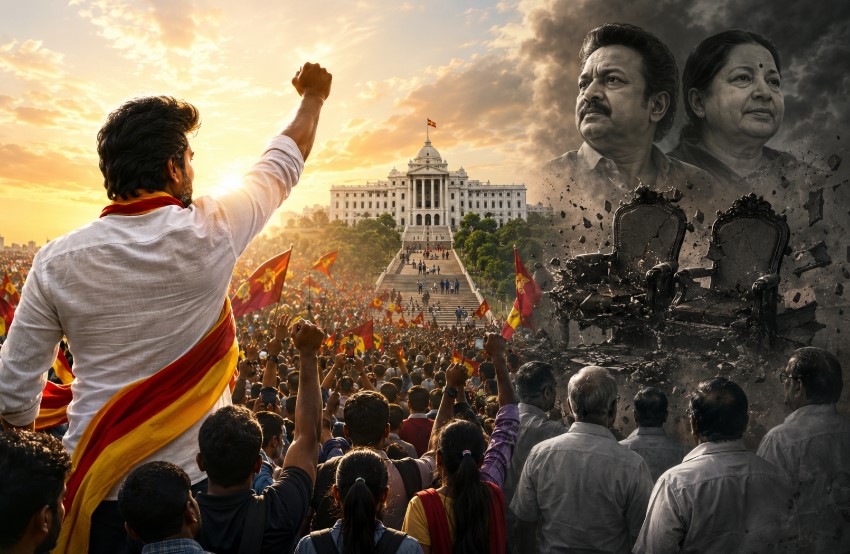
When the results of the 2026 Tamil Nadu Legislative Assembly elections were finally tallied, the political establishment did not just absorb a shock. It absorbed a reckoning. Tamilaga Vettri Kazhagam, the party founded by actor-turned-politician Vijay barely two years before the election, had secured a mandate that no seasoned political analyst had confidently predicted. The question that now hangs over Tamil Nadu's political landscape is not simply who won, but what the victory means.
Is this a wave powered by the personal magnetism of a superstar? Or is it a structural verdict, years in the making, driven by voter disenchantment with a political duopoly that had governed the state for over five decades? The answer, as with most decisive elections, refuses to be simple.
The Numbers and Their Weight
TVK's performance in the 2026 election was not merely impressive. It was, by any honest measure, historic. A party without a single prior electoral contest, without a legacy of cadre-built infrastructure, without the institutional memory that DMK and AIADMK have accumulated across generations, broke into the assembly with a force that disrupted every conventional model of Tamil Nadu politics.
The DMK, which had governed the state since 2021, suffered significant losses in urban constituencies and was decimated among voters under 35. The AIADMK, still struggling to find its ideological and organisational footing in a post-Jayalalithaa era, failed to consolidate its traditional base. TVK filled the space between them with a combination of fresh rhetoric, disciplined campaigning, and the undeniable gravitational pull of its founder.
"This is not just a victory. It is a rejection of political predictability," said a senior political scientist at the University of Madras, speaking on condition of anonymity. The observation captures something essential: Tamil Nadu voters did not simply choose TVK. They chose disruption.
The Vijay Factor: Real, But Not Unlimited
To dismiss Vijay's personal influence on this result would be intellectually dishonest. Tamil Nadu has a long tradition of film stardom converting into political capital. M. G. Ramachandran built an entire ideological ecosystem around his screen persona. Jayalalithaa sustained it for three decades. Vijay entered a political culture that had, in some sense, always been waiting for him.
His public image carried enormous sentimental weight. His films, particularly over the last decade, had increasingly adopted a social and political register, depicting systemic corruption, caste oppression, and elite indifference with a directness that resonated in districts where formal political discourse rarely reached. When Vijay stepped onto a rally stage, he did not arrive as a stranger to the electorate. He arrived as a familiar face carrying an unfamiliar promise.
"Vijay did not just enter politics. He entered a vacuum," noted a political commentator who has tracked Tamil Nadu elections for over two decades. That vacuum had been created not by any single failure but by the accumulated fatigue of a generation that watched two parties trade power while the fundamental conditions of their lives remained unchanged.
Anti-Incumbency and the Dravidian Exhaustion
The structural explanation for TVK's success is arguably more durable than the celebrity explanation. Tamil Nadu's voters had, by 2026, spent the better part of three decades watching DMK and AIADMK alternate in power without delivering a qualitatively different governance experience. Welfare schemes multiplied. Corruption allegations accumulated. The vocabulary of Dravidian politics, once electric with ideas of social justice and Tamil cultural pride, had become a ritual language emptied of urgency.
Anti-incumbency against the DMK government was particularly sharp among communities that had expected more from the 2021 mandate. Unemployment among educated youth remained high. Infrastructure promises in Tier-2 towns had stalled. And the perception that political proximity to the ruling party was a prerequisite for economic access had hardened into cynicism.
The AIADMK's failure to offer a credible alternative amplified this frustration. Without Jayalalithaa's commanding authority, the party had spent years in factional turbulence, unable to present a coherent vision or a unifying leader. Tamil Nadu voters did not abandon Dravidian politics. They renegotiated it, looking for its original promises in a new political vessel.
The Youth Vote and the Grammar of Aspiration
Perhaps the most consequential dimension of the 2026 verdict is its generational character. First-time voters, aged 18 to 23, turned out in numbers that surprised even TVK's own polling estimates. This is a cohort that did not inherit strong party loyalties from their households in the way previous generations did. They formed their political opinions through social media, through their experience of the job market, and through a general impatience with the gap between political rhetoric and lived reality.
For this demographic, Vijay represented something beyond cinema. He represented the possibility that institutions could be challenged, that the script of Tamil Nadu politics could be rewritten. TVK's campaign, notably, spoke the language of aspiration more fluently than either established party. It did not merely promise welfare. It promised dignity and accountability.
This distinction matters enormously. Welfare politics, long the foundation of Dravidian electoral strategy, can secure loyalty but rarely inspires mobilisation. The 2026 election saw mobilisation, particularly in urban and semi-urban constituencies, that suggested something closer to a movement than a campaign.
Media Narrative and the Celebrity-to-Politician Arc
The media's role in this transition cannot be understated, nor can it be overstated. Tamil news channels and digital platforms had provided Vijay with sustained coverage since the day of TVK's formation, much of it driven by curiosity rather than political conviction. But the cumulative effect of that coverage was an amplification of TVK's presence that no advertising budget could have purchased.
The celebrity-to-politician transition in Tamil Nadu is always mediated by narrative. MGR's image was constructed across decades of cinema before it translated into votes. Vijay's translation was faster and more turbulent, occurring in real time, under constant scrutiny. That he navigated it without a career-defining scandal or a visible policy contradiction was itself a political achievement.
"The camera had already done half the work," observed one media analyst. "The question was always whether the candidate could survive the transition from screen to street. In most constituencies, he did."
TVK's Organisational Depth: More Than a Fan Club
Critics of TVK's rise consistently pointed to its thin organisational base, arguing that fan clubs masquerading as party units could not deliver booth-level mobilisation. The election results complicate that argument significantly.
TVK had spent the months before the election systematically converting its fan network into a structured ground operation. District coordinators were trained. Booth committees were constituted. The party deployed a data-driven strategy for voter outreach that was, by most accounts, more sophisticated than AIADMK's and competitive with DMK's.
Whether this organisational infrastructure can sustain itself in government, or whether it fractures under the pressures of power, remains the central question of the next five years. Winning an election and governing a state require fundamentally different institutional capacities.
The Limits of Personality: A Necessary Counterargument
No honest analysis of this verdict can ignore what the history of Tamil Nadu politics teaches about personality-driven electoral surges. The state has seen dramatic entries and equally dramatic collapses. Actors, spiritual leaders, and business figures have periodically disrupted the political order only to find that disruption without institutional depth is temporary.
Vijay will face pressures that no screen performance prepares a politician for. Coalition management, bureaucratic inertia, caste arithmetic in cabinet formation, and the management of competing expectations among a newly mobilised electorate are challenges that charisma alone cannot resolve. The very diversity of his coalition, drawn from across caste lines and economic classes by a shared desire for change, will become harder to hold together once the governance trade-offs begin.
"Tamil Nadu voters are not sentimental about power. They reward delivery and punish failure with equal efficiency," noted a former state election commissioner. This is perhaps the most sobering truth for TVK's leadership to internalise as it prepares to govern.
Verdict: Wave, Revolt, or Both
The most accurate answer to the question this election poses is also the least satisfying. TVK's 2026 victory is simultaneously a Vijay wave and a structural shift. The two are not in competition. They are in combination.
Vijay's personal charisma was the catalyst that made the wave visible and rapid. But the fuel for that wave was accumulated across years of voter frustration, generational alienation, and the erosion of party loyalty that had once been the bedrock of Dravidian political dominance. Without Vijay, that frustration might have dispersed into abstention or fragmented across smaller parties. Without the structural conditions, Vijay's star power might have produced enthusiasm without votes.
Tamil Nadu voters have always been politically sophisticated, resistant to being read as mere admirers. They voted for TVK not because they believed in Vijay the icon unconditionally, but because they calculated that this was the most credible vehicle available for a change they had long desired.
Whether TVK can consolidate this mandate into a durable political force, or whether 2026 becomes a footnote in the long story of the Dravidian parties' resilience, depends on the quality of governance in the years ahead.
This verdict may have been delivered in ballots, but its consequences will unfold over the next decade.


Comments (0)
Leave a Comment
No comments yet
Be the first to comment