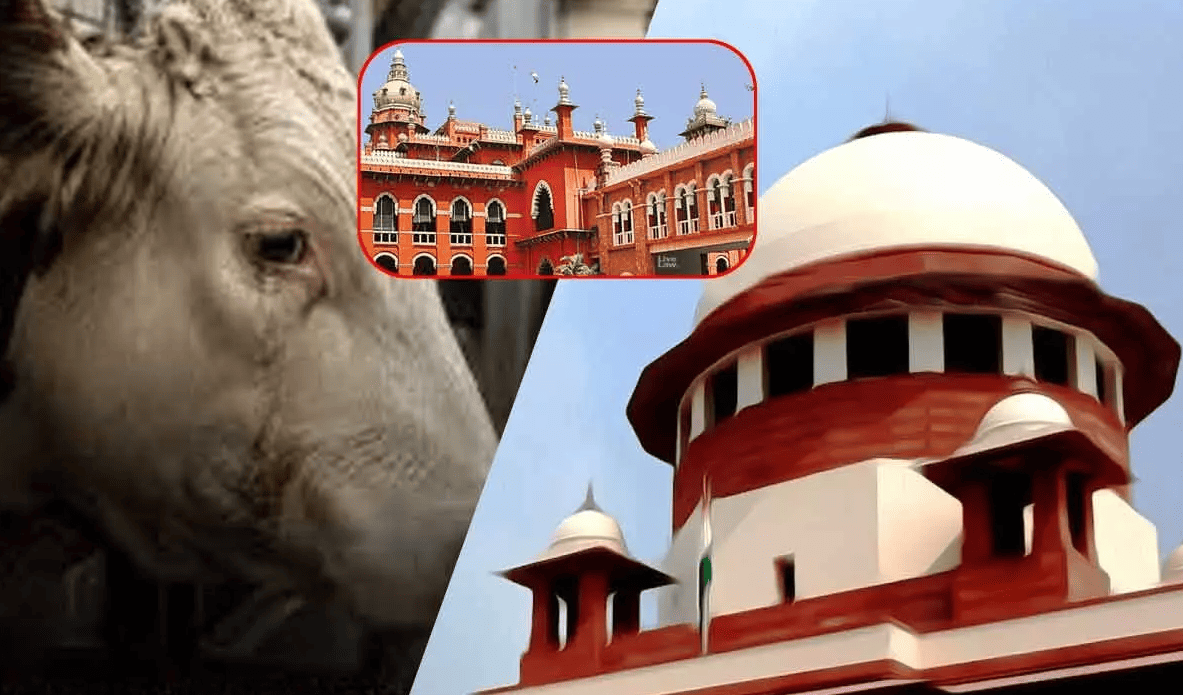
The Tamil Nadu government has moved the Supreme Court against a Madras High Court order that imposed a blanket ban on cow and calf slaughter across the state. The state's Special Leave Petition argues that the High Court's May 27 direction goes beyond what the Tamil Nadu Animal Preservation Act, 1958 permits, and effectively replaces statutory law with judicial legislation.
What the Madras High Court Ordered
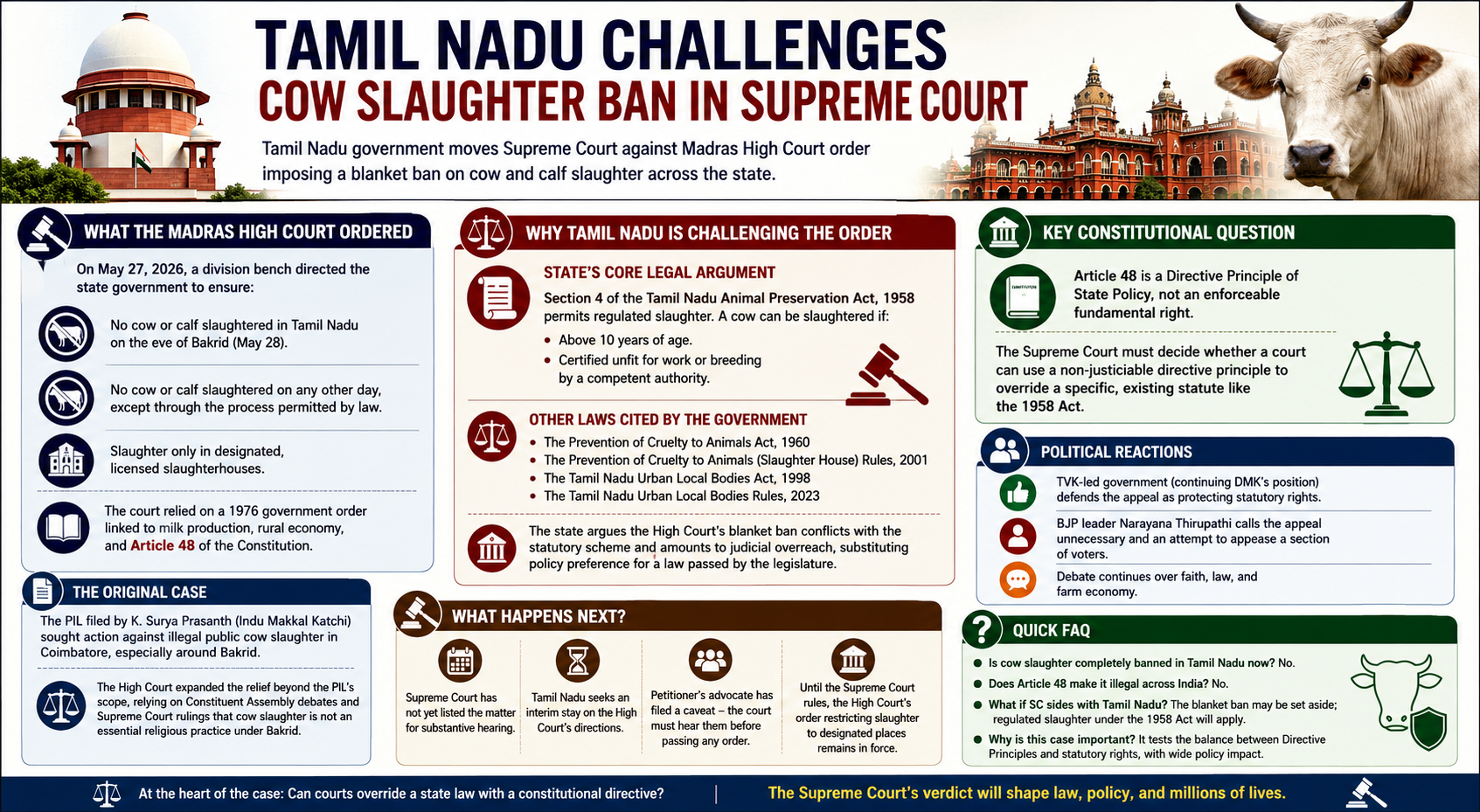
A division bench of Justice G.R. Swaminathan and Justice V. Lakshminarayan passed the order on May 27, 2026, while hearing a public interest litigation(PIL) filed by K. Surya Prasanth, state general secretary of the Indu Makkal Katchi. The petition had sought action against alleged illegal cow slaughter in public places in Coimbatore.
The bench directed the Chief Secretary and the Director General of Police to ensure that:
- No cow or calf was slaughtered in Tamil Nadu on the eve of Bakrid, May 28.
- No cow or calf was slaughtered on any other day, except through the process permitted by law.
- Animal slaughter took place only in designated, licensed slaughterhouses.
The court relied on a 1976 government order that had linked a cow slaughter ban to milk production and rural economic interests. It also invoked Article 48 of the Constitution, which directs the state to take steps toward prohibiting the slaughter of cows, calves, and other milch and draught cattle.
Why Tamil Nadu Is Challenging the Order
The State's Core Legal Argument
The Tamil Nadu government contends that Section 4 of the Tamil Nadu Animal Preservation Act, 1958 already permits regulated slaughter. Under this provision, a cow can be slaughtered if it is:
- Above 10 years of age.
- Certified unfit for work or breeding by a competent authority.
The state's petition argues the High Court's blanket prohibition conflicts with this statutory scheme. It says the original PIL only sought to stop slaughter in public places during Bakrid, but the Division Bench expanded the scope to an absolute ban covering even licensed slaughterhouses, a relief the petitioner never asked for.
Other Laws Cited by the Government
Tamil Nadu's petition also points to a wider regulatory framework that governs, but does not prohibit, cow slaughter:
- The Prevention of Cruelty to Animals Act, 1960.
- The Prevention of Cruelty to Animals (Slaughter House) Rules, 2001.
- The Tamil Nadu Urban Local Bodies Act, 1998.
- The Tamil Nadu Urban Local Bodies Rules, 2023.
According to the state, these laws regulate the conditions of slaughter but stop short of a total prohibition, which is the crux of its objection to the High Court order.
The government has separately disputed the High Court's finding that police had admitted cows were being, or were likely to be, slaughtered in public places. It says the police counter affidavit had actually confirmed preventive steps were already in place.
The Original Case: How the PIL Reached This Point
The dispute traces back to a narrow request: stopping unlicensed, public cow slaughter around Bakrid in Coimbatore. The High Court's final order, however, was not confined to that ask. It cited Constituent Assembly debates on the cultural and religious significance of the cow, along with earlier Supreme Court rulings holding that cow slaughter is not an essential religious practice tied to Bakrid.
Advocate P.V. Yogeswaran, representing the original petitioner, has filed a caveat in the Supreme Court, meaning the court must hear him before passing any order in the matter.
Key Constitutional Question: Directive Principles vs Statutory Rights
Article 48 is a Directive Principle of State Policy, not an enforceable fundamental right. The central legal question before the Supreme Court is whether a court can use a non-justiciable directive principle to override a specific, existing statute like the 1958 Act. Tamil Nadu's petition frames this as judicial overreach: a court substituting its own policy preference for a law passed by the legislature.
This is not a new tension in Indian constitutional law. Courts have previously balanced Article 48 against state Animal Preservation Acts in several states, generally upholding regulated slaughter provisions rather than absolute bans, provided the state law already addresses the subject.
Political Reactions
The TVK-led state government's appeal continues a position earlier held by the DMK administration on this issue. The move has drawn criticism from the opposition. BJP leader Narayana Thirupathi called the appeal unnecessary and described it as an attempt to please a section of voters, arguing the High Court order was clear and should stand.
What Happens Next
The Supreme Court has not yet listed the matter for a substantive hearing. Tamil Nadu has sought an interim stay on the High Court's directions while the appeal is pending. Until the top court rules, the Madras High Court's order restricting slaughter to designated places remains the operative direction on the ground.




Comments (0)
Leave a Comment
No comments yet
Be the first to comment