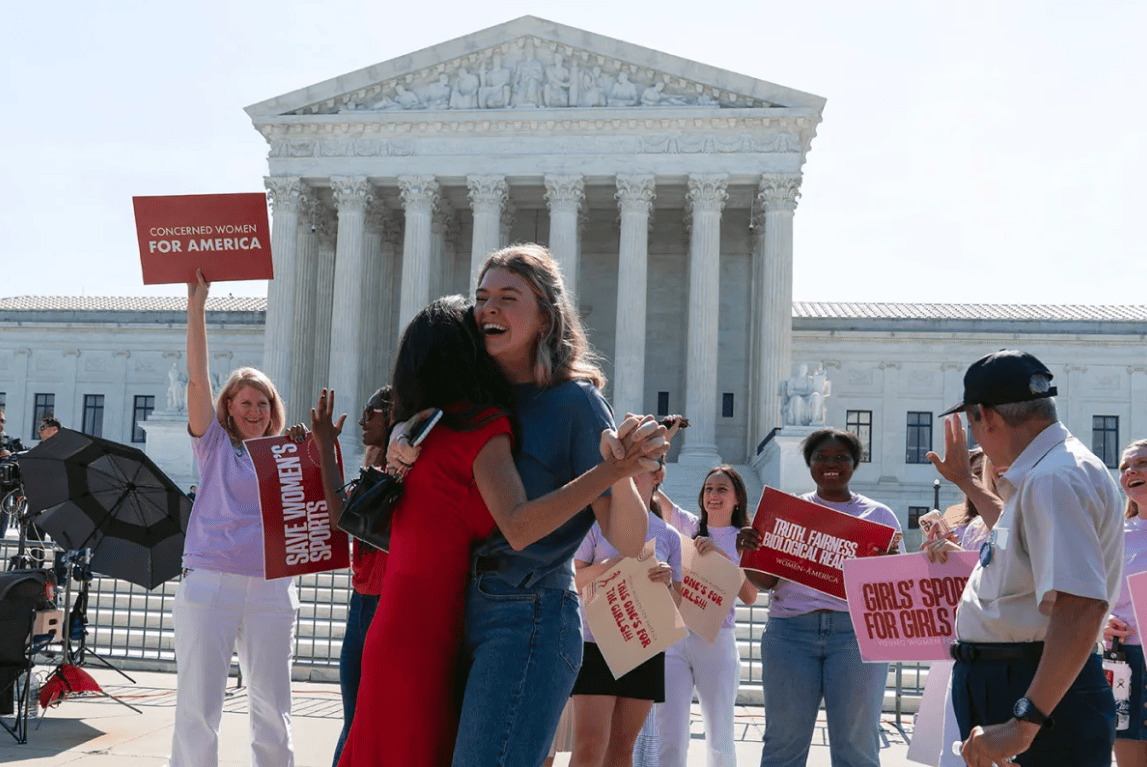
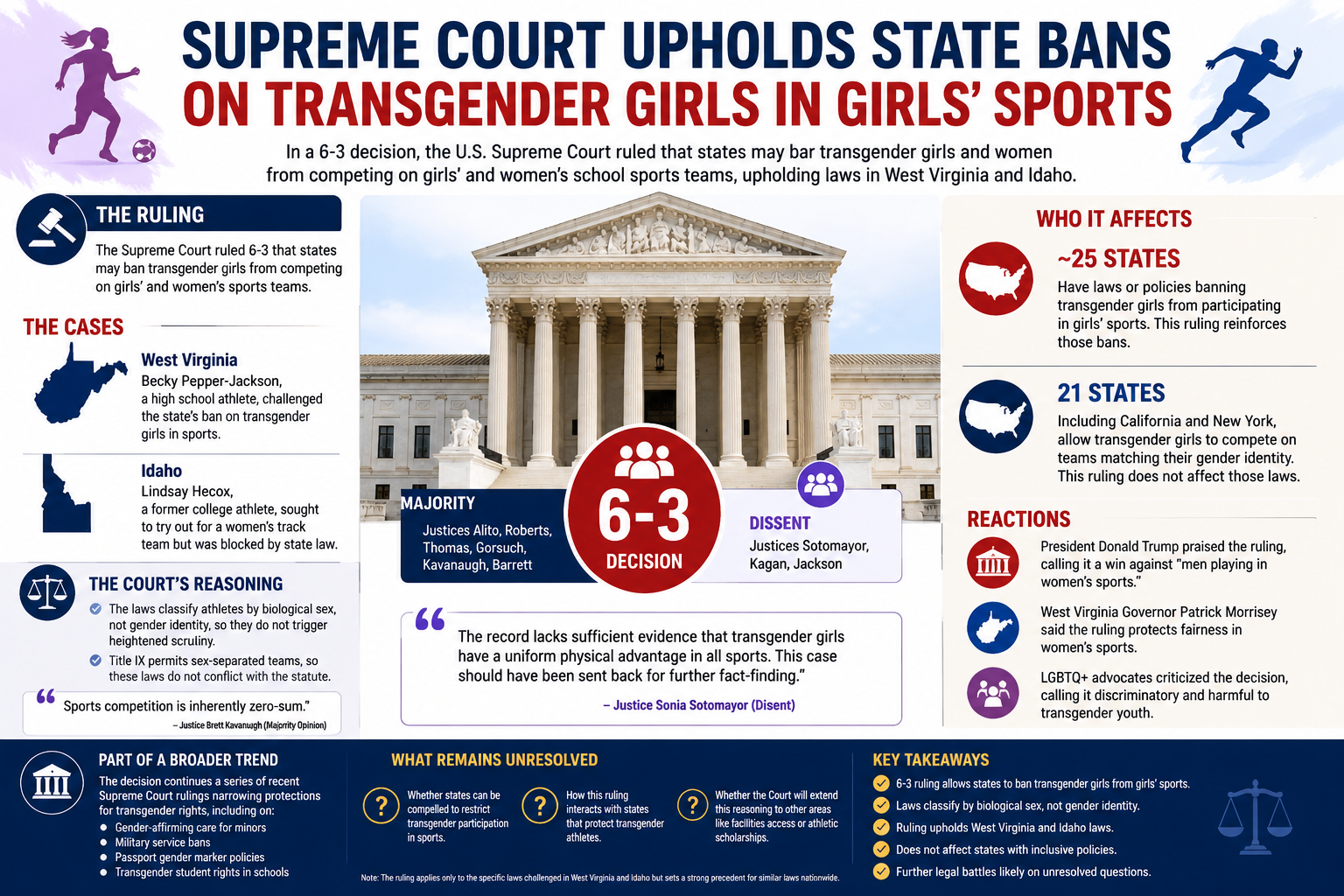
WASHINGTON — The Supreme Court ruled Tuesday that states may bar transgender girls and women from competing on girls' and women's sports teams, reversing lower court decisions that had struck down laws in West Virginia and Idaho. The 6-3 ruling, authored by Justice Brett Kavanaugh, rejected claims that the bans violate Title IX or the Constitution's Equal Protection Clause.
The decision resolves a question the court had avoided for years and is expected to reshape school athletics policy in dozens of states.
What the Court Decided
The cases involved Becky Pepper-Jackson, a West Virginia teenager who competes in shot put, discus and cross-country, and Lindsay Hecox, a former Idaho college student who sought to try out for a women's track team. Both had won earlier rulings from federal appeals courts finding the state bans unconstitutional or in conflict with Title IX.
The majority reversed those rulings on two grounds:
- The laws classify athletes by biological sex, not gender identity, so they do not trigger heightened scrutiny under the Equal Protection Clause the way a policy targeting transgender status directly would.
- Title IX itself permits sex-separated athletic teams, meaning a law that keeps those teams organized by biological sex does not conflict with the statute's purpose.
Kavanaugh wrote that sports competition is inherently zero-sum, meaning that allowing one additional athlete onto a roster necessarily displaces another. He also stated that transgender athletes deserve respect and should not be "ostracized or vilified," while maintaining that the Constitution does not require states to open girls' teams to transgender competitors.
The Dissent
Justice Sonia Sotomayor, joined by the court's two other liberal justices, dissented from the equal protection portion of the ruling. She argued that the record lacked sufficient evidence to establish that transgender girls hold a uniform physical advantage across every sport, and that Pepper-Jackson's case should have been returned to a lower court for further fact-finding rather than resolved outright.
Legal and Political Reach
The ruling technically applies only to the West Virginia and Idaho statutes at issue, but its reasoning is broad enough to support similar laws already in place in roughly 25 other states. Twenty-one states, including California and New York, currently allow transgender girls to compete on teams matching their gender identity, and the ruling does not disturb those policies for now.
Reactions split sharply along familiar lines:
- President Donald Trump praised the outcome on social media, calling it a win against "men playing in women's sports."
- West Virginia Governor Patrick Morrisey said the ruling reaffirmed that women's sports exist to give female athletes a fair chance to compete.
- LGBTQ advocacy groups criticized the decision, arguing it excludes transgender youth from ordinary school activities under the banner of fairness.
Where This Fits in the Court's Recent Record
A Pattern of Rulings on Transgender Rights
Tuesday's decision extends a string of rulings from the same six-justice majority. Last year, the court upheld a Tennessee law barring certain gender-affirming medical treatments for minors. In separate cases, the justices allowed Trump administration policies barring transgender individuals from military service and from listing their gender identity on passports. Earlier this year, the court also sided with parents objecting to California policies related to transgender students.
What Remains Unresolved
The opinion leaves open several questions that are likely to reach the court again:
- Whether states can be compelled, rather than merely permitted, to restrict transgender participation in sports.
- How the ruling interacts with states that have laws explicitly protecting transgender athletes' participation.
- Whether similar equal protection reasoning will extend to other areas, such as facilities access or eligibility for scholarships tied to athletic teams.
For now, the ruling gives state legislatures clear constitutional footing to enact or keep sex-based eligibility rules, while leaving states that choose inclusion largely untouched.



Comments (0)
Leave a Comment
No comments yet
Be the first to comment