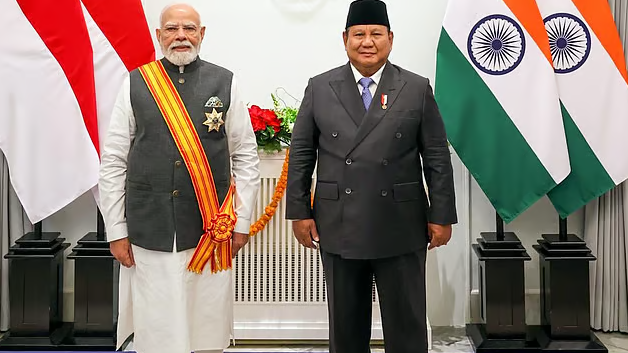
Prime Minister Narendra Modi was conferred the Bintang Adipurna of the Republic of Indonesia, the country's highest civilian and military honour, by President Prabowo Subianto on Tuesday, July 7, 2026, at the Istana Merdeka presidential palace in Jakarta. The ceremony marked a defining moment in India-Indonesia relations and underscored the expanding strategic partnership between the two Indo-Pacific democracies.
Modi received the honour during a three-day visit to Indonesia, the first stop of a broader tour that also includes Australia and New Zealand. He becomes only the second Indian prime minister to receive the award after Jawaharlal Nehru, who was honoured in 1995 during Indonesia's fiftieth Independence anniversary.
What Is the Bintang Adipurna Award
The Bintang Adipurna, or Medal of Honour, was instituted in 1959 as the top class of the Bintang Republik Indonesia order. The President of Indonesia serves as its grandmaster for the duration of their tenure, and the award is reserved for individuals who have rendered exceptional service toward the unity, continuity, and prosperity of the republic.
A Rare Distinction for Foreign Leaders
The honour is periodically extended to foreign heads of state who play a pivotal role in strengthening bilateral ties. Past Indonesian presidents, including Joko Widodo, Sukarno, and Suharto, are also recipients, since the award transfers automatically with the presidency.
Key facts about the award include:
- Established in 1959 as Indonesia's highest civilian and military distinction.
- Awarded to Modi in recognition of his role in deepening India-Indonesia relations.
- Previously given to only one other Indian leader, Jawaharlal Nehru, in 1995.
- Forms part of a broader pattern of international recognition for Modi, marking his 33rd such honour.
Modi's Response and the India-Indonesia Partnership
Speaking at a joint press conference with President Prabowo, Modi dedicated the award to the people of India, describing it as a reflection of the historic and civilisational bonds between the two nations. He thanked Prabowo and the Indonesian government for the gesture and called it a marker of trust built over decades of diplomatic engagement.
The two leaders used the visit to elevate the India-Indonesia Comprehensive Strategic Partnership, announcing a series of agreements spanning defence, maritime security, critical minerals, technology, healthcare, and education. Among the most significant outcomes was progress on BrahMos missile cooperation and India's role in developing Indonesian defence platforms, signalling deeper trust in sensitive strategic domains.
Strategic Significance for the Indo-Pacific
Analysts note that the timing and substance of the visit reflect New Delhi's push to strengthen ties with Southeast Asian partners amid shifting regional dynamics. Modi described the moment as the beginning of a "golden new chapter" in bilateral relations, linking it to broader ambitions such as Indonesia's "Indonesia Emas" vision and India's own development goals.
The visit also touched on regional and global issues. Modi reiterated India's support for a two-state solution on Palestine and stressed the growing importance of dialogue and diplomacy amid global turbulence.
A Pattern of Global Recognition
The Bintang Adipurna adds to a long list of honours Modi has received internationally. Earlier in 2026, he received the Royal Order of the Polar Star from Sweden, and Seychelles named him "Guardian of the Blue Horizon" the previous month. Between June 2024 and July 2025 alone, he received at least 13 international honours, including four during a multi-nation tour covering Ghana, Trinidad and Tobago, Brazil, and Namibia.
Countries that have previously honoured Modi include the United States, Russia, Saudi Arabia, Egypt, Bhutan, Fiji, Palau, and France, among others. Observers see this pattern as reflective of India's expanding diplomatic footprint and its growing role in shaping regional and global partnerships.



Comments (0)
Leave a Comment
No comments yet
Be the first to comment