What Is Operation Urja Suraksha?
Operation Urja Suraksha is the Indian Navy's dedicated mission launched in March 2026 to protect India-bound energy shipments as they transit the Strait of Hormuz and the Gulf of Oman, amid Iran's effective blockade of the waterway following the Iran-Israel-US conflict.
The name Urja Suraksha means Energy Security, and the mission is built precisely around that objective: to maintain continuous supply of oil, LNG, and LPG to India via high-risk waterborne routes.
The operation is being conducted with calibrated precision and minimal publicity to ensure the uninterrupted and secure movement of Indian-flagged vessels carrying critical energy supplies.
The stakes are direct and tangible. The Strait of Hormuz carries roughly 85 percent of the oil and gas destined for Asian countries. India is one of the world's largest consumers of LPG, with hundreds of millions of households depending on it for daily cooking. A sustained disruption to this corridor does not stay an abstract geopolitical problem for long. It becomes a cooking gas shortage, a fuel price spike, and an industrial input crisis within weeks.
What Exactly Are Indian Navy Warships Doing?
This is not a conventional naval escort mission and that distinction matters analytically.
Naval personnel are not merely accompanying tankers. They are guiding them, step by step, through one of the world's most sensitive maritime passages.
The Navy's role is more hands-on. Officials said naval teams remain in continuous communication with ships preparing to exit the Persian Gulf, offering route-specific instructions to help them navigate safely through the narrow passage.
US intelligence agencies have alleged that Iran has deployed underwater mines in and around the Strait of Hormuz, invisible, deadly, and capable of sinking a fully loaded tanker without warning. To navigate safely, Indian naval personnel are providing real-time route guidance, using hydrographic charts of the ocean floor to identify the safest possible corridors, and maintaining constant communication with each vessel throughout the transit.
Once a vessel clears the Strait with Iranian approval, Indian Navy destroyers and frigates take over, escorting it through the Gulf of Oman under a layered security arrangement, all the way to safer waters in the northern Arabian Sea. Defence Minister Rajnath Singh has reviewed the security situation and the Navy is working in close coordination with the Ministry of Ports, Shipping and Waterways and the Directorate of Naval Operations throughout.
Ships Escorted So Far: The Numbers
The operation has already produced measurable results.
LPG carriers Shivalik and Nanda Devi were among the first vessels guided out, carrying a combined 92,700 metric tonnes of LPG from Ras Laffan Industrial City, Qatar. Shivalik alone carried approximately 32.4 lakh standard 14.2 kg domestic cylinders, meeting one full day of India's LPG net import needs.
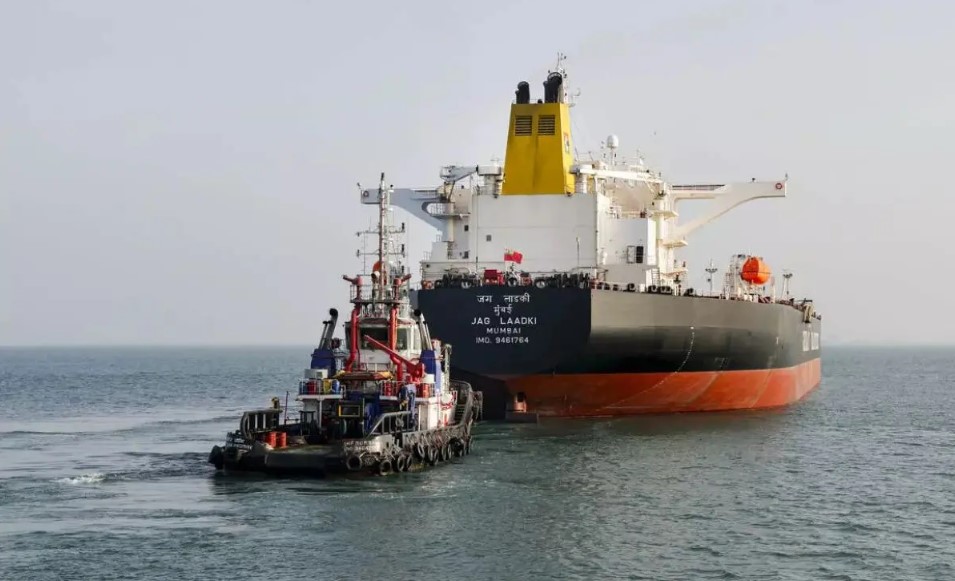
Two additional vessels, LPG carriers Pine Gas and Jag Vasant carrying approximately 92,000 tonnes of LPG, were due to reach Indian ports on March 26 and 27. Crude oil tanker Jag Laadki was also escorted out of the Persian Gulf in the earlier phase of the operation.
Six more LPG tankers with a combined three lakh tonnes of LPG remain in the region. As of March 19, the Indian Navy's presence in the region was being expanded from three warships to six or seven, including logistics ships.
The Diplomatic Dimension: How India Got Iran's Permission
Operationally, Operation Urja Suraksha would not be possible without a prior diplomatic breakthrough.
On March 12, Prime Minister Narendra Modi spoke directly with Iranian President Dr. Masoud Pezeshkian. Modi made India's position clear: the safety of Indian nationals and the unhindered movement of goods and energy resources are India's top priorities. That conversation appears to have resulted in a quiet understanding. Iran would allow Indian-flagged vessels to pass through the Strait, subject to verification within Iranian waters.
Senior risk analyst Martin Kelly of EOS Risk Group confirmed that Iran is permitting certain vessels to transit the Strait only after they undergo verification while still within Iranian waters. This means Indian ships must pass an Iranian inspection inside the Strait before the Indian Navy can take over escort duties on the other side.
India is walking a careful line, protecting its energy interests without joining any US-led military coalition against Iran, and without publicly antagonising Tehran, whose cooperation is operationally essential.
Operation Urja Suraksha vs Operation Sankalp: Key Differences
Operation Sankalp was launched on June 19, 2019, primarily to guarantee the safe transit of Indian-flagged vessels passing through the Strait of Hormuz amidst escalating security concerns in the area at that time. The word Sankalp means Commitment in Sanskrit.
Both operations share the same geography and the same core objective of protecting Indian shipping through the Strait. But they are fundamentally different in almost every other dimension.
Threat environment: In 2019, the primary concern under Operation Sankalp was surface-level threats, tanker attacks by unidentified actors, and rising US-Iran tensions. There were no reports of underwater mines. In 2026 under Operation Urja Suraksha, the threat has escalated dramatically. US intelligence has alleged Iranian mine deployment, making every transit a navigation challenge requiring hydrographic expertise, not just a security escort.
Operational scale: Operation Sankalp was conducted with a modest naval presence and a broader mandate covering general maritime domain awareness across the Indian Ocean Region. Operation Urja Suraksha is a named, focused, high-priority mission with over five frontline warships concentrated specifically at the Strait and Gulf of Oman corridor.
Nature of escort: Under Operation Sankalp, naval vessels primarily provided a visible security presence and responded to distress situations. Under Operation Urja Suraksha, the Navy is providing active navigational guidance, sharing hydrographic chart data, and maintaining continuous vessel communication, a significantly more hands-on and technically demanding role.
Diplomatic prerequisite: Operation Sankalp operated in a tense but not fully blockaded environment. Operation Urja Suraksha required a direct head-of-state conversation with Tehran before a single ship could safely exit the Strait. The diplomatic groundwork is now a prerequisite to the operational one.
Energy specificity: Operation Urja Suraksha is explicitly scoped around energy carriers, with all 22 identified vessels carrying LNG, LPG, or crude oil. Operation Sankalp covered broader commercial shipping interests.
Why This Operation Matters Beyond the Immediate Crisis
The establishment of Operation Urja Suraksha has policy implications that extend beyond the current Iran conflict.
There is initial evidence to suggest that the Urja Suraksha escort-pattern model can be codified into the standing procedures of subsequent maritime security operations, particularly during periods of regional unrest or during periods of increased piracy.
India imports approximately 85 percent of its crude oil and is the world's third-largest energy consumer. Its energy supply chains run almost entirely through a single chokepoint, the Strait of Hormuz, making any disruption there a national security event, not merely a market one. The Navy's ability to combine diplomatic clearance, hydrographic guidance, layered warship escort, and inter-ministerial coordination in a single coherent operation represents a meaningful evolution in India's blue-water maritime capability.
Conclusion: Operation Urja Suraksha Signals India's Strategic Maturity
Operation Urja Suraksha is the Indian Navy's most consequential maritime security operation in years. It is not a combat mission. It is a precisely calibrated blend of diplomacy, navigational expertise, and naval deterrence, designed to keep 600 Indian seafarers safe and hundreds of millions of Indian households supplied with cooking gas while the region around them is at war.
Its contrast with Operation Sankalp is instructive. Seven years and a dramatically escalated threat environment later, India has responded not with military aggression or alliance-joining, but with a more sophisticated, more capable, and more diplomatically nuanced version of exactly the kind of independent strategic action it took in 2019.
The Strait of Hormuz remains open for India's tankers. That outcome, at this moment, is the result of Operation Urja Suraksha.



Comments (0)
Leave a Comment
No comments yet
Be the first to comment