What Is the NITI Aayog 11th Governing Council Meeting and Why Does It Matter?
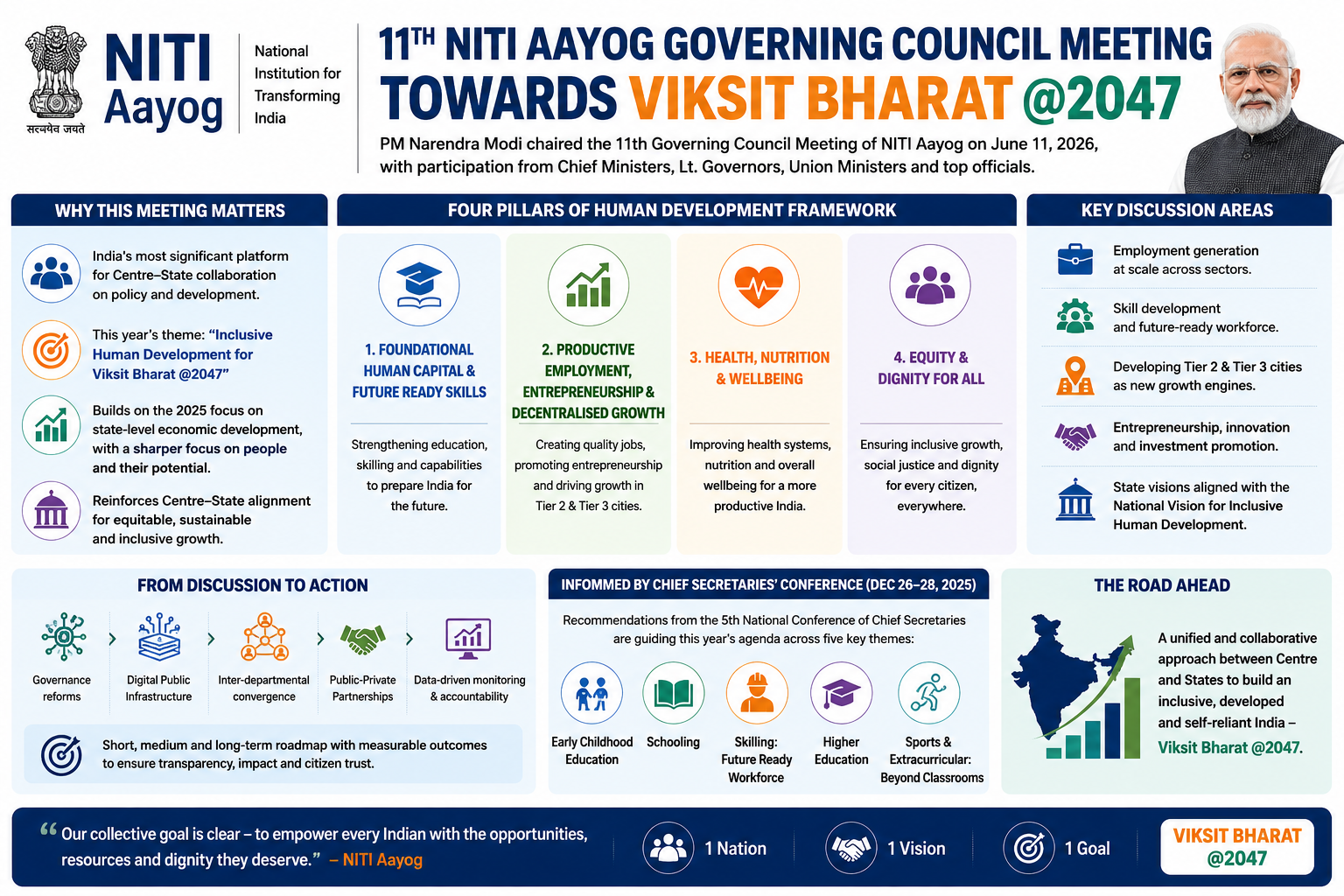
Prime Minister Narendra Modi chaired the 11th Governing Council Meeting of NITI Aayog on June 11, 2026, at the Rashtrapati Bhavan Cultural Centre in New Delhi. This isn't a routine government calendar event. It is arguably the most consequential annual policy convergence that India holds the room where Chief Ministers, Lieutenant Governors, Union Ministers, and top NITI Aayog leadership sit together and, at least in principle, commit to a shared direction.
This year's theme is "Inclusive Human Development for Viksit Bharat 2047," which emphasises the well being and development of all citizens regardless of age, region, gender, or socio economic background. That framing is deliberately broader than previous years. The 10th meeting in May 2025 focused on state level economic development; this one is anchored explicitly in people their skills, their health, their dignity, their economic participation.
For anyone tracking India's policy trajectory from the outside investors, educators, workforce development organisations, content publishers covering the Indian economy the meeting sets the tone for Centre state coordination through at least the next 12 months.
Why the 2026 meeting marks a pivot from 2025
The Governing Council will also address the recommendations of the 5th National Conference of Chief Secretaries held from December 26 to 28, 2025, covering five key themes: Early Childhood Education, Schooling, Skilling: Future Ready Workforce, Higher Education, and Sports and Extracurricular: Beyond Classrooms. The fact that a December 2025 chief secretaries' conference is feeding directly into a June 2026 governing council agenda is itself notable it signals a more continuous policy pipeline than the episodic approach India's federal governance has sometimes been accused of.
What Are the Four Pillars Driving India's Human Development Framework?
The meeting's discussions are structured around four core pillars: Foundational Human Capital and Future Ready Skills; Productive Employment, Entrepreneurship and Decentralised Growth; Health, Nutrition and Wellbeing; and Equity and Dignity for All. Each pillar represents a distinct policy domain, but they are deliberately interconnected. A child who misses foundational education becomes a young adult who cannot access skilled employment; a worker without health coverage becomes a fiscal burden on a system that can least afford it.
The first two pillars skills and employment are where the heaviest policy action is expected, and they are the ones with the most direct bearing on India's demographic dividend debate.
Skills: from training volumes to employment outcomes
India's skilling ecosystem has a well documented mismatch problem. Over the last decade, Skill India and its predecessor programmes trained tens of millions of workers. Placement rates have been the persistent weak point. The Governing Council is examining measures to foster entrepreneurship, strengthen skill development initiatives, and generate sustainable employment opportunities at scale across the country. The emphasis on "at scale" is doing real work in that sentence. Incremental improvements to existing ITIs and vocational centres won't move the needle on a labour force of this size. The meeting is being asked to think in systems, not schemes.
Decentralised growth: getting jobs outside the metros
The discussions place particular emphasis on developing Tier 2 and Tier 3 cities as new growth engines, including infrastructure development, skill training, and policy support to attract investments to these emerging urban centres. This is worth dwelling on. The concentration of formal employment in a handful of metros is a structural problem India has been aware of for at least two decades. Whether the 2026 framework translates into genuine fiscal and regulatory incentives for smaller cities or remains a set of aspirational targets will be the test.
How Will the Government Actually Implement These Commitments?
This is the question that every serious observer of Indian policy reform asks, and it deserves a direct answer rather than the usual policy speak.
A key focus is on mapping out an implementation roadmap that harnesses critical enablers, including governance reforms, digital public infrastructure, inter departmental convergence, public private partnerships, and data driven monitoring systems, to ensure both short term and long term outcomes are tracked with accountability and measurable impact. The inclusion of Digital Public Infrastructure as an explicit enabler is significant. India's DPI stack Aadhaar, UPI, DigiLocker has already demonstrated that technology driven delivery can bypass traditional bureaucratic bottlenecks. Extending that logic to skilling delivery, employment verification, and social benefit distribution has real potential.
The role of state Centre alignment
A key thrust will be on aligning State Visions with the National Vision on Inclusive Human Development, reinforcing a unified and collaborative approach toward equitable and sustainable growth. In practice, this means asking states to map their own skill and employment targets against the national framework and then be held accountable to both. That's a harder ask than it sounds in a federation where states guard their policy autonomy closely and where electoral cycles don't always align with five year planning horizons.
I've tracked Centre state convergence exercises across three previous governing council cycles. The pattern is consistent: momentum is highest in the six months following the meeting, then slows as state budgetary pressures and local political priorities reassert themselves. The 2026 framework's explicit short, medium, and long term tracking mechanism is the most concrete attempt yet to break that cycle.
What Digital Public Infrastructure means for workforce development
The UPI analogy is instructive but imperfect. Financial transactions are discrete, verifiable events; skill acquisition and employment outcomes are diffuse, contested, and hard to attribute. Building a DPI layer for workforce development means solving identity verification for informal workers, creating portable credential systems that employers actually accept, and designing data pipelines that don't exclude the workers most in need of support those without smartphones, stable addresses, or formal employment histories.
Which States Are Attending and What Are They Pushing For?
Newly sworn in Chief Ministers DK Shivakumar and C Joseph Vijay, along with Telangana Chief Minister Revanth Reddy, Andhra Pradesh Chief Minister Chandrababu Naidu, and other NDA chief ministers, are in attendance. The political diversity in the room is real. Tamil Nadu's Chief Minister Vijay represents a state that just won a landslide Assembly election in May 2026 and is arriving with specific demands pushing for bigger financial support from the Centre for the state's infrastructure and welfare programmes.
That tension between states that want greater fiscal autonomy and a Centre seeking a unified national framework runs through every governing council meeting. It isn't a dysfunction; it's federalism working as designed. But it does mean that the "Team India" rhetoric in NITI Aayog's communications should be read as aspiration, not description.
The MSME and informal employment question
Recognising that micro, small, and medium enterprises form the backbone of India's economy, the meeting is addressing rural non-farm employment opportunities and urban informal sector challenges, with Chief Ministers expected to share state specific initiatives and best practices for supporting MSMEs. MSMEs employ roughly 110 million people in India. They are also the segment most exposed to formalisation pressures from GST compliance, credit access constraints, and the loss of informal labour protections. Any skill and employment strategy that doesn't centre MSME health will struggle to show results at the population level.
What Do Experts Say About India's Skill to Employment Gap?
India's workforce challenge has been examined in detail by development economists and labour market researchers. Mahesh Vyas, CEO of the Centre for Monitoring Indian Economy (CMIE), has consistently highlighted that India's labour force participation rate particularly for women remains one of the lowest among comparable emerging economies, hovering around 40% in recent years. Raising it by even five percentage points would add tens of millions of workers to the formal economy, but only if jobs exist to absorb them.
Economist Pronab Sen, former Chief Statistician of India, has argued in multiple public forums that the quality of employment not just the quantity is what determines whether skilling investments translate into poverty reduction. A certificate from an ITI that leads to a contractual, minimum wage job with no social protection is a different outcome than a certificate that opens a pathway to a career. The 2026 framework's emphasis on "sustainable employment opportunities" is aligned with Sen's framing, but the implementation machinery will determine whether sustainability means anything in practice.


Comments (0)
Leave a Comment
No comments yet
Be the first to comment