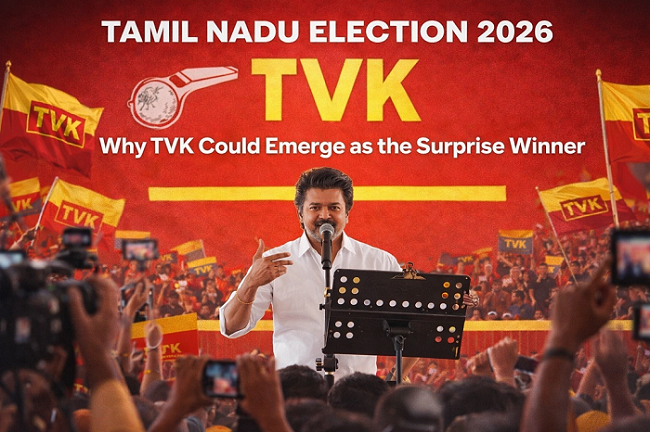
Tamil Nadu's 2026 assembly election arrives at a moment when the state's five-decade Dravidian duopoly faces the most credible structural challenge it has ever encountered. The emergence of TVK , Tamilaga Vettri Kazhagam led by actor-turned-politician Vijay introduces a variable that traditional parties cannot model out of their calculations.
Tamil Nadu's 2026 assembly election arrives at a moment when the state's five-decade Dravidian duopoly alternating power between the DMK and the AIADMK faces the most credible structural challenge it has ever encountered. The emergence of TVK, Tamilaga Vettri Kazhagam, led by actor-turned-politician Vijay, has introduced a variable that the traditional parties' campaign managers cannot simply model out of their calculations. Whether TVK converts grassroots energy into a governing majority is an open question. That it will materially reshape the vote-share arithmetic is not.
The Political Landscape: Fatigue Setting the Stage
DMK, under Chief Minister M.K. Stalin, won the 2021 elections on the back of strong anti-incumbency against the late Edappadi K. Palaniswami's AIADMK government. That mandate was decisive 133 seats in a 234-seat house. Five years later, however, any ruling party faces the compounding weight of expectations unmet. Tamil Nadu's unemployment rate among youth remains stubbornly elevated. While the government's welfare transfer infrastructure has expanded, the narrative has quietly shifted from what has been given to what has not been built. Jobs, not freebies, have become the aspirational benchmark of the young voter.
AIADMK, meanwhile, has failed to resolve its fundamental post-Jayalalithaa identity crisis. The party's leadership has oscillated between centralisation and internal fracture. With O. Panneerselvam's faction effectively neutralised and the Palaniswami leadership unable to project a unifying vision, the party enters 2026 as an apparatus in search of a constituency, not a movement in search of power.
This vacuum is TVK's founding political opportunity. Vijay's party is not competing in a crowded field it is walking into a space that the two principal parties have progressively abandoned: aspirational politics aimed at working-age Tamilians who feel left behind by both governance and opposition.
"The 2026 Tamil Nadu election may be remembered not for who won, but for when the Dravidian binary finally cracked."
Survey Trends and the Voter Mood
Formal pre-election polling in Tamil Nadu, as in most Indian states, suffers from the silent-voter problem. Large segments of the electorate particularly first-generation urban migrants, women in semi-urban households, and youth disengaged from traditional patronage networks either refuse to answer surveys or provide socially expected responses that don't reflect actual ballot intent.
What we can read from trend-based analysis: youth voter registration has increased sharply in Tamil Nadu, with the 18–25 demographic registering in numbers unseen in prior cycles. First-time voter blocs in constituencies spanning Coimbatore, Salem, Madurai, and Chennai's peripheral zones show engagement patterns that correlate with political novelty-seeking. Where TVK has held public meetings, localised social media engagement has produced amplified attendance signals crowd sizes that have surprised even neutral observers.
Anti-incumbency polling, which is typically more reliable than preference polling, consistently shows urban Tamil Nadu's satisfaction with governance at below-50 levels on key metrics: road conditions, job availability, bureaucratic responsiveness, and infrastructure delivery speed. Rural Tamil Nadu shows higher satisfaction with welfare transfers but remains genuinely persuadable on economic aspiration grounds. This divergence creates a multi-front opportunity.
TVK's Structural Advantages
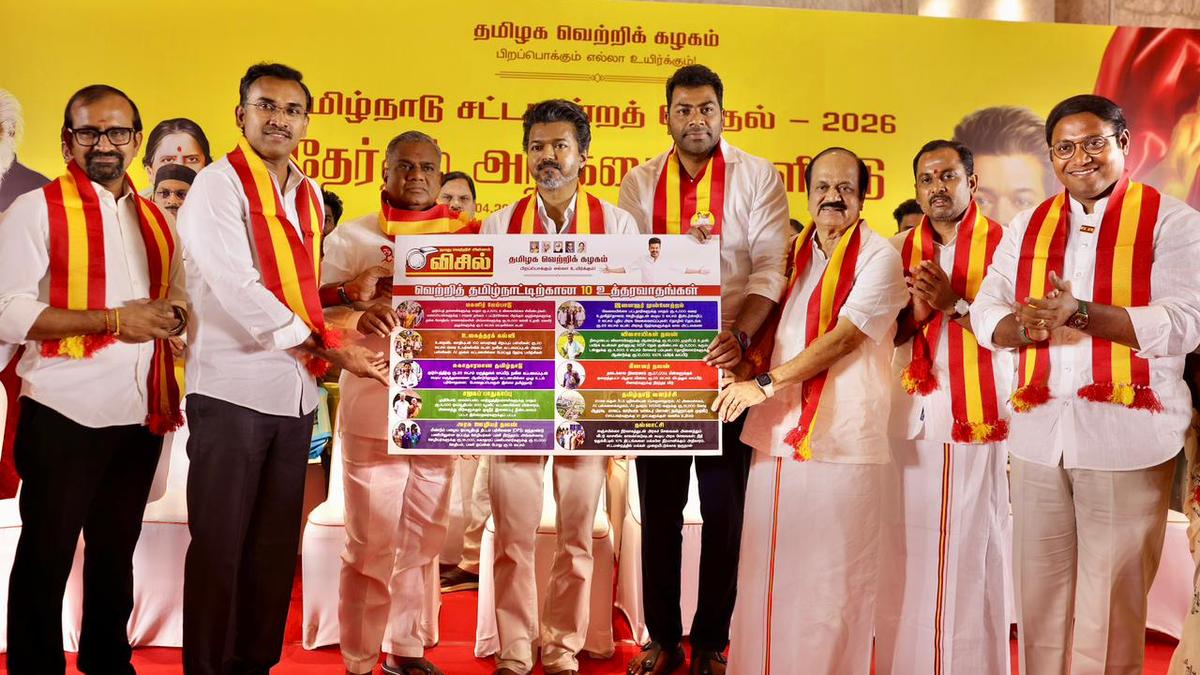
Three structural advantages distinguish TVK from conventional challenger parties. The first is celebrity mobilisation. Vijay's fanbase in Tamil Nadu does not operate like a conventional political constituency. Fan clubs (rasigar manrams) have historically functioned as parallel social organisations with genuine ground penetration they handle community events, festivals, and local dispute mediation. Converting this into electoral infrastructure requires only a reorientation of purpose, not construction from scratch.
The second is cross-caste appeal. Both DMK and AIADMK have become increasingly legible to specific caste blocs their support bases predictable and geographically concentrated. TVK, precisely because Vijay's cinematic persona cuts across caste lines, has the potential to attract voters who feel their identity is not served by either legacy party. This is not guaranteed caste-based voting in Tamil Nadu remains powerful but the potential for a caste-agnostic appeal exists at a scale that newer parties rarely possess.
The third is digital-first mobilisation. Tamil Nadu has one of India's highest smartphone penetration rates. TVK's capacity to run hyperlocal campaigns via WhatsApp networks, YouTube channels, and Instagram reels gives it an asymmetric advantage over DMK and AIADMK, whose digital infrastructure is less organically integrated with their ground operations.
Weaknesses of Traditional Parties
DMK's challenge is structural, not superficial. Five years of governance have created accountability points. The promised job creation numbers have not matched stated targets. Urban middle-class voters in Chennai report dissatisfaction with infrastructure maintenance. The party's internal dynastic structure despite Stalin's genuine administrative competence has limited the upward mobility of younger, lower-caste cadres, creating a simmering organisational resentment.
AIADMK's challenge is existential. The party has not resolved who its voter is in a post-Jayalalithaa world. Her personality was irreplaceable as a political force her welfare schemes carried her name, her rallies were events of mass theatre, and her administrative style inspired genuine fear and loyalty simultaneously. No current AIADMK leader replicates even one of these dimensions. The party enters 2026 relying on legacy loyalty, which is powerful but finite.
Regional Battleground Analysis
- Northern Districts (Vellore, Tiruvannamalai, Ranipet)~28 seatsCompetitive
- Western Belt (Coimbatore, Erode, Salem, Tiruppur)~42 seatsTVK Opportunity Zone
- Southern Districts (Madurai, Tirunelveli, Tenkasi, Thoothukudi)~44 seatsThree-way contest likely
- Chennai Urban Region (Chennai, Kancheepuram, Tiruvallur)~45 seatsHigh anti-incumbency, TVK upside
- Delta Region (Thanjavur, Tiruvarur, Nagapattinam)~20 seatsDMK stronghold, limited penetration
The Western belt industrialising rapidly, home to a large migrant worker population and a significant youth bulge is the most likely region where TVK can convert enthusiasm into seats. Coimbatore's urban professional class and Tiruppur's textile worker communities are both underserved by the current party structures. Three-corner contests here, where TVK draws from both DMK and AIADMK vote shares without consolidating against either, could produce surprising first-past-the-post wins on margins as narrow as 8–12%.
Youth and First-Time Voters: The Decisive Variable
Tamil Nadu has approximately 6.2 million voters in the 18–25 age bracket, a number that has grown significantly due to recent registration drives. This cohort has no memory of Jayalalithaa's dominance, no lived experience of DMK's pre-2006 era, and no emotional debt to either party's founding ideologies. They are, as political strategists call them, "available voters" persuadable, turnout-dependent, and susceptible to narrative momentum.
Youth unemployment in Tamil Nadu particularly among degree-holders unable to find formal sector employment is a genuine policy failure that cuts across party lines. TVK has positioned itself around this exact grievance. The combination of Vijay's aspirational cultural persona and a jobs-first political narrative creates a resonant signal for this cohort. If TVK can convert 60% of new youth voter turnout in competitive constituencies, it materially changes seat outcomes in at least 35–40 battleground seats.
Campaign Strategy: Where Momentum Outweighs Legacy
DMK's campaign will be competence-led: governance deliverables, welfare transfer receipts, and a stability narrative. It is a campaign built for a voter who is satisfied and wants continuity. AIADMK's campaign will be identity-led: invoking Amma's legacy, mobilising community networks, and running a negative framing against DMK. TVK's campaign will be aspirational and insurgent: large crowd optics, digital amplification, and a media narrative of change.
Modern Indian elections, particularly since 2014 at the national level, have demonstrated that momentum-based narratives often outperform legacy-based ones. The voter who is uncertain and Tamil Nadu in 2026 will have an unusually high proportion of uncertain voters tends to resolve their uncertainty in favour of energy. TVK's campaign, if managed competently, will generate energy. The question is whether ground infrastructure can convert that energy into polling booth turnout in 117+ constituencies simultaneously.
The Silent Wave Theory
Political scientists studying Indian state elections have documented a recurring phenomenon: the "silent wave," where support for an outsider or challenger party is systematically under-detected in pre-election surveys. This happens for several reasons. Social desirability bias causes voters to report support for parties perceived as establishment-legitimate. Survey sampling tends to over-represent older, more politically engaged respondents, who skew toward legacy parties. And challenger party supporters, particularly celebrity-driven ones, are often less forthcoming with pollsters.
Examples abound in recent Indian electoral history the AAP wave in Delhi 2015 that polls underestimated, the YSRCP's landslide in Andhra Pradesh 2019 that exceeded all projections, and even regional upsets in Telangana. In each case, the challenger's support was real but underweighted. TVK's demographic base young, digitally active, first-time is precisely the segment most likely to be invisible to conventional survey instruments.
Seat Projection Scenarios
Scenario A
Conservative
25–40 seats
TVK contests credibly, establishes presence. DMK retains majority.
TVK becomes principal opposition in select zones.
Scenario B
Competitive
65–90 seats
Hung assembly. TVK holds balance of power.
Anti-incumbency consolidates behind TVK in Western and Chennai urban seats.
Scenario C
Breakthrough
110–130 seats
Silent wave materialises fully. Youth turnout spikes.
Three-corner contests split DMK-AIADMK share across 80+ seats. TVK forms government.
Scenario C is the least probable but not implausible. It requires: peak youth turnout (above 72%), effective candidate selection with clean local credibility, an absence of major coalition formation between DMK and AIADMK, and a sustained media narrative of momentum in the final three weeks of campaigning. If three to four of these conditions align simultaneously, the breakthrough becomes achievable rather than merely theoretical.
Risks That Could Prevent TVK Victory
Organisational depth remains TVK's most significant vulnerability. Converting fan-club enthusiasm into disciplined polling-booth management identifying voters, assigning booth-level agents, preventing vote suppression, and managing counting-day logistics requires institutional experience that TVK, as a young party, has not yet demonstrated at scale.
Candidate selection is the second risk. In Tamil Nadu's constituency-level politics, the local candidate's caste, community standing, and personal reputation often override party wave effects. TVK must field credible, locally acceptable candidates across 200+ constituencies. A significant proportion of poor candidate choices will cost seats regardless of how favourable the macro-political environment is.
Resource management and potential coalition arithmetic also matter. If the contest moves toward a hung assembly, DMK and AIADMK traditionally opposed may find common cause in preventing a TVK government. This scenario, while politically dramatic, is not historically unprecedented in Indian state politics.
Final Strategic Assessment
TVK's path to forming a government in Tamil Nadu in 2026 is narrow but structurally coherent. It does not require a political miracle it requires a specific confluence of conditions that the current political environment is, by measurable indicators, moving toward. Voter fatigue with both legacy parties is real. Youth political aspiration is real. The silent wave dynamic in celebrity-led political movements is historically demonstrated.
What is not yet real and what the next several months will determine is whether TVK has the organisational maturity to convert political opportunity into electoral arithmetic. The party's leadership will be tested not in its ability to fill grounds or trend on social media, but in its ability to run a technically competent, booth-level election operation across 234 constituencies simultaneously.
The honest strategic assessment: TVK is a credible contender, not a guaranteed winner. It has earned the right to be taken seriously as a governing possibility, which itself represents a significant shift from where it stood 18 months ago. Tamil Nadu's 2026 election will not simply reconfirm the Dravidian binary. Whether it breaks it entirely depends on choices that Vijay and his campaign strategists will make in the months ahead choices that no survey, however sophisticated, can yet model with confidence.


Comments (0)
Leave a Comment
No comments yet
Be the first to comment