
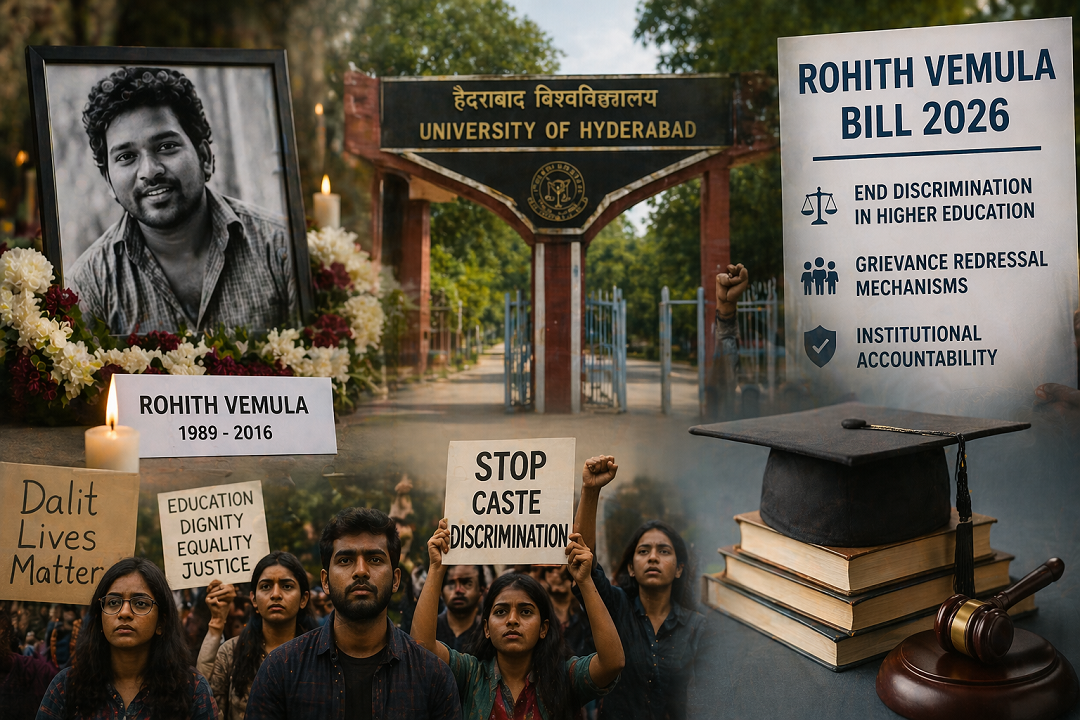
More than a decade after the death of Rohith Vemula shook the conscience of a nation, Telangana is preparing to turn grief and outrage into law. The state government has constituted a cabinet sub-committee to draft the Rohith Vemula Bill 2026, a proposed piece of legislation that could fundamentally alter how higher education institutions in India respond to caste-based and identity-based discrimination. If enacted, the bill would represent one of the most significant legal interventions in Indian campus life in recent memory.
A Name That Became a Movement
Rohith Vemula was a Dalit doctoral student at the University of Hyderabad who died by suicide in January 2016 after he and several other students were suspended over allegations that were widely disputed. His death was immediately politicised, but it also triggered a sustained national conversation about the systematic exclusion and social humiliation that students from marginalised communities face inside India's elite academic institutions.
In the years that followed, student-led movements demanded structural reform. Investigations pointed to discriminatory practices embedded in everything from scholarship disbursement to hostel allocations, from the composition of internal complaints committees to the casual prejudice that students from Scheduled Caste and Other Backward Class communities encountered in day-to-day academic life. The Rohith Vemula Bill 2026 is, in many ways, the legislative response to that decade of advocacy.
What the Cabinet Sub-Committee Is Tasked to Draft
The Telangana cabinet sub-committee is expected to produce a draft that defines identity-based discrimination in a legally precise manner, covering caste, religion, gender, sexuality, and tribal identity. Legal experts familiar with the process say the committee is looking at drawing from international frameworks, including aspects of anti-discrimination law practiced in the United Kingdom and South Africa, while adapting them to the Indian constitutional context.
Among the provisions being actively discussed is a formal grievance redress mechanism within universities. Under the proposed framework, every higher education institution receiving state funding would be required to establish an independent anti-discrimination cell staffed by officials with no direct departmental conflict of interest. Complaints would be required to be acknowledged within a specified time frame, and unresolved cases would escalate to a state-level appellate authority.
Institutional accountability is another pillar of the draft framework. Universities could face penalties, including suspension of government grants, if they are found to have repeatedly failed to address discrimination complaints. Senior administrative officials could be held personally liable in egregious cases of institutional negligence.
The Legal Gap the Bill Seeks to Fill
India's existing legal framework does address caste discrimination in various forms. The Scheduled Castes and Scheduled Tribes (Prevention of Atrocities) Act, 1989, and the Constitution's anti-discrimination provisions under Articles 15 and 17 offer broad protections. However, legal practitioners and civil society groups have consistently argued that these instruments are poorly suited to address the subtler, systemic discrimination that unfolds inside university settings. Harassment, academic sabotage, social exclusion, and bureaucratic delays that disproportionately affect marginalised students often do not meet the threshold for criminal prosecution under existing law.
The Rohith Vemula Bill 2026 is designed to fill precisely this gap. Rather than operating through the criminal justice system alone, it envisions an administrative and civil enforcement model that is more accessible to students and faster in its resolution.
Reactions From Experts and Student Communities
Education policy researchers have responded to the bill's announcement with cautious optimism. Several academics note that the success of such legislation will depend heavily on implementation. India has a well-documented history of progressive legislation that stalls at the enforcement stage, particularly when it requires institutional cooperation from universities that have historically been resistant to external oversight.
Student organisations, especially those rooted in Dalit and Bahujan politics, have welcomed the move but are pressing for a few non-negotiable inclusions. Chief among these is the demand that the anti-discrimination cells be staffed by individuals from marginalised communities themselves, rather than appointed through existing administrative channels that tend to reflect upper-caste hierarchies. Transparency in reporting is another persistent demand: students want annual public disclosures on the number of complaints received, resolved, and dismissed at each institution.
Some university administrators, speaking informally, have expressed concerns about the scope of institutional liability, arguing that holding universities financially accountable for individual acts of discrimination could create an adversarial environment that hinders academic functioning. These concerns are expected to form a significant part of the consultative process before the bill is tabled.
A Potential Model for the Rest of the Country
The Rohith Vemula Bill 2026 is a state-level initiative, but its implications may reach far beyond Telangana. India's federal structure leaves education as a concurrent subject, meaning both state and central governments can legislate in this space. If Telangana's bill demonstrates measurable impact in reducing campus discrimination, it could serve as a template for other states to follow, or even prompt Parliament to consider a central legislation on the same lines.
Legal scholars have drawn comparisons to how Maharashtra's early experiments with anti-discrimination administrative bodies at the local government level gradually influenced national conversations on affirmative action in public employment.
For now, the drafting process remains ongoing, and the bill has not yet been tabled in the state assembly. But the political will behind it appears strong, and the social momentum that has built over a decade of activism is real.
A Long Wait for a Legal Answer
Ten years is a long time to wait for policy to catch up with tragedy. What makes the Rohith Vemula Bill 2026 significant is not just what it proposes, but what it acknowledges. It acknowledges that discrimination in higher education is not incidental but structural. It acknowledges that grievances need formal channels, not informal goodwill. And it acknowledges that accountability must be legally enforceable, not merely aspirational.
Whether the bill lives up to that ambition will depend on the rigour of its drafting, the seriousness of its enforcement, and the political commitment to see it through. India's higher education system is overdue for this reckoning. The students who come after Rohith Vemula deserve something more than symbolic gestures; they deserve a law that actually works.




Comments (0)
Leave a Comment
No comments yet
Be the first to comment