Introduction
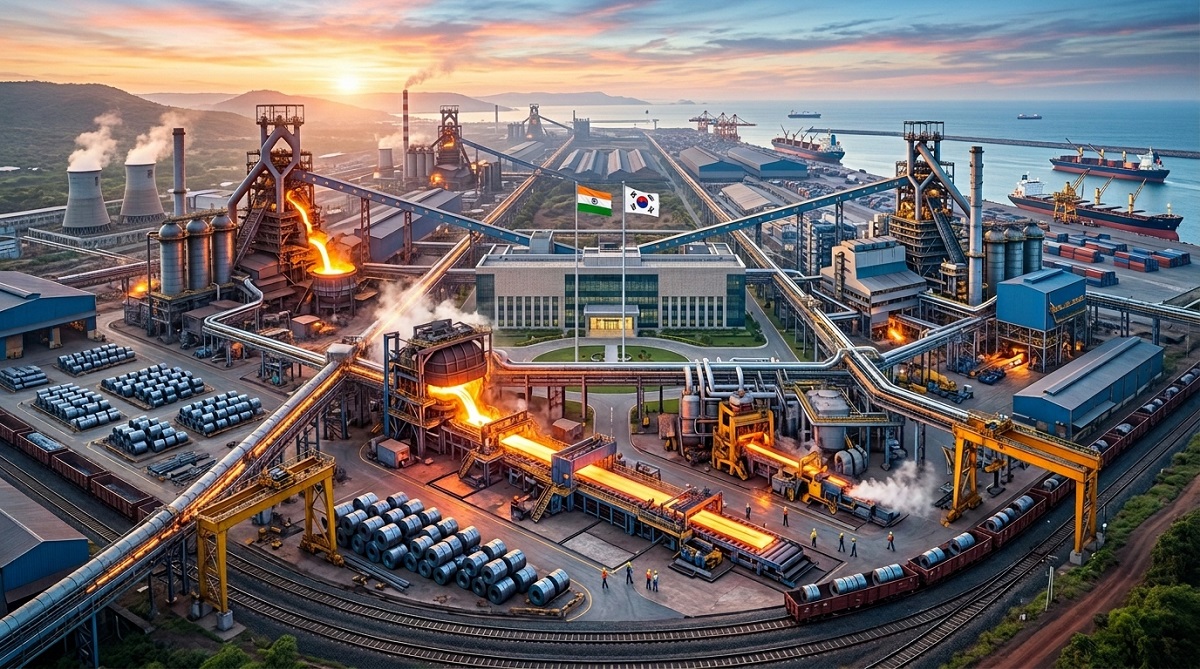
The JSW Steel POSCO Joint Venture marks one of the most strategically significant partnerships in India's industrial history. By combining JSW Steel's domestic market dominance with POSCO's world-class steelmaking technology, this collaboration positions India as a serious contender in the global steel manufacturing landscape. As India accelerates its infrastructure ambitions and industrial modernisation agenda, this joint venture arrives at a defining moment, offering both scale and technological depth that neither company could achieve independently at the same pace.
Company Overview: Two Industry Giants Join Forces
JSW Steel - India's Largest Integrated Steel Producer
JSW Steel, the flagship entity of the JSW Group led by Chairman Sajjan Jindal, is India's largest private steel manufacturer by capacity. With an installed crude steel capacity exceeding 28 million tonnes per annum (MTPA) across plants in Karnataka, Maharashtra, Odisha, and Tamil Nadu, the company has built a deeply integrated steel business spanning raw material sourcing, processing, and downstream product delivery.
JSW Steel serves a broad range of end-user sectors including automotive, construction, energy pipelines, and consumer appliances. Its consistent focus on capacity expansion, operational efficiency, and value-added product development has made it one of the most competitive steel companies in Asia. JSW Steel is listed on the Bombay Stock Exchange and the National Stock Exchange, and its revenues have consistently ranked it among India's top industrial conglomerates.
POSCO - South Korea's Global Steel Powerhouse
POSCO, headquartered in Pohang, South Korea, is one of the world's largest and most technologically advanced steel companies. Established in 1968, POSCO has pioneered steelmaking innovation for over five decades and operates state-of-the-art production facilities across South Korea, Southeast Asia, and beyond. The company is renowned for its proprietary FINEX technology, a coal-based iron-making process that offers environmental and cost advantages over conventional blast furnace methods.
POSCO has long viewed India as a strategic priority market. The country's growing appetite for high-grade steel, combined with its expanding manufacturing sector, aligns closely with POSCO's global investment philosophy. The company has prior experience engaging with Indian partners and regulatory frameworks, and this joint venture represents a re-energised commitment to India's steel ecosystem.
Strategic Partnership Details: A Collaboration Built on Complementary Strengths
Why JSW Steel Partnered with POSCO
The decision to formalise a joint venture reflects the strategic logic of combining JSW Steel's land assets, logistics networks, and market access with POSCO's proprietary steelmaking processes and quality standards. For JSW Steel, the partnership opens a clear path to upgrading product grades, particularly for advanced high-strength steel used in automotive manufacturing, where domestic supply has historically lagged behind import volumes.
For POSCO, the joint venture provides a foothold in one of the world's fastest-growing steel markets without bearing the full burden of greenfield development. India's regulatory and supply chain complexities are considerably reduced when entering with an established domestic partner of JSW Steel's calibre.
Expected Plant Development and Technology Collaboration
The partnership is expected to involve the development of integrated steel manufacturing facilities with an initial target capacity in the range of 5 MTPA, with scalability provisions built into the project's design. POSCO's advanced FINEX and HyREX processes, including its development of hydrogen-based ironmaking, are expected to be incorporated over time, aligning the project with India's commitment to reducing industrial carbon intensity.
Technology transfer is a central feature of the arrangement. JSW Steel will gain access to POSCO's advanced cold-rolled and coated steel production technologies, enabling the manufacture of high-specification products that support India's growing automotive and white goods sectors.
Investment Outlook
The joint venture is projected to involve a combined capital investment running into several billion US dollars across phased development. Both companies have signalled a long-term commitment, with initial phases focused on site development, regulatory clearances, and technology integration, followed by progressive capacity ramp-up over a five-to-ten-year horizon.
Industry Impact: Supporting India's Manufacturing Ambitions
Alignment with India's Industrial Policy
India's National Steel Policy targets domestic steel production capacity of 300 MTPA by 2030, up from approximately 160 MTPA currently. The JSW Steel POSCO Joint Venture directly supports this trajectory by adding meaningful capacity backed by premium-grade technology. At the same time, it advances the objectives of the Production Linked Incentive (PLI) scheme for specialty steel, which incentivises domestic production of high-value steel grades over which India has traditionally depended on imports.
Steel Demand Growth in India
India's steel consumption is growing at a compound annual growth rate of approximately 7 to 8 percent, driven by government-led infrastructure investment in roads, railways, ports, and affordable housing. The demand for flat steel products, a core output of the JSW-POSCO facility, is rising particularly sharply in the automotive, construction, and white goods segments, making the timing of this joint venture commercially well-founded.
Export Potential and Global Competitiveness
By adopting POSCO's quality standards, JSW Steel gains the ability to compete for export contracts in premium international markets, including Europe and East Asia, where certification requirements for advanced high-strength steel are stringent. India's cost advantage in steelmaking, combined with POSCO-grade product quality, creates a compelling export value proposition.
Leadership and Strategy: A Vision-Driven Corporate Approach
JSW Steel's Long-Term Positioning
Under Sajjan Jindal's leadership, JSW Steel has consistently pursued a strategy of bold capacity expansion combined with product portfolio premiumisation. The POSCO partnership is consistent with this approach. It is not a passive joint venture but an active platform for technology acquisition, capability building, and market development. JSW Steel's management has articulated a clear ambition to rank among the global top five steel producers by capacity within the next decade, and the POSCO collaboration advances that goal materially.
POSCO's India Strategy
POSCO's re-engagement with India reflects a broader recalibration of its global growth strategy following shifts in trade patterns, raw material supply dynamics, and the accelerating demand for green steel. India, with its young population, expanding middle class, and government-backed infrastructure pipeline, represents one of the most attractive long-term steel markets globally. POSCO's leadership has consistently identified India as a priority investment destination.
The joint venture structure itself reflects sound corporate governance. Both parties bring defined roles, technologies, and obligations, with shared upside aligned to market outcomes rather than speculative projections.
Market and Economic Impact: Building Beyond Steel
Job Creation and Workforce Development
A fully operational integrated steel facility of the scale envisaged under this joint venture typically employs between 10,000 and 25,000 workers in direct and indirect roles. This includes skilled positions in engineering, metallurgy, and plant operations, as well as a wider supply chain ecosystem of raw material vendors, logistics providers, maintenance contractors, and ancillary service businesses.
Infrastructure Development and Regional Benefits
Steel plants of this magnitude catalyse significant regional infrastructure development. Road connectivity, port upgrades, power supply expansion, and water management investments typically accompany large-scale industrial projects, creating lasting economic assets for the surrounding region. The host state government stands to benefit from increased tax revenues, employment generation, and accelerated urbanisation in the facility's catchment area.
Future Outlook: Scaling Toward a Stronger Steel Ecosystem
Expansion Opportunities
The current joint venture structure is designed with scalability in mind. As Phase 1 operations demonstrate commercial viability and technology transfer progresses, both partners have indicated openness to expanding capacity, product range, and geographic footprint. Discussions around downstream processing units such as service centres, coated steel lines, and precision tube mills are likely to accompany Phase 1 commissioning, extending value addition along the steel supply chain.
Global Collaboration and Green Steel
The partnership has the potential to evolve into a broader research and development collaboration, particularly in the area of green steel production. POSCO's HyREX hydrogen-based ironmaking technology, still in developmental scaling, could find a commercially significant deployment platform in India as the country advances its green hydrogen production capacity. This alignment of industrial and climate objectives positions the joint venture as a forward-looking enterprise, not merely a conventional capacity addition.
India's Steel Industry Future
India's steel sector is entering a structural growth phase underpinned by policy support, demographic demand drivers, and rising industrial sophistication. The JSW Steel POSCO Joint Venture exemplifies the kind of global-domestic partnership model that will be essential to achieving India's 300 MTPA production ambitions while simultaneously upgrading product quality and environmental performance. It stands as a model for how Indian industry can attract world-class technology partners while retaining strategic control over domestic industrial development.
Key Takeaways
- The JSW Steel POSCO Joint Venture combines India's largest private steelmaker with one of the world's most technically advanced steel producers.
- The partnership targets the development of an integrated steel facility with an initial capacity of approximately 5 MTPA, with built-in scalability.
- Technology transfer, including POSCO's FINEX and coated steel processes, is a central feature, enabling JSW Steel to manufacture high-specification automotive and industrial steel grades.
- The joint venture directly supports India's National Steel Policy target of 300 MTPA production capacity by 2030 and the PLI scheme for specialty steel.
- Beyond steel production, the partnership is expected to generate tens of thousands of direct and indirect jobs while stimulating regional infrastructure development and export capacity.
Data Summary
The JSW Steel POSCO Joint Venture targets an initial integrated steelmaking capacity of approximately 5 MTPA, with a combined capital investment projected to reach several billion US dollars across phased development. India's current installed steel capacity stands near 160 MTPA against a 2030 policy target of 300 MTPA. Steel consumption in India is growing at an estimated 7 to 8 percent CAGR, driven by infrastructure, automotive, and construction demand. JSW Steel's existing capacity exceeds 28 MTPA, while POSCO is ranked among the world's five largest steel producers by output.




Comments (0)
Leave a Comment
No comments yet
Be the first to comment