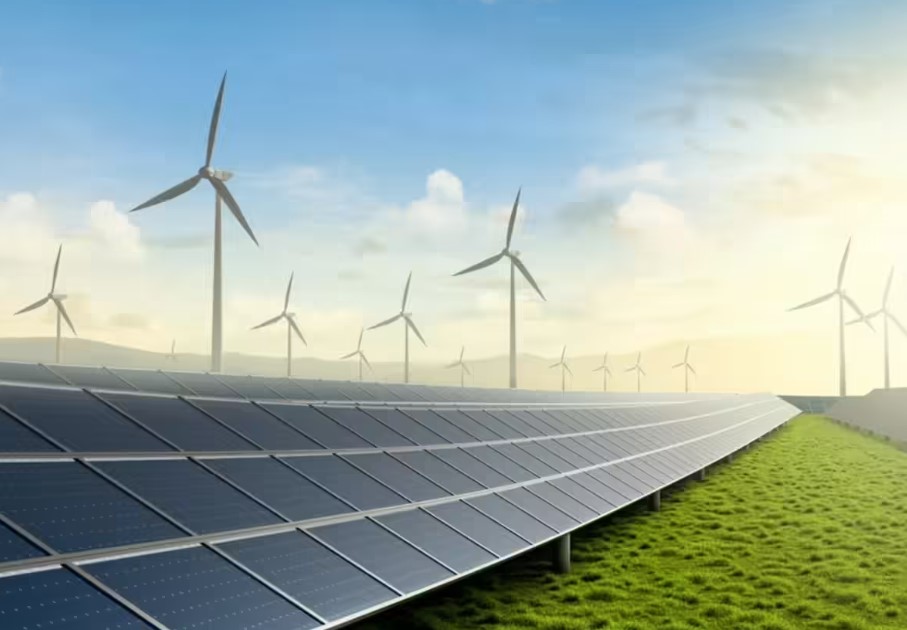
A Turning Point in India's Energy Story
This milestone is not merely a statistical achievement. It represents a structural transformation of one of the world's most energy-hungry economies a country of 1.4 billion people, historically dependent on coal, pivoting with accelerating force toward clean power. Against the backdrop of climate commitments made in Paris and reinforced at successive COPs, India's renewable surge signals that the green energy transition is no longer aspirational. It is operational.
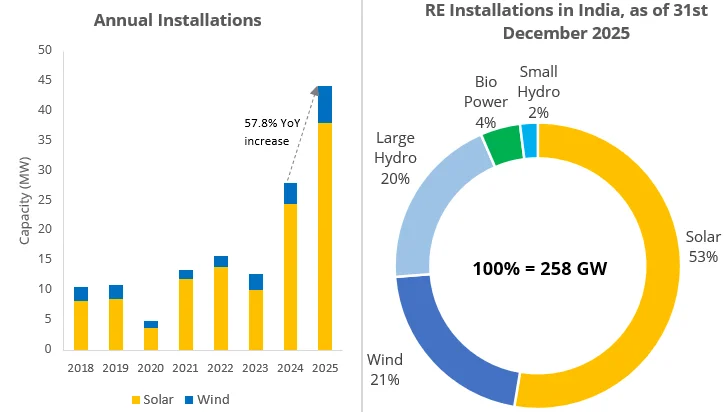
In a landmark moment for global climate action, India added 50.9 GW of renewable energy capacity in FY 2025–26 the highest annual addition in the country's history and one of the largest single-year expansions by any nation on earth. Solar energy led this historic charge, contributing 44.6 GW of new capacity, while wind power added 6.05 GW, its own record annual figure. Together, these additions pushed India's total renewable energy capacity past the 223 GW mark (excluding large hydro), cementing the country's position as the third-largest renewable energy nation globally.
India now targets 500 GW of non-fossil energy capacity by 2030, and the trajectory set in FY 2025–26 suggests that goal is firmly within reach. For policymakers, investors, and climate advocates worldwide, the message is unambiguous: India's energy transition has entered its decisive decade.
India's Renewable Energy Milestone: A Full Breakdown
The numbers behind FY 2025–26's record addition tell a story of solar dominance, wind maturation, and a broadening energy mix.
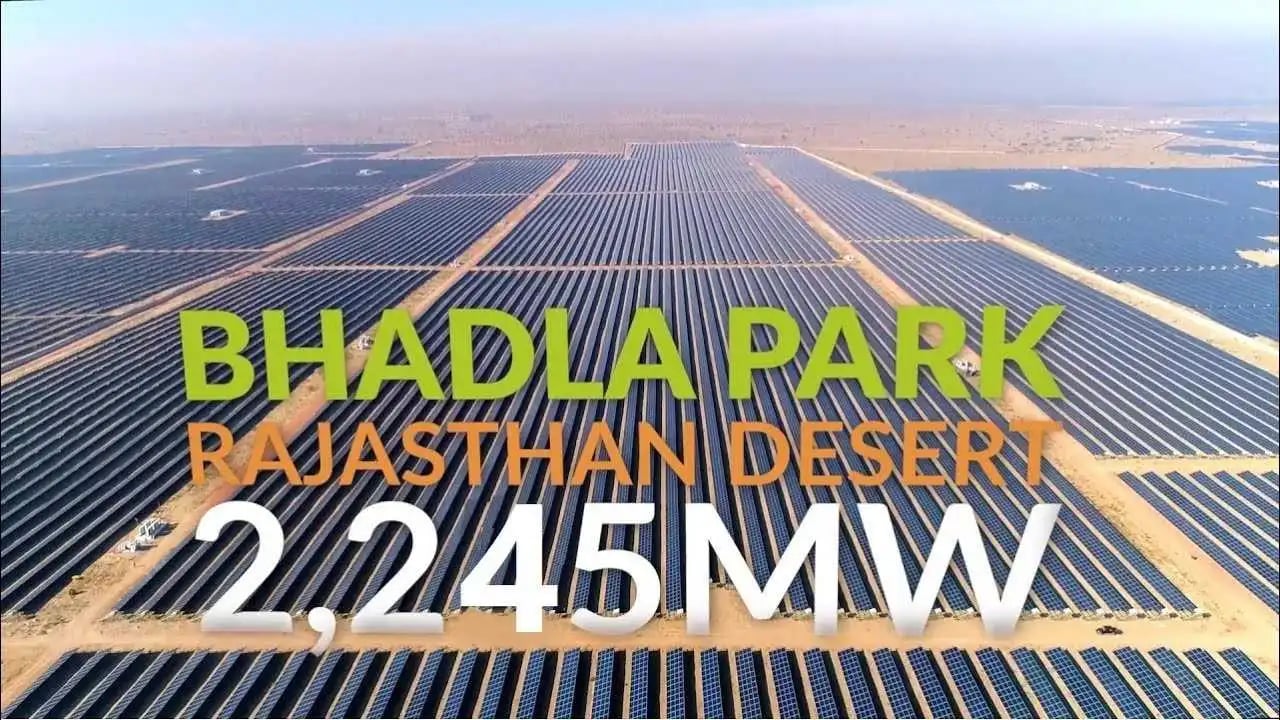
Solar power was the undisputed engine of growth, accounting for 44.6 GW of the 50.9 GW total an 87.6% share. This reflects both the dramatic fall in photovoltaic (PV) panel costs and a maturing pipeline of utility-scale solar parks developed across sun-rich states like Rajasthan, Gujarat, Karnataka, and Andhra Pradesh. India's solar capacity, which barely registered a gigawatt before 2012, has become the backbone of its clean energy future.
Wind energy added 6.05 GW, its highest-ever annual figure, driven by renewed momentum in offshore wind planning and onshore capacity expansion in Tamil Nadu, Gujarat, and Maharashtra. The wind sector, which had stagnated for several years due to policy uncertainty and land acquisition challenges, appears to have found its footing again.
Rooftop solar continued its quiet but consequential expansion, with installations on homes, commercial buildings, and industrial rooftops contributing meaningfully to distributed generation targets. Government schemes like PM Surya Ghar Muft Bijli Yojana have been instrumental in pushing rooftop adoption into smaller towns and rural areas.
With total renewable capacity at 223 GW, India's energy mix has undergone a fundamental shift. Renewables now account for a commanding share of installed power capacity, reducing the thermal fleet's relative dominance and providing a clean baseload for a growing grid. The capacity has grown nearly three times since 2014, underscoring the scale and pace of this transformation.
Historical Background: India's Long Road to Green Power
Understanding this milestone requires tracing India's energy evolution across four distinct phases.
Pre-2010: The Coal Era: For most of independent India's history, energy policy was synonymous with coal policy. The country's abundant coal reserves powered a rapidly industrialising economy, and thermal power dominated generation capacity well above 70%. Renewable energy existed largely on the margins small hydro, biomass, and early wind experiments in Tamil Nadu and Rajasthan.
2010–2015: The Early Solar Push: The National Solar Mission, launched in 2010 under the Jawaharlal Nehru National Solar Mission framework, set India's first serious renewable targets. The initial goal of 20 GW of solar by 2022 seemed ambitious at the time but was quickly overtaken by reality. India began attracting international solar investment, and falling panel prices started making large-scale solar economically viable.
2015–2020: Paris Agreement Acceleration: India's ratification of the Paris Agreement in 2016 and its nationally determined contributions (NDCs) supercharged renewable ambitions. Prime Minister Modi's government revised the 2022 solar target upward to 100 GW and set an overall renewable energy target of 175 GW. Annual capacity additions began scaling up, and India moved into the global top five for renewable installations.
2020–2026: The Rapid Expansion Phase: The final phase has been defined by exponential scale. Industrial and infrastructure policy aligned to support domestic solar manufacturing, auction pipelines deepened, and private sector investment poured in. Annual additions climbed steeply from roughly 10 GW per year in the early 2020s to the record-shattering 50.9 GW of FY 2025–26. India's renewable capacity has tripled since 2014, a growth rate that few analysts predicted and fewer nations have matched.

Why Green Energy is Critically Important for India
India's renewable push is not simply an environmental statement. It is an economic and strategic imperative.
Climate Change Mitigation:
India is among the most climate-vulnerable nations on earth. Extreme heat events, erratic monsoons, coastal flooding, and agricultural disruption all carry enormous human and economic costs. Transitioning away from coal directly reduces the carbon dioxide and particulate emissions that drive these risks. According to the International Energy Agency (IEA), coal power plants remain the single largest source of India's CO₂ emissions, making their displacement by renewables the most impactful lever available.
Energy Security:
India imports roughly 85% of its crude oil and significant volumes of natural gas and coal. Each unit of energy generated domestically from sun and wind reduces this import dependency, strengthening macroeconomic resilience and reducing exposure to global commodity price shocks. In a world of geopolitical energy disruptions, domestic renewable generation is strategic insurance.
Economic Growth:
Clean energy is not a constraint on growth it is increasingly its engine. Renewable power is now cheaper than new coal power in most Indian states, reducing industrial electricity costs and improving manufacturing competitiveness. Abundant, affordable, and reliable clean power is becoming a key input for India's ambitions to become a global manufacturing hub.
Industrial Transformation.:
Sectors from steel to cement to chemicals are beginning their decarbonisation journeys, and access to large-scale renewable energy is central to those transitions. Green hydrogen, produced from renewable electricity, is positioned as the next frontier for hard-to-abate industrial sectors.
Sustainability and Equity:
Distributed solar and rural electrification programs have brought electricity to millions of previously unserved households, delivering social and economic inclusion alongside environmental benefit.

Why Renewable Energy Growth Is Accelerating
Several converging forces have created the conditions for record capacity addition.
Government Policy Architecture:
The Ministry of New and Renewable Energy (MNRE) has built a comprehensive policy ecosystem: production-linked incentive (PLI) schemes for solar module manufacturing, viability gap funding for offshore wind, transmission waivers for renewables, and aggressive auction schedules ensuring a predictable pipeline for investors.
Collapsing Solar Costs: The cost of utility-scale solar in India has fallen by over 85% in the past decade, making it the cheapest source of new electricity generation. According to IRENA (International Renewable Energy Agency), India consistently achieves some of the world's lowest solar tariffs at auction, driven by competition, scale, and improving module efficiency.
Domestic Manufacturing Scale-Up: India is aggressively expanding its solar PV manufacturing base, reducing dependence on Chinese imports and building a domestic supply chain for modules, cells, wafers, and inverters. PLI schemes have attracted significant investment into Indian solar manufacturing, strengthening both energy security and industrial policy goals.
Private Sector Investment: Indian conglomerates Reliance Industries, Adani Green Energy, Tata Power, and JSW Energy alongside global players, have committed hundreds of billions of rupees to renewable capacity. The sector has become one of the most attractive destinations for domestic and foreign capital.
Battery Storage Integration: The falling cost of lithium-ion battery storage is beginning to address renewable intermittency. Utility-scale battery storage projects are being tendered alongside solar and wind capacity, improving grid reliability and enabling higher penetration of variable renewables.
Smart Grid and Transmission Modernisation: India's grid operator has invested in transmission upgrades and real-time management systems to handle the variability of large-scale renewable generation, gradually reducing the technical barriers to higher renewable shares.
Economic Impact: Beyond the Megawatt Numbers
The economic implications of India's renewable surge extend well beyond the power sector.
Job Creation at Scale: According to World Bank energy data and IRENA estimates, the renewable energy sector supports hundreds of thousands of direct and indirect jobs in India across manufacturing, installation, operations and maintenance, and supply chain activities. Reaching 500 GW by 2030 is projected to generate millions of new employment opportunities, many in rural areas where solar and wind projects are sited.
Infrastructure Investment: Each gigawatt of renewable capacity deployed requires substantial investment in transmission lines, substations, grid stabilisation equipment, and access roads. This infrastructure spending has a significant multiplier effect on regional economies.
Investment Inflows: India's renewable sector attracted over $15 billion in foreign direct investment in recent years, and domestic capital mobilisation has been even larger. The sector has become a major component of India's broader infrastructure investment story.
Fossil Fuel Displacement: Every GWh of clean energy generated displaces coal-fired generation, reducing fuel import costs and the financial burden on state electricity distribution companies (DISCOMs) that have historically struggled with expensive thermal power procurement. As renewable costs continue to fall, the fiscal arithmetic of clean energy grows steadily more compelling.
Climate and Environmental Impact
India's renewable expansion has real and measurable environmental consequences.
Carbon Emission Reductions: With India's grid emission factor at approximately 0.7 tonnes of CO₂ per MWh, the addition of 50.9 GW of zero-emission capacity represents a substantial annual carbon offset potential once fully operational. Over a 25-year asset life, this single year's additions could prevent hundreds of millions of tonnes of cumulative CO₂ emissions.
Air Quality Improvement: Coal combustion is the primary driver of particulate matter (PM2.5) and sulphur dioxide pollution in India's major cities. Displacing coal with renewables produces measurable improvements in urban air quality, reducing respiratory disease burden and associated healthcare costs. Cities like Delhi, Kanpur, and Ahmedabad, which consistently breach safe air quality thresholds, stand to benefit directly.
Climate Resilience: By reducing dependence on monsoon-dependent hydropower and heat-vulnerable thermal plants, diversified renewable capacity improves the climate resilience of India's energy system itself — an important consideration in a country increasingly exposed to climate extremes.
India vs Global Renewable Leaders
India's 3rd-place global ranking in renewable capacity reflects a striking rise in international standing, though the gap with the leaders remains significant.
China remains in a league of its own. With over 1,500 GW of renewable capacity, China adds more solar and wind in a single year than most countries have in total. Its dominance in manufacturing, backed by state-led industrial policy, gives it unmatched cost advantages and scale.
The United States holds second position with approximately 400 GW of renewable capacity, driven by the Inflation Reduction Act's historic incentive framework, which has unleashed a wave of clean energy investment across solar, wind, and storage.
India, at 223 GW, trails both leaders substantially in absolute terms but punches above its weight given the constraints of a middle-income economy managing a complex federal energy system. Crucially, India's growth rate rivals or exceeds both peers, its tripling of capacity since 2014 outpaces the relative expansion achieved by either China or the US in the same period.
The European Union presents a different model distributed across 27 member states, the bloc's collective renewable capacity exceeds India's, but its pace of annual additions has been slower relative to its installed base.
India's trajectory suggests it could challenge the US for second place in absolute renewable capacity before 2035 if the 500 GW 2030 target is met and sustained beyond it.
Challenges Ahead
The record FY 2025–26 additions are reason for optimism, but significant structural challenges must be addressed for the momentum to hold.
Grid Stability: Integrating 50+ GW of variable renewable energy in a single year strains grid balancing infrastructure. Frequency management, reactive power support, and curtailment risk require continued investment in grid modernisation and flexible capacity.
Land Acquisition: Utility-scale solar and wind projects are land-intensive. Competing land uses agriculture, ecology, tribal rights create legal and logistical delays that increase project development timelines and costs.
Storage Costs: Despite falling battery prices, grid-scale storage remains expensive relative to the marginal cost of renewable generation, limiting the economically viable renewable share at which storage becomes mandatory.
Financing Challenges: While the sector attracts significant capital, smaller and mid-tier developers face higher borrowing costs, and DISCOMs' financial weakness creates offtake risk that deters some investors. Strengthening the financial health of state utilities remains a prerequisite for sustained private sector participation.
Transmission Expansion: India's renewable resources are concentrated in a handful of states, while demand centres are geographically dispersed. Building inter-state transmission capacity at the required scale involves regulatory, financial, and right-of-way challenges that have historically caused delays.
Future Outlook: The Road to 2030 and Beyond
India's energy future is being written in solar panels and wind turbines, but several emerging technologies and policy directions will shape the next chapter.
500 GW by 2030: India's NDC target of 500 GW non-fossil capacity by 2030 requires sustained additions of approximately 50–60 GW per year broadly consistent with the FY 2025–26 performance. If grid, storage, and transmission challenges are addressed, this target is achievable. Missing it would signal systemic constraints that require urgent policy attention.
Green Hydrogen Economy: India's National Green Hydrogen Mission targets 5 million tonnes of annual green hydrogen production by 2030, requiring enormous quantities of renewable electricity. Green hydrogen for export and domestic industrial decarbonisation could become one of the largest drivers of additional renewable capacity in the 2027–2035 window.
Battery Storage Scale Up: India is developing a domestic battery storage manufacturing ecosystem, supported by PLI schemes. As costs fall and capacity grows, storage integration will progressively smooth renewable intermittency and enable higher renewable penetration without grid instability.
Smart Grid Infrastructure: Advanced metering, demand response, and AI-driven grid management will become essential tools for operating a 500 GW+ renewable system efficiently.
Electric Vehicle Integration: India's rapidly growing EV fleet represents both a flexible demand resource (charging during peak solar hours) and a distributed storage asset that can contribute to grid balancing as vehicle-to-grid technology matures. By 2030, millions of EVs could serve as mobile batteries supporting the renewable-heavy grid.
Looking to 2040: Analysts at the IEA and IRENA project that India could reach 1,000 GW of renewable capacity by the late 2030s if technology cost curves continue to fall and policy support is sustained. At that scale, India would represent one of the defining success stories of the global energy transition.
Expert Insight
Energy economists and policy analysts tracking India's renewable trajectory are broadly encouraged by the FY 2025–26 data, though they urge caution about the structural challenges that persist.
"The 50.9 GW addition is genuinely transformative it demonstrates that India has moved past the demonstration phase and into mass deployment," notes a senior energy economist at a leading multilateral development institution. "The real test now is whether grid infrastructure and DISCOM reforms can keep pace with generation capacity. Generation without evacuation and reliable offtake is capacity on paper, not power in homes."
A policy analyst specialising in South Asian energy markets observes: "India's renewable story is also a manufacturing story. The move to domestic solar module production is strategically significant — it reduces import dependency, builds an export-capable industry, and creates jobs in a labour-abundant economy. That's a rare trifecta in energy policy."
Climate experts watching India's NDC compliance note that the FY 2025–26 additions put India ahead of the pace needed to meet its 500 GW 2030 commitment. "India's credibility at international climate negotiations is increasingly backed by domestic action," says a climate finance researcher at an independent think tank. "That changes the diplomatic calculus and strengthens the case for concessional climate finance flows into India's energy transition."
Conclusion: Why This Moment Is Historically Significant
When historians write the story of the global energy transition, FY 2025–26 will likely appear as one of its watershed moments. India, a country of 1.4 billion people, deeply dependent on coal for more than a century, navigating the complex politics of a federal democracy added more renewable energy in a single fiscal year than most nations have in total.
This is not merely a number. It is evidence of a structural transformation taking root: in policy frameworks, in manufacturing ecosystems, in capital markets, and in the everyday economics of energy generation. India's renewable capacity, which has tripled since 2014, is reshaping the country's energy mix, reducing its carbon footprint, strengthening its energy security, and creating economic opportunity at a scale that few would have predicted a decade ago.
The 500 GW target by 2030 is ambitious but no longer implausible. Meeting it will require sustained political will, continued cost innovation, grid investment, and DISCOM reform. But the trajectory of FY 2025–26 provides the clearest evidence yet that India has the institutional capacity and industrial momentum to deliver.
For the world watching a nation of this scale make this transition, the message is both inspiring and instructive: the energy transition is not a luxury of wealthy nations. It is a strategic imperative for the world's largest developing economies and India is showing it can be done.




Comments (0)
Leave a Comment
No comments yet
Be the first to comment