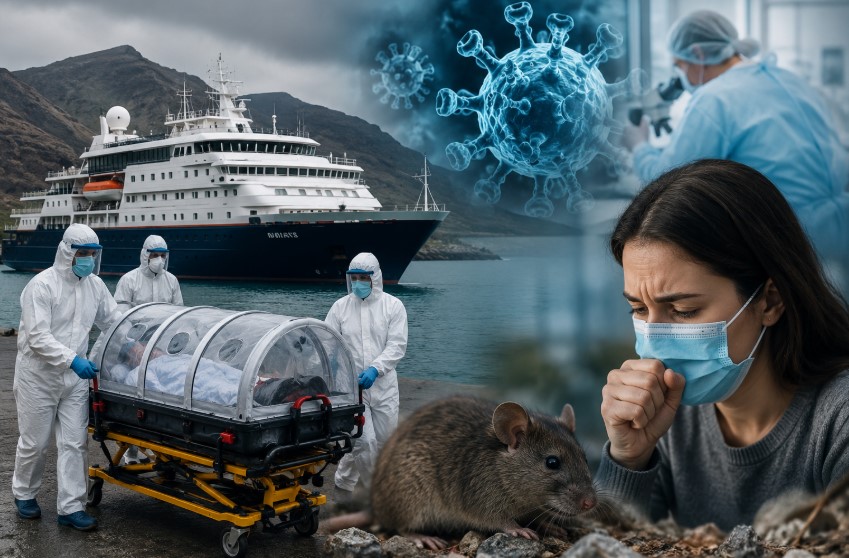
A deadly hantavirus outbreak linked to the cruise ship MV Hondius has reached two continents, with a US citizen and a French national both confirming positive cases after returning to their home countries. The development has alarmed global health authorities and reignited debate over how nations should handle passengers from an active disease outbreak.
The US Department of Health and Human Services confirmed that two American nationals showed symptoms during the repatriation flight from Tenerife, Spain. Both were transported in biocontainment units. All 17 Americans on the flight are now undergoing clinical assessment at a medical facility in Nebraska. Seven other US passengers who had returned earlier are being monitored at home.
In France, Health Minister Stéphanie Rist confirmed that an infected woman is now isolating in Paris. Her condition is reportedly deteriorating, and authorities have already traced 22 contact cases.
Three Dead, Dozens Being Monitored
Three passengers have died following travel on the MV Hondius, currently docked in the Canary Islands. A Dutch couple and a German woman lost their lives. Two of the three deaths are confirmed to involve hantavirus.
More than 90 passengers are being repatriated across multiple countries. Twenty British nationals arrived at Manchester Airport on a chartered flight and were taken to Arrowe Park Hospital in Wirral for 72 hours of isolation. None reported symptoms. Two other British nationals with confirmed infections are being treated in the Netherlands and South Africa.
Spain flew 14 of its nationals to Madrid, where they face mandatory quarantine at a military hospital. A separate flight carrying 26 passengers, including eight Dutch nationals, has landed in the Netherlands. Australia is receiving six of its passengers.
What Is the Andes Strain of Hantavirus?
The World Health Organization believes passengers contracted the Andes strain of hantavirus while the ship was in South America. Unlike most hantavirus strains, the Andes strain is the only one known to spread through human-to-human contact, making it significantly more concerning in a group travel setting.
Hantaviruses are primarily carried by rodents. Symptoms include fever, extreme fatigue, muscle aches, stomach pain, vomiting, diarrhoea, and shortness of breath. The progression can be rapid and severe.
WHO vs CDC: A Public Disagreement
The outbreak has exposed a sharp divide between the WHO and US health leadership. WHO Director-General Tedros Adhanom Ghebreyesus warned that the US decision not to follow the organisation's recommended 42-day isolation protocol "may have risks." The warning came before the American case was confirmed, lending it immediate credibility.
Dr Jay Bhattacharya, acting head of the US Centers for Disease Control and Prevention, pushed back, arguing that human-to-human transmission remains rare and should not trigger Covid-level panic.
That disagreement now sits under uncomfortable scrutiny given that the US passenger has tested positive.
Key Takeaways
- A US national and a French national have tested positive for hantavirus after leaving the MV Hondius
- Three passengers have died; two deaths are confirmed hantavirus cases
- The Andes strain, contracted likely in South America, can transmit between humans
- WHO recommends 42-day isolation; the US followed a shorter protocol
- France has traced 22 contact cases from one confirmed patient
- Officials maintain the risk of a major outbreak remains low
What Happens Next
Health agencies across Europe, the US, and Australia are racing to trace and monitor contacts of confirmed cases. France's 22 traced contacts represent the most significant secondary exposure chain so far. The coming days will determine whether the French case triggers further community spread.
The WHO-CDC disagreement over isolation protocols may prompt a broader review of international coordination standards for disease outbreaks aboard vessels in international waters.



Comments (0)
Leave a Comment
No comments yet
Be the first to comment