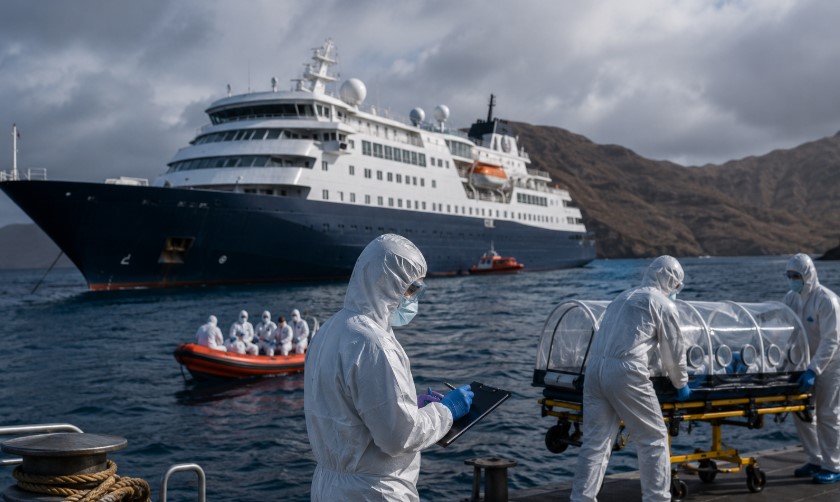
A luxury cruise ship carrying 150 passengers from 23 countries has become the center of one of the most alarming hantavirus cruise ship emergencies in modern travel history. Three people are dead, eight cases have been confirmed or suspected, and the MV Hondius, operated by Dutch company Oceanwide Expeditions, is now sailing toward Spain's Canary Islands after days stranded off the coast of Cape Verde. The outbreak involves the rare Andes strain of hantavirus, a variant capable of limited human-to-human transmission, and it has sent shockwaves through global public health systems from Amsterdam to Johannesburg.
What Happened on the Hantavirus Cruise Ship
The MV Hondius departed Ushuaia, Argentina, on April 1, 2026, bound for Antarctica and a series of remote South Atlantic islands. What began as an expedition into one of the world's most isolated regions ended in crisis at sea.
A Dutch man died on board on April 11. His body was removed at Saint Helena, a British overseas territory. His wife disembarked at the same stop and died in a South African hospital on April 26. A British expedition guide fell ill on April 27 after the ship departed Saint Helena and was evacuated to Johannesburg, where he remains in intensive care in improving condition. On May 2, a German passenger died on board after presenting with severe pneumonia. By May 5, the World Health Organization had been notified of seven cases including three deaths. A Swiss patient, identified the following day, became the eighth confirmed case, now isolated at University Hospital Zurich.
On May 6, three people were medically evacuated from the vessel off Cape Verde. Two landed in Amsterdam under specialist care. The third plane made an unscheduled stop at Gran Canaria Airport due to a technical fault.
Why Experts Are Alarmed: The Andes Hantavirus Factor
Laboratory analysis confirmed the outbreak strain as Andes hantavirus, a variant predominantly found in Argentina and Chile. Unlike most hantavirus strains, the Andes strain has documented, though rare, human-to-human transmission.
"Hantavirus is not a casual airborne virus like influenza," WHO epidemiologist Maria Van Kerkhove stated at a press briefing. "Transmission occurs through prolonged and very close contact." Still, the confirmation of the Andes strain triggered immediate contact tracing across multiple countries.
South African health authorities launched contact tracing following the evacuations to Johannesburg. European health agencies began monitoring individuals who traveled aboard or near the vessel. Switzerland confirmed its case after Oceanwide Expeditions proactively emailed former passengers, prompting one man to seek hospital care.
WHO Director-General Tedros Adhanom Ghebreyesus stated the broader public risk remains "low," but the multi-country spread has drawn serious attention.
The Political and Public Health Tension: Canary Islands Health Alert
Spain's central government cleared the MV Hondius to dock in Tenerife. Canary Islands President Fernando Clavijo publicly opposed the decision, stating regional authorities lacked sufficient information to guarantee public safety.
"The situation exposes precisely how interconnected global travel risks have become," said one infectious disease analyst tracking the outbreak. "One ship, one departure point, one index case, and suddenly you have a health incident spanning four continents."
Spain's Health Minister Monica Garcia confirmed the vessel would dock in Tenerife within approximately three and a half days, adding that no remaining passengers were currently symptomatic. Upon arrival, non-Spanish nationals will be repatriated to their home countries.
What Is Hantavirus?
Hantavirus is a family of viruses carried primarily by rodents. Humans contract it through contact with infected rodent urine, feces, or saliva, usually in enclosed or rural environments. The Andes strain can cause Hantavirus Pulmonary Syndrome, characterized by fever, gastrointestinal distress, and rapid progression to acute respiratory distress. Fatality rates for severe cases can reach 40 percent. There are no approved antiviral treatments. Unlike Covid-19, hantavirus does not spread through casual social contact or routine air travel environments.
The Bigger Warning for Global Travel
The MV Hondius outbreak has laid bare the vulnerabilities of closed-environment travel at scale. Passengers visited extraordinarily remote wildlife-rich habitats, locations where rodent populations carry endemic hantavirus. International health coordination was reactive rather than proactive.
"This case will likely become a reference point for how quickly an emerging pathogen can follow a luxury itinerary across the world," said a global health researcher familiar with ship-based outbreak protocols. The episode also revealed how cruise ship operators, sovereign states, and international health bodies can fall into jurisdictional friction precisely when unified action is most needed.
The MV Hondius is now a floating case study in what pandemic preparedness frameworks have not yet solved.



Comments (0)
Leave a Comment
No comments yet
Be the first to comment