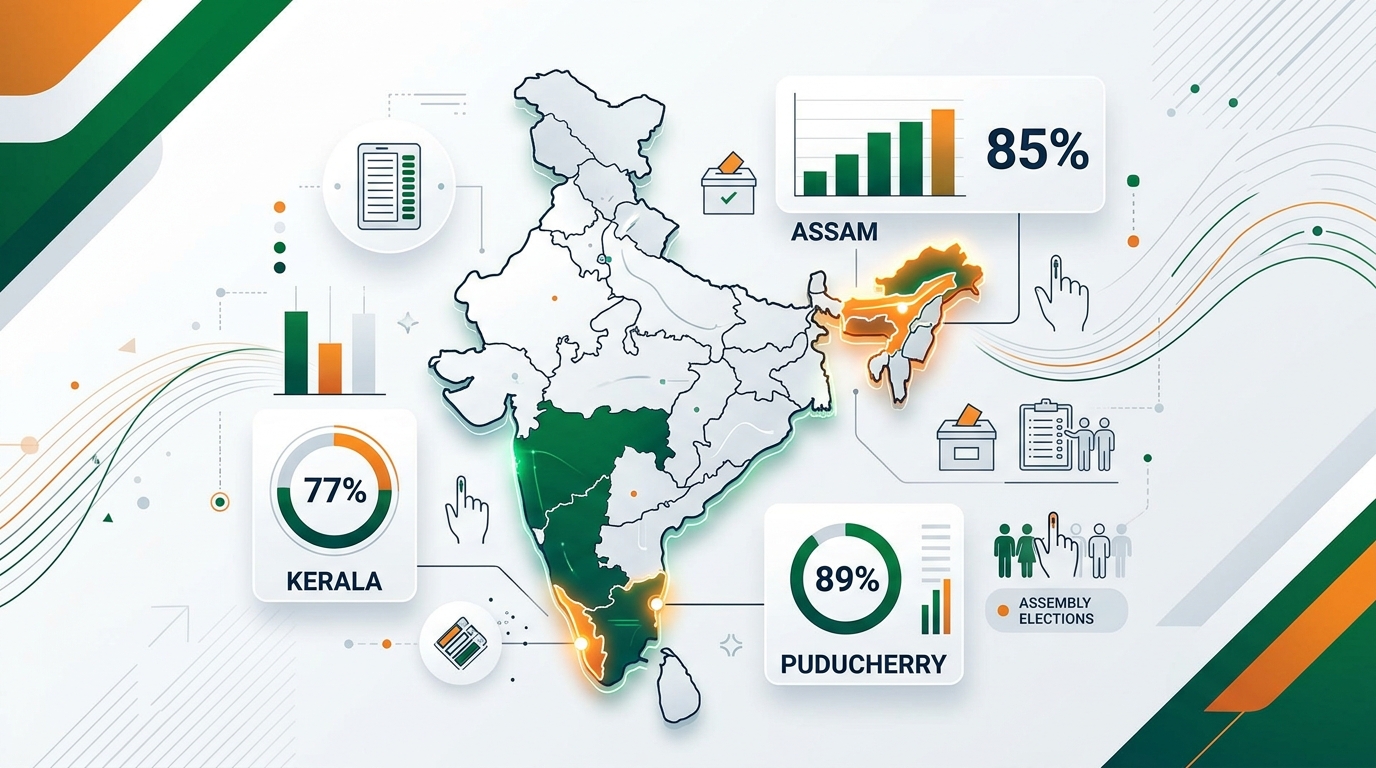
On April 9, 2026, voters across 296 constituencies in Assam, Kerala and Puducherry cast their ballots in single-phase Assembly elections. The Election Commission of India confirmed final turnout figures of 85.04% in Assam, 77.38% in Kerala and 89.08% in Puducherry. Results are scheduled for May 4, 2026.
These are impressive numbers. But impressive numbers demand careful reading.
What Is Voter Turnout and Why Does the Formula Matter
Voter turnout is calculated as votes cast divided by total registered voters, multiplied by 100. The denominator, which is the total registered voter base, plays an equally important role as the numerator. When electoral authorities conduct Special Intensive Revision (SIR) of voter rolls before elections, deceased voters, duplicate entries and migrated voters are removed. This shrinks the denominator. A smaller denominator mechanically pushes the percentage upward, even when actual votes cast remain nearly the same.
Understanding this formula is essential before drawing conclusions from any turnout headline.
Assam: A Genuine Surge in Participation
In Assam, the 2026 turnout surpassed the 82.04% recorded in the 2021 Assembly elections, with the state crossing its previous benchmark by the close of polling hours.
Critically, in Assam's case, the registered voter base did not contract. Both the voter list size and total votes cast moved upward together. This is the clearest indicator of organic participation growth. The competitive electoral environment, with the BJP-led NDA seeking a third consecutive term against a resurgent Congress campaign led by Gaurav Gogoi, appears to have genuinely mobilized voters.
Assam's data passes all three analytical tests: more absolute votes, stable or expanded voter list, and a percentage rise consistent with actual engagement.
Kerala: Real Engagement, Partly Amplified by Statistics
In Kerala, turnout stood at 77.38% by the close of polling, notably higher than the 74.06% recorded in the 2021 Assembly elections.
However, Kerala's voter rolls underwent significant revision before this election. A large volume of names were removed during SIR. Because the registered voter base shrank, the percentage rise appears steeper than the actual change in absolute votes cast would suggest.
Kerala's political history adds another layer of context. The highest-ever polling in Kerala was 85.72% recorded in 1960. The 2026 figure, while strong, do es not cross the 80% threshold that political analysts traditionally associate with a decisive political wave in the state.
The verdict for Kerala: participation genuinely increased, but the percentage figure is partly amplified by voter roll revision effects, a variable that electoral data analysts often flag in post-election studies.
Puducherry: When Percentages Outrun Reality
Voter turnout in Puducherry was recorded at 89.08%, making it the highest figure among the three regions. At first glance, this appears to represent extraordinary democratic enthusiasm in the Union Territory.
But Puducherry's small electorate and significant pre-election voter list deletions mean that even a modest increase in absolute votes cast translates into a sharp percentage jump. This is a textbook case of denominator-driven percentage inflation. Actual participation did improve, but the 89% figure overstates the scale of that improvement when viewed in isolation.
Why Headlines Can Mislead and What Analysts Should Measure
The three indicators every analyst must examine before citing turnout figures are: absolute votes cast compared to the previous election, the net change in the size of the voter list, and the historical turnout trend adjusted for electoral roll revisions.
Without these three data points, a high turnout percentage tells only part of the story. A state could record a 5% jump in turnout while the number of actual voters remains flat, simply because thousands of names were removed from the rolls.
Does High Turnout Signal a Political Wave
Political science research does not support the assumption that high turnout automatically benefits ruling governments or signals anti-incumbency. Research on Indian electoral behavior consistently shows that high turnout reflects competitive contestation rather than directional voter sentiment. The strong turnout across all three regions is being widely seen as a reflection of the competitive political environment in each state.
The Takeaway
The 2026 Assembly election turnout data from Assam, Kerala and Puducherry offers a useful case study in data literacy. Assam's rise is largely genuine. Kerala's is a mix of real engagement and statistical effects. Puducherry's dramatic percentage is primarily driven by a shrunken voter base.
High turnout is always worth celebrating. But the numbers deserve more than a headline. In modern electoral analysis, understanding how a percentage is constructed is as important as the percentage itself. Readers and journalists who engage with voter turnout methodology, electoral roll revision data and Election Commission of India reports will always be better equipped to read these numbers accurately.




Comments (0)
Leave a Comment
No comments yet
Be the first to comment