
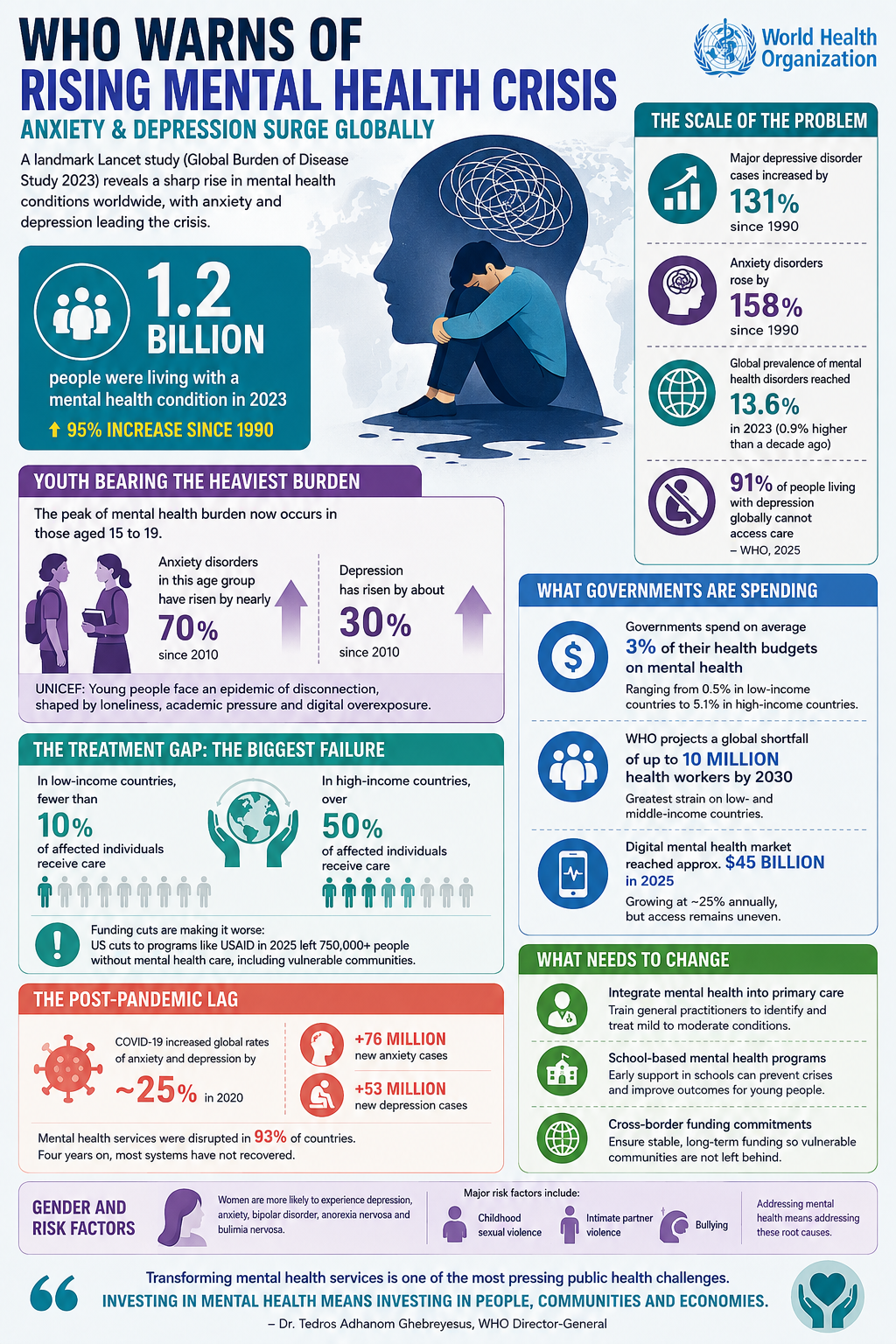
A landmark study published in The Lancet on May 21, 2026, as part of the Global Burden of Disease Study 2023, confirmed what public health officials have warned for years: the world is in the middle of a deepening mental health emergency. Around 1.2 billion people were living with a mental health condition in 2023, marking a 95% increase since 1990. The two conditions driving that surge are anxiety and depression, now recognized as the world's most common mental disorders. The findings arrive as health systems in many countries remain underprepared, underfunded, and overwhelmed.
The Scale of the Problem in 2026
The numbers from the Global Burden of Disease Study are hard to ignore:
- Major depressive disorder cases increased by 131% since 1990, while anxiety disorders rose by 158%.
- The WHO estimates depression and anxiety alone cause $1 trillion in lost productivity and 12 billion lost working days globally each year.
- The global prevalence of mental health disorders reached 13.6%, which is 0.9% higher than a decade ago.
- According to the WHO's World Mental Health Today report published in 2025, 91% of people living with depression around the world are not able to access care.
Dr. Damian Santomauro, lead study author, said he was "honestly shocked at the magnitude" of the findings, adding that the data suggests "we are entering an even more concerning phase of worsening mental disorder burden globally."
Youth Bearing the Heaviest Burden
The peak of mental health burden now occurs in those aged 15 to 19. Since 2010, anxiety disorders in this age group have risen by nearly 70%, and depression by about 30%. These are not abstract statistics. They represent an entire generation entering adulthood already dealing with clinical levels of psychological distress. UNICEF's State of the World's Children 2024 described young people as facing an epidemic of disconnection, shaped by loneliness, academic pressure, and digital overexposure.
Why the Treatment Gap Remains the Central Failure
Knowing the scale of the problem matters less if access to care does not follow. The gap between who needs treatment and who receives it remains the most documented failure in global mental health policy.
In low-income countries, fewer than 10% of affected individuals receive care, compared to over 50% in higher-income nations. That gap is not narrowing. In many regions it is widening, partly because of recent funding cuts to global health programs.
The Global Mental Health Action Network reported that US government funding cuts to programs like USAID in 2025 immediately cut off more than 750,000 people from mental health care, including 310,000 torture survivors, 82,000 LGBTQI+ individuals, 400,000 women, and 255,000 children.
What Governments Are Actually Spending
Budget allocation tells the real story of how seriously governments treat mental health as a public health priority:
- Governments spend on average 3% of their health budgets on mental health, ranging from 0.5% in low-income countries to 5.1% in high-income countries.
- The WHO projects a global shortfall of up to 10 million health workers by 2030, with the greatest strain falling on low- and middle-income countries.
- The digital mental health market reached approximately $45 billion in 2025, growing at roughly 25% annually, though access remains uneven across income groups.
The Post-Pandemic Lag Has Not Recovered
COVID-19 increased global rates of anxiety and depression by approximately 25% in 2020, adding 76 million new anxiety cases and 53 million new depression cases. The pandemic also disrupted mental health services in 93% of countries, creating a catastrophic gap between rising demand and reduced supply. Four years on, most health systems have not rebuilt to pre-pandemic service levels, let alone expanded to meet the higher post-pandemic need.
What Needs to Change in Global Mental Health Policy
WHO Director-General Dr. Tedros Adhanom Ghebreyesus stated directly: "Transforming mental health services is one of the most pressing public health challenges. Investing in mental health means investing in people, communities, and economies, an investment no country can afford to neglect."
The Lancet study authors were equally clear. They wrote that responding to the mental health needs of the global population, especially the most vulnerable, "is an obligation, not a choice," noting that mental illness also affects families, workplaces, and governments through reduced productivity, lower workforce participation, and growing pressure on welfare and healthcare systems.
Three Areas Where Action Is Overdue
Public health experts consistently point to three systemic gaps that need addressing:
- Primary care integration: Training general practitioners to identify and treat mild to moderate depression and anxiety reduces pressure on specialist services and improves early intervention rates.
- School-based mental health programs: Given the severity of the adolescent burden, waiting until young people reach clinical crisis is too late. Preventive programs in schools show measurable results when consistently funded.
- Cross-border funding commitments: The damage from the 2025 USAID cuts demonstrates how fragile mental health service delivery is in low-income countries when external funding disappears without domestic replacement.
Gender and Risk Factors the Data Cannot Ignore
Among women, depression and anxiety were the most frequent conditions. Persistent depressive disorder, bipolar disorder, anorexia nervosa, and bulimia nervosa also occurred more often in females. The study also identified childhood sexual violence, intimate partner violence, and bullying as major risk factors linked to depression, anxiety, schizophrenia, and eating disorders. Addressing mental health without addressing these structural causes will only produce temporary gains.




Comments (0)
Leave a Comment
No comments yet
Be the first to comment