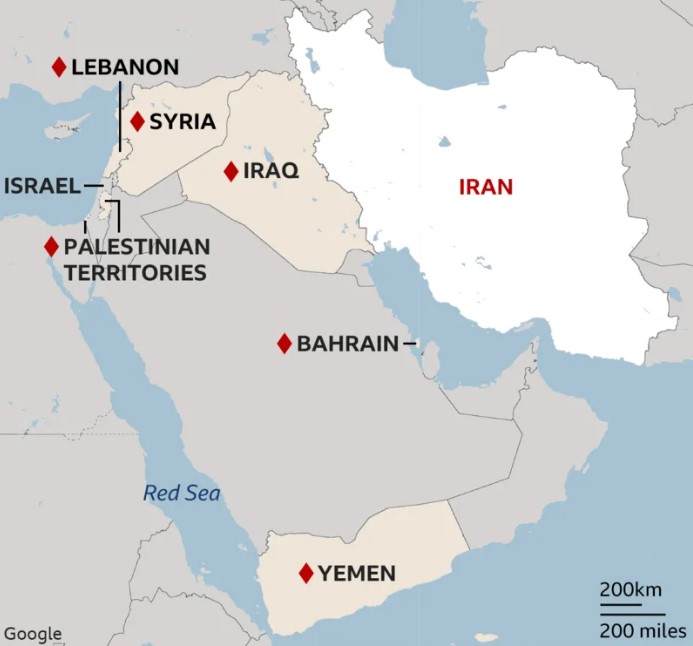
A Region at War, A World on Edge
The US Israel Iran war has entered its third day, Missile launches continue. Volcanic smoke continues to blot out the clear air of cities. News alerts have yet to stop vibrating. Only three days after the United States, Israel and Iran first went into open hostilities, there is no escaping the harsh reality that:
No one knows where this might end.
The conflict began with coordinated attacks from each country on opposing factions; however, due to the unpredictable nature of the conflict, there are currently military forces of each country, in addition to other foreign forces, actively participating in the escalation of the conflict.
Iran has directly attacked some Arab countries that align with the United States. Tensions remain high throughout the Gulf Region as a result of the continuation of missile launches by the various parties involved in the conflict. Military bases of western countries are currently on a high state of alert as a result of the increase of tension. Equity markets are also experiencing extreme volatility. While leaders of each country are proclaiming victory, very few leaders are quantifying the cost.
This is not another escalation of the Middle East as is often seen in the past.
This is a geopolitical gamble with long-term consequences.
The Conflict Was Triggered by U.S./Israel's Strikes Against Iran
The recent escalation of hostilities between Iran and the United States and Israel, and their respective allies, erupted following the United States and Israel hitting Iran's military infrastructure with a joint strike to destroy both its capability to create weapons of mass destruction (WMD) and its missile delivery capability; however, the United States also referred to it as a pre-emptive strike aimed at eliminating Iran's missile capabilities and neutralizing a perceived imminent threat.
In a video message delivered from his Mar-a-Lago estate in Florida, Donald Trump declared that:
- He would eliminate Iran's missile producing capabilities.
- He would annihilate all Iranian naval capabilities.
- He would end the reach of Iran's regional proxy forces.
Trump went on to explain the reasons for such military actions; that Iran has been a threat since the 1979 Islamic Revolution and is developing capabilities to produce nuclear weapons. His statements have created significant arguments within the intelligence and diplomatic communities.
However, the primary question that must be answered is:
Is this a war designed to provide deterrent capabilities, or is it a war to overthrow the Iranian regime?
Victory according to Trump
The way in which Trump defines what it means to be victorious is very expansive and black and white.
He has stated numerous times that once the Iranian leadership has been degraded, that the Iranian people will then be able to "take back" their government; therefore, this will incite the Iranian people to commit acts of revolution while at the same time, conduct air strikes from outside Iran.
History tells us that we should be careful.
Military air power as an example, has not generally been able to produce a regime change in an existing state with a strong governance structure. A military ground invasion was necessary in 2003 for the ousting of Saddam Hussein; for example. NATO bombers provided air cover to assist anti-government rebels in overthrowing Moammar Gadhafi in Libya in 2011, only to see Libya disintegrate into disarray following Gadhafi’s departure.
Iran is not like Iraq.
The structures of Government in Iran differ considerably from that of Libya or Iraq. The complexity of the Government structure in Iran will make fighting against a regime change much more difficult.
Netanyahu's Long Game:
Prime Minister Netanyahu has been preparing for this fight with Iran for a number of years.
He has long regarded Iran as Israel's greatest threat, both because of Iran's nuclear ambitions, and because (of Iran) supporting militias throughout the region. During a press conference held on October 9, 2023 in Tel Aviv, Netanyahu stated that the United States and Israel would work together to "completely destroy the regime of terror."
For Netanyahu, the war is not only an existential issue but is also political in nature.
This was also the reason that there will be a general election in Israel soon after the attack on October 7, 2023. Many Israelis were concerned about Netanyahu's ability to provide security because of the attack. His political positioning could very well change if he can achieve a definitive military victory over Iran.
The Definition of Victory for Iran is Survival as a Nation
The Islamic Republic of Iran has been built to survive crises. Its structure does not depend on a single leader. In other words, the Islamic Republic is not a country where all power rests with one person; rather, it consists of a web of hierarchically arranged clerics who have authority over military, economic, and ideological matters.
The heart of the security apparatus is the Islamic Revolutionary Guard Corps (IRGC). The IRGC was created to secure the revolution from both internal and foreign threats, thus providing a basis to secure the Iranian regime. The IRGC controls not only conventional military units but also intelligence operations, paramilitary forces, and various segments of the Iranian economy.
Another key element of security is the Iran Bastion (Basij) militia, a loyal street-level enforcer often used by the Iranian regime during periods of intra-national unrest.
Through this lens, the Islamic Republic of Iran's definition of victory is not to physically defeat the United States in a military engagement; instead, it is simply to outlast the United States. As long as the regime endures sustained airstrikes, maintains its internal cohesion among its military forces, and does not suffer mass defections, the Islamic Republic will present its survival as a victory, despite its infrastructure being decimated.
Could the Regime Collapse?
In the wake of the death of a leader, many people speculated about the potential for an anti-establishment, pro-Western coup.
Is it possible? Yes.
Is it probable? Not at this point.
Historically, when there are disruptive events at the beginning of a repressive regime (disruption being the first wave of a series of events that will ultimately end the repressive regime), that regime will typically consolidate power and strengthen its internal command structure.
Martyrdom is a core tenet of the visible political theology in many Middle Eastern countries (including Iran) so regime's will actively mobilize their ideology during a crisis. There are thousands of people who gathered in mourning ceremonies throughout Tehran, but whether they were motivated by fear, loyalty or a combination of both is difficult to tell. The core support structural (loyalty) of a regime has not been seen breaking down within this event.
Historically, the only successful regime changes have been carried out via direct military action.
The Ripple Effect on a Regional Level
Iran has targeted not only the U.S. and Israeli assets but also their Arab neighbors who are allied with the US. This change has turned the battle into a larger regional conflict.
Tensions have escalated in the Persian Gulf. The shipping lanes are now at risk, energy markets have become unstable, and oil prices are increasing due to early trading.
If Hezbollah in Lebanon, militias in Iraq, or other militias set up by Iran were to fully activate, it could change the potential battlefield immensely.
Once a war expands, it becomes increasingly more difficult to regulate the tempo and determine when it will end.
The Ghost Of History
History is a cautionary tale.
After the U.S. removed Saddam Hussein, Iraq was left in chaos for a very long time and the conditions for extremist groups to thrive were set. Libya was left in disarray by the removal of Gaddafi and there are now many competing militias fighting over control of a fractured state.
Iran is about three times larger than Iraq, contains over ninety million people and has many different ethnic groups within its borders. If there were to be a sudden breakdown of the Iranian regime, the reaction to that would likely lead to fragmentation, insurgent activity or a protracted civil war.
The majority of Iranian citizens who are opposed to the current regime are more afraid of being in chaos than they are of remaining under an authoritarian regime.
The worst scenario may not be one where the current government in Iran still exists.
The worst-case scenario may be a very fragmented, chaotic and dysfunctional Iranian state.
The Gamble
Trump thinks that brute force can change the Middle East and make it a safer place to live. Netanyahu thinks that if Iran is defeated, Israel will be safe for generations.
Tehran believes that patience is the best way to defeat both of them.
It has only been three days since the war began and the situation continues to change dramatically.
Missiles are being launched continually. Diplomacy has been virtually non-existent. The world's markets are fluctuating. And civilians await the next stage of this disaster.
Wars typically do not proceed as they were planned; they develop a life of their own once commenced, driven by fear, pride, poor judgement and the instinct to survive.
At the present time there is no one in Washington, Tel Aviv or Tehran who has any confidence that he understands the final outcome
What is known is this: The Middle East has entered one of its most perilous periods in the past several decades.
The decisions that are made in the next few days could determine the future of the region for a generation.
The war commenced.
The end has not been written yet.



Comments (0)
Leave a Comment
No comments yet
Be the first to comment