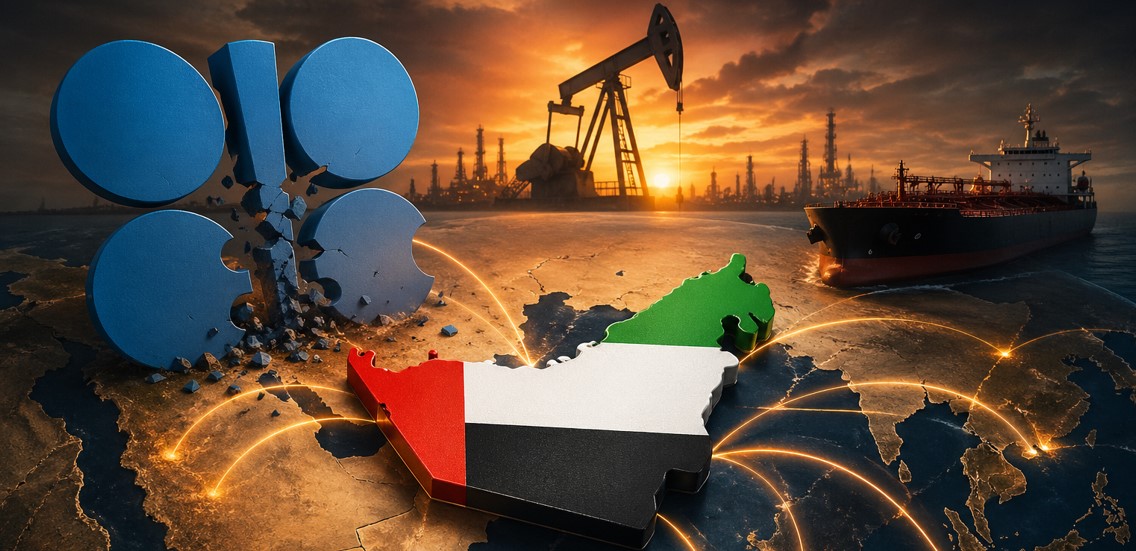
The United Arab Emirates is pulling away from the world's most powerful oil cartel. With the Strait of Hormuz already under pressure, the timing could not be more volatile for global energy markets and everyday fuel prices.
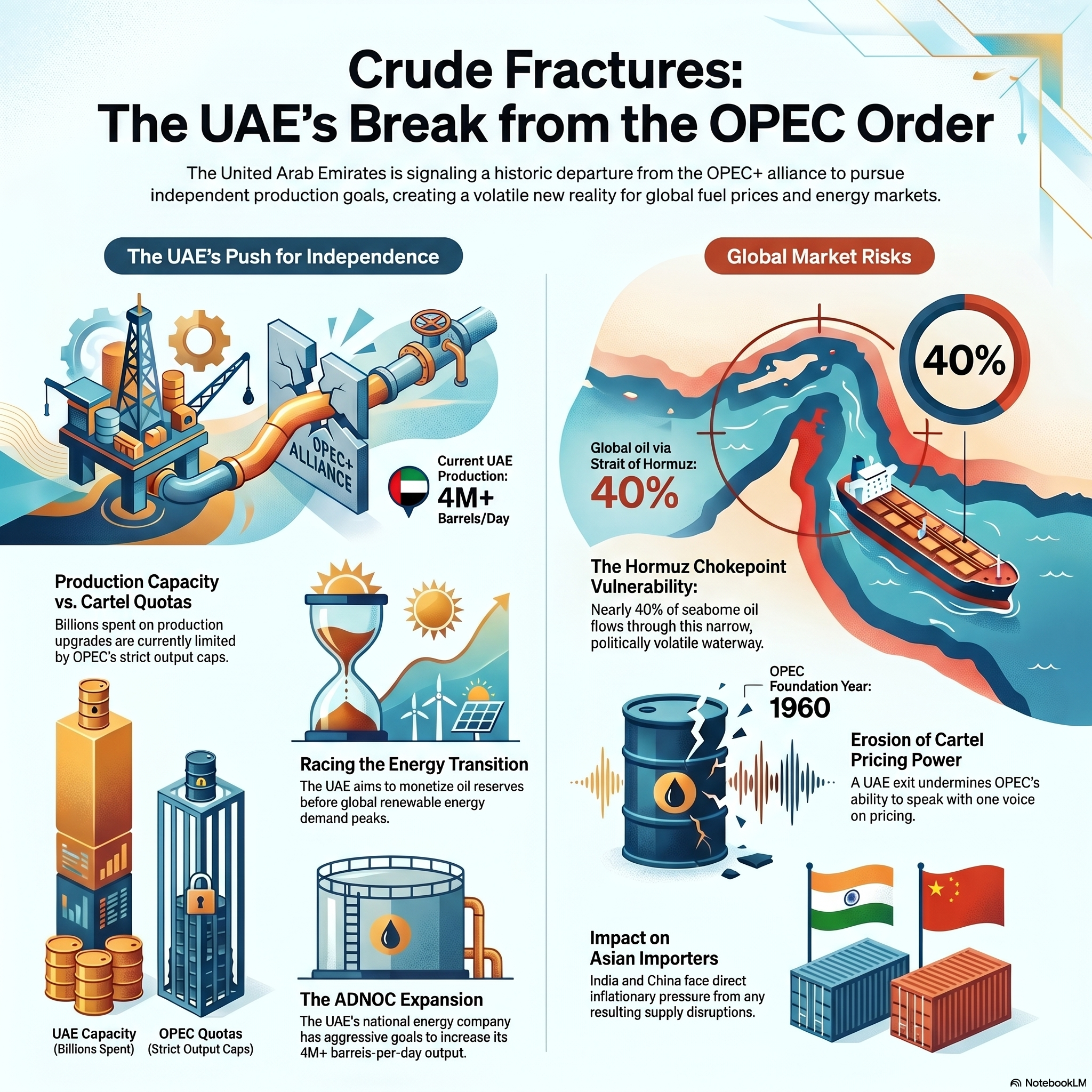
40% of global oil shipped via Strait of Hormuz |
13 OPEC member nations controlling supply |
4M+ barrels/day UAE currently produces |
1960 year OPEC was founded in Baghdad |
Something seismic is shifting beneath the global oil market. The United Arab Emirates, one of the world's top crude producers and a founding-era heavyweight inside the OPEC+ alliance, is signaling its intent to chart an independent course outside the oil cartel's control. At the same time, Iran's threats to block the Strait of Hormuz, the narrow waterway through which nearly 40 percent of seaborne oil flows, have pushed energy market volatility to levels not seen in years. For anyone who drives a car, pays an electricity bill, or buys groceries, what happens next in this geopolitical drama will hit close to home.
What Is OPEC and Why Does It Control Your Fuel Bill
The Organization of the Petroleum Exporting Countries was born in Baghdad in 1960. Five founding nations, Saudi Arabia, Iran, Iraq, Kuwait, and Venezuela, came together with a single shared goal: take back control of oil pricing from the Western companies that dominated the industry at the time.
Over the decades, OPEC grew into the most powerful commodity cartel the world has ever seen. Its members collectively hold more than two-thirds of the planet's proven oil reserves. When OPEC decides to cut production, global oil supply tightens, prices rise, and consumers everywhere pay more at the pump. When it opens the taps, prices fall. That leverage over the global economy is enormous.
In 2016, OPEC expanded into OPEC+ by pulling Russia and other major producers into a coordinated supply agreement. This made the alliance even more influential. But it also planted the seeds of internal tension that are now coming to a head.
OPEC+ controls roughly half of global oil output. When its internal unity cracks, markets pay attention.
Why the UAE Wants Out of OPEC's Shadow
The UAE's friction with OPEC, and particularly with Saudi Arabia, has been building for years. The core issue is straightforward: Abu Dhabi has spent billions of dollars expanding its oil production capacity through its national energy company, ADNOC. But OPEC's quota system kept capping how much the UAE could actually produce and sell.
Think of it like owning a factory you've invested heavily to upgrade, but being told by a committee how many units you can ship. That frustration became public in 2021, when the UAE nearly derailed an OPEC+ supply agreement over quota disputes.
There is also a longer-term calculation at play. The UAE's leadership is acutely aware that global demand for fossil fuels will not grow forever. The renewable energy transition is real and accelerating. If the UAE is going to earn maximum value from its oil reserves before that transition fully takes hold, it needs the freedom to pump and sell as much as possible, on its own terms, without waiting for a cartel consensus.
The UAE's decision is not just about today's barrel price. It is about extracting maximum long-term value from its reserves before the energy world changes permanently.
The Strait of Hormuz: A Crisis That Makes Everything Worse
While the UAE's OPEC exit is a slow-burning structural story, the Strait of Hormuz situation is an immediate and acute danger. Iran has repeatedly threatened to block this narrow passage between the Persian Gulf and the Arabian Sea. Nearly 20 million barrels of oil pass through it every single day.
If the strait were disrupted, even temporarily, it would trigger a global oil supply shock of historic proportions. Shipping insurance costs would spike overnight. Asian refineries dependent on Gulf crude would scramble for alternative supplies. Energy market volatility would be severe and sustained.
The cruel irony is that the UAE, despite leaving OPEC, remains geographically and economically exposed to a Hormuz crisis. Much of its own oil exports also pass through this chokepoint. A disruption hurts everyone in the region, cartel member or not.
How UAE's Exit Could Reshape Global Oil Prices
OPEC's greatest power has always been its ability to speak with one voice. A UAE exit undermines that collective bargaining power in a significant way. With the UAE free to produce independently, OPEC loses flexibility in managing supply, and therefore loses some leverage over prices.
In the short term, more UAE oil entering the market without cartel coordination could push prices downward, which sounds good for consumers but creates severe budget stress for oil-dependent economies like Saudi Arabia, which needs crude prices well above $80 per barrel to balance its government spending.
Over the medium term, the bigger risk is market fragmentation. If other Gulf producers or African OPEC members see the UAE operating profitably outside the cartel, the incentive to stay inside diminishes. A fragmented oil market, with producers competing individually rather than coordinating, could produce wild price swings that destabilize industries and national budgets alike.
Energy market volatility is not just a problem for oil companies. It is a problem for every government that plans budgets around fuel revenues or import costs.
India and Asia: Who Feels the Pain Most
For India, the UAE's OPEC exit and the Hormuz situation arrive at a difficult moment. India is the world's third-largest oil importer, deeply dependent on Gulf crude to fuel its fast-growing economy. Any oil supply disruption translates almost directly into higher petrol prices, higher transport costs, and broader inflation across the economy.
China, Japan, and South Korea face similar vulnerabilities. These Asian economies collectively import enormous volumes of Gulf oil through the very straits now under threat. A serious oil supply disruption would slow industrial output, raise energy costs, and weaken currencies already under pressure from global uncertainty.
For ordinary consumers in these countries, the consequences arrive in the most familiar ways: higher fuel prices at the pump, more expensive goods on the shelf, and tighter household budgets.
The Long-Term Power Shift in Global Energy
Beyond the immediate market drama, the UAE's move is a signal that the old rules of the oil world are being rewritten. The rise of American shale oil already broke OPEC's monopoly on marginal supply decisions. Now, internal defections from within the cartel itself further erode that collective power.
Meanwhile, solar, wind, and battery storage costs continue to fall. More countries are hitting aggressive renewable energy targets. The long-term demand trajectory for oil is bending downward, which means every major producer, inside or outside OPEC, is under pressure to monetize reserves faster, not slower.
This creates a paradox. The very thing that is driving UAE out of OPEC, the rush to produce more before demand peaks, could flood markets with oil at exactly the time the world needs less of it. The energy transition will not be smooth. It will be messy, competitive, and full of geopolitical turbulence.
A Historic Moment the World Cannot Afford to Ignore
The UAE leaving OPEC is not merely a bureaucratic reshuffling inside a commodities alliance. It is a historic signal that the global oil order, built carefully over six decades, is fracturing under the combined pressure of geopolitical rivalry, economic self-interest, and the looming reality of an energy transition.
Combined with the Strait of Hormuz crisis, readers worldwide are watching a convergence of oil supply disruption risks that could reshape fuel prices, inflation, and economic stability from Mumbai to Berlin to São Paulo.
Watch three things closely in the months ahead: whether other Gulf producers follow the UAE's lead, how Iran's Hormuz threats escalate or de-escalate, and whether OPEC+'s remaining members can hold together without the UAE inside the tent. The answers will shape what you pay for energy for years to come.



Comments (0)
Leave a Comment
No comments yet
Be the first to comment