Introduction
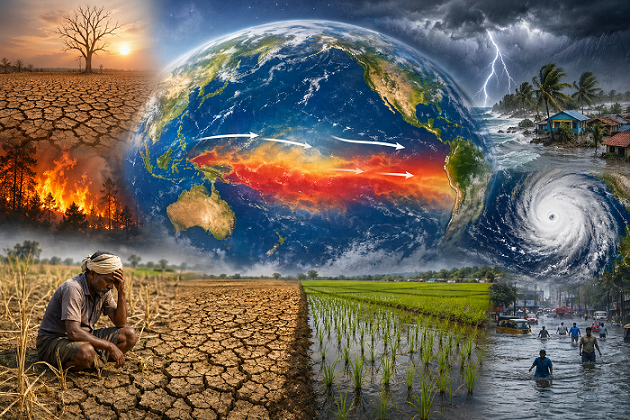
A strong El Niño expected to develop in mid-2026 is positioning itself as one of the most consequential climate events of this decade. Scientists at NOAA, the World Meteorological Organization (WMO), and research institutions across Asia and Europe are issuing early alerts as sea surface temperature anomalies in the central and eastern Pacific Ocean continue to rise. El Niño is a natural ocean-atmosphere phenomenon characterized by the periodic warming of Pacific surface waters, but when a strong El Niño expected scenario materializes, it disrupts weather systems across virtually every continent. For countries like India, which depend heavily on the annual monsoon for agricultural output and water security, the implications are severe and demand immediate policy attention.
What Causes a Strong El Niño?
El Niño begins with the weakening of the trade winds, the easterly winds that normally push warm surface water from the eastern Pacific toward Asia and Australia. When these winds weaken or reverse, warm water accumulates along the central and eastern Pacific coast near South America. This abnormal warming is measured using the Oceanic Nino Index (ONI), which tracks sea surface temperature anomalies in the Nino 3.4 region of the equatorial Pacific.
A standard El Niño event corresponds to an ONI value above +0.5 degrees Celsius for at least five consecutive overlapping three-month periods. A strong El Niño, classified when the ONI exceeds +1.5 degrees Celsius, is associated with amplified global weather disruptions. The 1997-98 and 2015-16 El Niño events crossed +2.5 degrees Celsius and were classified as Super El Niños, causing record-breaking temperatures and catastrophic flooding and drought across multiple regions simultaneously.
The development of a strong El Niño is influenced by climate cycles including the Pacific Decadal Oscillation (PDO) and the Madden-Julian Oscillation (MJO), which modulate how quickly warm water accumulates in the Pacific. In 2026, climate models from multiple agencies indicate a transition from the current neutral or La Nina phase toward a positive El Niño state, with a high probability of reaching the "strong" threshold by the Northern Hemisphere summer.
Global Impact of Strong El Niño Expected
The teleconnection effects of a strong El Niño cascade across continents through shifts in the jet stream, altered precipitation belts, and modified monsoon circulation.
Asia
In South Asia, a strong El Niño consistently correlates with below-average monsoon rainfall in India, Pakistan, Bangladesh, and Sri Lanka. In Southeast Asia, the phenomenon suppresses convection, triggering drought conditions across Thailand, Myanmar, Vietnam, and Indonesia. Agriculture across the region, particularly rice production, suffers significantly. Indonesia's rice yields fell by approximately 5 to 7 percent during the 2015-16 El Niño. A comparable or stronger event in 2026 would stress food supply chains across a region that produces over 90 percent of the world's rice.
Africa
East Africa, including Kenya, Ethiopia, Somalia, and Uganda, typically experiences drought during strong El Niño events, compounding existing food insecurity crises. However, equatorial and parts of southern Africa may face paradoxically heavier than normal rainfall, raising flood risks. The 1997-98 El Niño caused massive flooding in East Africa even as it triggered drought in southern regions, highlighting the complexity of regional impacts.
Australia
Australia is among the most consistently impacted countries during El Niño. Reduced rainfall in the eastern and southern states elevates bushfire risk, particularly from September through February. The catastrophic 2019-20 Australian bushfire season, while not driven solely by El Niño, was partly intensified by the dry, hot conditions associated with a moderate El Niño state. A strong event in 2026 would likely produce extreme heatwave conditions, drought in the Murray-Darling Basin, and record-low reservoir levels across Queensland and New South Wales.
North America
In North America, a strong El Niño typically brings increased storm activity and precipitation to the southern United States, including California, Texas, and Florida. The Pacific jet stream is displaced southward, funneling winter storms into regions that are otherwise prone to drought. Paradoxically, the northern United States and Canada experience warmer and drier than normal winters, reducing snowpack that is critical for spring river flows.
South America
The western coast of South America, particularly Peru and Ecuador, faces heavy rainfall and flooding due to direct ocean warming. Peru's fishing industry, one of the largest anchovy fisheries in the world, collapses during strong El Niño events as fish migrate away from warming coastal waters. Brazil's northeast region, conversely, faces drought. During the 1997-98 event, agricultural losses across South America reached several billion dollars.
Europe
The El Niño signal in Europe is weaker and more variable, but a strong event is associated with milder winters in northwestern Europe. While this may reduce heating energy demand in countries like the United Kingdom and France, it also disrupts seasonal agricultural cycles and can trigger anomalous late spring rainfall patterns that delay planting.
Impact of Strong El Niño Expected on India
Monsoon Impact
India's southwest monsoon, which delivers approximately 70 percent of the country's annual rainfall between June and September, is highly sensitive to El Niño. Historical data shows that roughly 60 percent of strong El Niño years have coincided with below-average monsoon rainfall in India. The India Meteorological Department (IMD) uses Pacific sea surface temperature data as a primary predictor for seasonal forecasts.
A strong El Niño in 2026 is projected to weaken the monsoon circulation by suppressing the temperature gradient between the land and ocean that drives moisture-laden winds from the Arabian Sea and Bay of Bengal into the Indian subcontinent. Regional variance is significant. The northwest and central India regions, including Maharashtra, Gujarat, Rajasthan, and Madhya Pradesh, are most vulnerable to deficient rainfall. The northeastern states and the Himalayan foothills receive relatively more rainfall during El Niño years due to their proximity to Bay of Bengal systems.
Monsoon onset delays are also probable. Historically, El Niño years see monsoon onset over Kerala delayed by seven to ten days beyond the normal June 1 date, with cascading delays across the country through the peak July-August period.
Agriculture Impact
India's agriculture sector, which employs approximately 45 percent of the workforce and contributes about 17 percent to GDP, faces severe disruption under a strong El Niño scenario.
Rice: Kharif rice, planted during the monsoon season, is the most vulnerable major crop. Below-average June and July rainfall directly reduces planting area and yield. During the 2002 and 2009 El Niño events, India's rice production dropped by 15 to 20 percent in the worst-hit states.
Wheat: While wheat is a rabi (winter) crop and less directly affected by monsoon shortfall, reduced soil moisture recharge during the kharif season leads to inadequate irrigation water availability for winter crops, stressing yields in Punjab, Haryana, and Uttar Pradesh.
Pulses: Pulses including tur dal, moong, and chana are particularly vulnerable as they are rain-fed crops with limited irrigation coverage. Production shortfalls in drought years typically exceed 20 percent, driving sharp price increases in protein staples consumed heavily by lower income households.
Sugarcane: Maharashtra and Uttar Pradesh, which together account for over 70 percent of India's sugarcane production, experience yield decline during deficient monsoon years. This affects not only sugar supply but also the ethanol blending program that is a pillar of India's energy transition strategy.
Irrigation pressure increases substantially when rainfall is deficient. Over-extraction from aquifers, already stressed across Punjab, Haryana, and Telangana, accelerates further. Food price inflation historically rises by 3 to 6 percentage points above baseline in post-monsoon quarters following a drought year.
Water Resources
Below-normal monsoon rainfall reduces inflows into India's major reservoirs. The 91 major reservoirs monitored by the Central Water Commission collectively hold approximately 250 billion cubic meters of live storage capacity. During El Niño years, live storage at the end of September is typically 20 to 30 percent below the ten-year average.
Rural communities dependent on ponds, check dams, and shallow borewells face acute drinking water shortages from December onward if the preceding monsoon was deficient. Groundwater recharge, which relies on monsoon infiltration, is severely compromised. Districts in Marathwada, Bundelkhand, and interior Karnataka are historically the first to declare water scarcity conditions.
Heatwaves
A strong El Niño intensifies the pre-monsoon heatwave season from April through June. Surface temperatures in north and central India are already pushing above 45 degrees Celsius in recent years. With El Niño further suppressing cloud cover and delaying monsoon onset, the heat season extends longer and peaks higher. Urban heat island effects in cities like Delhi, Nagpur, and Ahmedabad compound mortality risks. The 2015 El Niño year saw over 2,500 heat-related deaths in India, one of the deadliest heatwave events in the country's recorded history.
Risk of Extreme Weather Events
A strong El Niño elevates the probability of multiple categories of extreme weather events simultaneously. Drought conditions affecting agriculture and drinking water coexist with flood risks in coastal and low-lying areas. Cyclone formation in the Arabian Sea increases during El Niño as sea surface temperatures off the Indian west coast warm. Wildfires expand across Australia, Southeast Asia, and parts of Africa due to dry vegetation and high temperatures. These concurrent crises strain emergency response systems and amplify humanitarian risk.
Economic Impact on the World
The 1997-98 El Niño caused an estimated 45 billion dollars in direct economic losses globally, with agricultural, infrastructure, and insurance sectors bearing the largest share. A strong El Niño in 2026, given the growth of global GDP and increased climate exposure, could produce losses several times larger.
Food inflation is the most pervasive economic consequence. When South Asia, Southeast Asia, and East Africa simultaneously experience drought, global grain prices spike. The World Food Programme estimates that each major El Niño event pushes an additional 10 to 20 million people toward food insecurity. Energy demand rises as reduced hydropower capacity in drought-hit countries forces greater reliance on thermal generation, increasing fossil fuel consumption and energy costs. Supply chain disruptions from port flooding in South America and road damage in Southeast Asia further inflate global logistics costs.
Climate Change and Super El Niño Risk
Global warming is reshaping the baseline against which El Niño operates. The additional heat trapped by greenhouse gases means that even a moderate El Niño today produces temperature anomalies that would have qualified as extreme events two decades ago. Climate scientists have documented a statistically significant increase in the frequency and intensity of strong El Niño events since the 1970s.
The possibility of a Super El Niño in 2026, defined by an ONI exceeding +2.0 degrees Celsius, cannot be dismissed. The 2023-24 El Niño crossed +2.0 degrees and drove global average surface temperature above 1.5 degrees Celsius above pre-industrial levels for the first time on record. A 2026 Super El Niño event could push global temperatures to new records, with particularly dangerous consequences for heat-vulnerable populations in South Asia, sub-Saharan Africa, and the Arabian Peninsula.
How Governments and Farmers Can Prepare
For Governments
Governments must treat the El Niño forecast as an operational emergency, not merely a scientific projection. Water management systems should accelerate reservoir conservation protocols by reducing non-essential allocations from January 2026. Crop insurance programs require pre-season expansion to cover smallholder farmers in drought-prone districts before the kharif sowing season begins. Early warning systems connecting IMD seasonal forecasts to state-level agricultural departments and district collectors must be tested and operationalized. National Disaster Response Force units should be pre-positioned in historically vulnerable regions from May onward.
For Farmers
Farmers should begin shifting toward drought-resistant crop varieties including improved millets, sorghum, and short-duration rice varieties that can complete their growth cycle with lower rainfall. Micro-irrigation adoption, particularly drip systems for sugarcane and horticulture, should be accelerated through existing government subsidy programs. Crop diversification away from water-intensive kharif rice toward pulses and oilseeds in deficit-rainfall zones can reduce both economic risk and water demand.
Future Outlook for 2026 and Beyond
Climate monitoring agencies including NOAA, the Japan Meteorological Agency, and the European Centre for Medium-Range Weather Forecasts will issue updated El Niño outlooks through the early months of 2026. The Boreal spring predictability barrier, a phenomenon that makes El Niño forecasts less reliable before May, will resolve by April or May, allowing high-confidence forecasts for the monsoon season.
If El Niño peaks in mid-to-late 2026, the system typically begins to weaken by early 2027, with a possible transition to La Nina conditions by the 2027-28 year. The recovery phase may bring above-normal monsoon rainfall to India, but the transition period itself is associated with climate instability and unpredictable extreme events.
Conclusion
A strong El Niño expected in 2026 represents a major and multidimensional global climate threat. Its consequences extend from rice paddies in Odisha to livestock farms in Kenya to wheat fields in Australia, linking agricultural vulnerability, water scarcity, heat risk, and economic instability into a single planetary event. For India, the stakes are particularly high given the dependence of food security and rural livelihoods on the monsoon. Early preparation, informed by science and executed through robust government policy and farmer-level adaptation, is the only credible response. Long-term climate resilience investment, not just crisis response, is now the strategic imperative for every nation in El Niño's path.



Comments (0)
Leave a Comment
No comments yet
Be the first to comment