What Is the Core Battle in Tamil Nadu Election 2026?
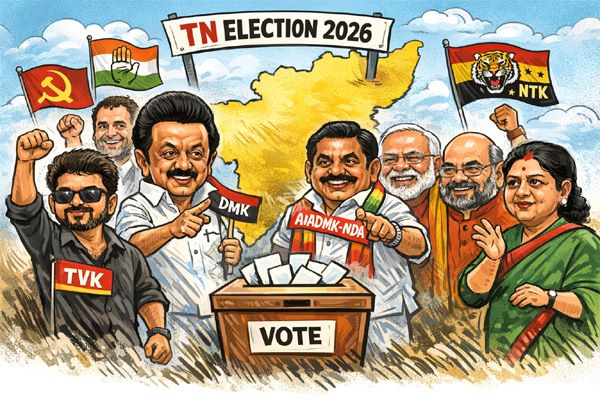
Tamil Nadu election 2026, scheduled for April 23 across all 234 constituencies, is shaping up as the most analytically complex state contest the southern state has seen in decades.
On the surface, it remains what it has always been: a DMK vs AIADMK contest rooted in Dravidian ideology, welfare economics, and caste-community arithmetic. But three structural changes make this cycle different from 2021. The AIADMK-BJP alliance has been reconstituted after a bitter split. Actor-politician Vijay has launched a third political force with real youth traction. And both major parties have escalated their welfare manifesto promises to levels that stretch the credibility of fiscal implementation.
The party that navigates all three changes most effectively on April 23 forms the government.
DMK Strategy: Defend the Record, Outbid on Welfare
The DMK enters this election with five years of governance to defend and a manifesto designed to reframe that defence as an offensive.
The DMK's campaign focuses on welfare expansion, infrastructure development, and improvements in education and healthcare, projecting a governance model centred on social development and inclusive growth.
Stalin's flagship manifesto promise is the "Illathu Arasi" scheme, a Rs 8,000 coupon per family for household appliances. The DMK's own political template traces back to former party president M. Karunanidhi's promise of free colour television sets in the 2006 elections, which helped sweep the party to power and became a model for welfare-led campaigns across India. Two decades on, the Illathu Arasi coupon is that promise scaled up and reframed.
A 12-member drafting committee led by DMK Deputy General Secretary and MP Kanimozhi toured Tamil Nadu to gather public feedback before finalising the 525 promises. Stalin is framing the coupon not as a freebie but as a demand-side economic intervention that puts money into neighbourhood shops and stimulates local retail, a framing designed to neutralise opposition charges of populism.
The final DMK lineup reflects a balance between experienced leaders, sitting MLAs, and over 60 new faces, signalling the party's attempt to refresh its electoral base. The candidates include professionals such as advocates, engineers, doctors, and PhD holders. M. K. Stalin contests from Kolathur, while Deputy Chief Minister Udhayanidhi Stalin contests again from Chepauk.
AIADMK Strategy: Anti-Incumbency, Alliance Rebuild, Palaniswami as Face
The AIADMK's challenge is structural before it is electoral. Since Jayalalithaa's death, the party has spent more energy on internal disputes than on governance positioning.
Since the death of J. Jayalalithaa, the AIADMK has struggled to reassert itself as a cohesive force. Leadership tussles have hardened into enduring factional divides. While Edappadi K. Palaniswami has brought a degree of organisational control, unity remains elusive.
Palaniswami's response to that challenge is to make this election a personal mandate. AIADMK General Secretary Edappadi K. Palaniswami announced he will personally contest from Edappadi, the constituency he has held for decades. This is his fifth time contesting from that seat. He has staked his own reputation on this election.
On July 7, 2025, AIADMK general secretary Palaniswami launched a statewide campaign with the slogan "Makkalai Kaappom, Thamizhagathai Meetpom" meaning Let's Protect the People, Let's Save Tamil Nadu. On March 24, 2026, Palaniswami released the election manifesto.
The AIADMK's 297-point manifesto promised free refrigerators to all rice ration card-holding families, a one-time Rs 10,000 special assistance per household, and Rs 2,000 monthly under the Kulam Vilakku Scheme to the female head of every ration card-holding family.
On corruption, Palaniswami alleged that Tamil Nadu liquor shops sell 1.5 crore bottles daily and a Rs 10 surcharge per bottle has resulted in a Rs 24,000 crore scam over four years. He has also promised to take legal action through the Enforcement Directorate if the AIADMK forms the government.
The alliance architecture has been restored after the 2024 separation. AIADMK is leading the NDA alliance in Tamil Nadu and will contest 169 seats, with BJP allotted 27 seats, PMK 18 seats, and AMMK 11 seats.
The TVK Wildcard: How Vijay Could Decide Who Wins Without Winning
Tamilaga Vettri Kazhagam, launched by Tamil film star Vijay, is not expected to win a majority. It does not need to in order to determine who does.
Tamil Nadu has dozens of constituencies where the gap between the DMK candidate and the AIADMK candidate will be somewhere between 5,000 and 20,000 votes. In those seats, even a modest TVK performance changes who wins. The voters most likely to back Vijay are young people, urban residents, those who feel that the two Dravidian parties have been passing power back and forth for 50 years without much changing.
An opinion poll conducted by Vote Vibe states that the DMK alliance is likely to win 113 to 123 seats while the AIADMK alliance is likely to win 106 to 116 seats. Vijay's TVK is likely to win 2 to 8 seats.
The seat math matters: 118 seats are required for a majority in the 234-member assembly. If TVK peels away even 10,000 votes in 30 marginal seats, those constituencies could shift from DMK to AIADMK, potentially making the difference between a majority and a hung assembly.
On March 24, 2026, Kamal Haasan's Makkal Needhi Maiam announced that it would not contest the election but extended support to the Secular Progressive Alliance led by DMK, a decision that strengthens the DMK's alliance headcount without adding a contentious seat-sharing negotiation.
Why Anti-Incumbency Has Not Crystallised Against DMK
Anti-incumbency is real in Tamil Nadu. It is not, however, unified.
While there may be pockets of dissatisfaction with the DMK government, the absence of a unified opposition prevents this sentiment from coalescing into a decisive electoral force. Instead, it is likely to disperse across multiple players including the AIADMK, BJP, PMK, and Vijay's TVK, each drawing from overlapping constituencies. As one veteran observer puts it, discontent exists, but there is no agreement on who should benefit from it.
This structural asymmetry is the DMK's most durable advantage. Tamil Nadu's ideological foundations, rooted in the Periyarist tradition of social justice and rationalism, have historically insulated Dravidian parties from Hindutva mobilisation. Tamil Nadu's resistance to Hindutva politics remains its defining feature, with elections fought not on identity alone but on dignity, welfare and rights, as Chennai-based academic C. Lakshmanan observes. This limits the BJP's ceiling in Tamil Nadu even as it benefits from the AIADMK alliance seat-sharing.
The Manifesto War: Promises vs Fiscal Reality
Both parties have entered a welfare bidding war that neither has fully costed.
Notably, neither the DMK nor the AIADMK manifesto makes any reference to liquor prohibition, a conspicuous omission given that a total ban on alcohol has historically been a high-profile campaign demand, particularly in DMK circles. This silence reflects both parties' dependence on TASMAC excise revenue to fund the welfare schemes they are simultaneously promising.
The DMK's 525 promises and AIADMK's 297 points together represent the most expansive welfare commitments in Tamil Nadu's election history. The fiscal credibility question, how either government would fund these schemes while managing debt sustainability, will follow whichever party wins into its first budget.
What the Pre-Poll Numbers Say
When asked who they wanted as Chief Minister in 2026, 39.9% chose M. K. Stalin, 37.5% chose Edappadi Palaniswami, and 14.7% chose TVK leader Vijay. On how they viewed the contest, 41.2% said it would be a completely two-way battle, while 18.7% said it would be a three-way contest.
A Parawheel survey found the DMK ahead with 41.5 percent vote share, AIADMK at 36.2 percent, and TVK emerging as a third major bloc. The margin between the two leading parties in vote share terms is narrow enough that local candidate quality, community mobilisation, and final-week campaigning will materially affect the seat count.
Conclusion: Tamil Nadu Election 2026 Is a Welfare and Legitimacy Contest
The Tamil Nadu election 2026 on April 23 is not simply a repeat of the DMK vs AIADMK rivalry. It is a contest between two competing theories of political legitimacy.
The DMK argues that five years of welfare delivery, infrastructure investment, and social equity programming entitle it to a second term. The AIADMK argues that governance drift, corruption allegations, and law and order failures disqualify the incumbent. Vijay's TVK argues that both parties have had fifty years and that the answer is generational replacement.
Voters across 234 constituencies will give one of those arguments a majority on May 4. The pre-poll data, the manifesto content, and the alliance structures all point narrowly toward the DMK. But Tamil Nadu's political history is full of upsets built on exactly the kind of fragmented opposition that surveys can undercount.
April 23 will provide the definitive answer.

Comments (0)
Leave a Comment
No comments yet
Be the first to comment