When the Venue Becomes the Message
“When India’s second-highest constitutional authority chooses a naturopathy ashram to articulate the nation’s health philosophy, the signal goes far beyond ceremony.”
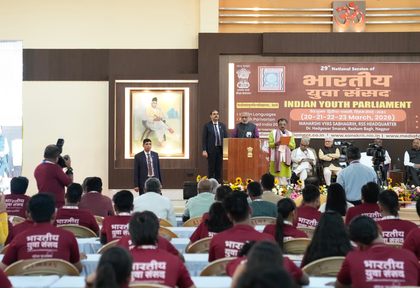
On Sunday, March 22, 2026, Vice President C.P. Radhakrishnan addressed the 81st Foundation Day of the Nisargopachar Ashram in Uruli Kanchan, Pune. Conceptualised by Mahatma Gandhi, the Ashram remains one of India’s oldest naturopathy centres.The choice of venue stands out. It was not a hospital, nor a policy summit, but a Gandhian wellness institution. This setting framed the message even before the speech began.The Vice President was joined by Maharashtra Governor Jishnu Dev Varma, Deputy Chief Minister Sunetra Ajit Pawar, and Rajya Sabha Deputy Chairman Harivansh Narayan Singh. The presence of senior constitutional and political figures underscored the institutional weight of the event.
Institutional Memory Meets Policy Continuity
Radhakrishnan’s return to Maharashtra carries added meaning. Having served as Governor from July 2024 to September 2025, he combines ceremonial authority with regional familiarity. This continuity lends credibility to his message and reinforces the idea that the visit was not symbolic, but strategic.
Reframing Development: Swasth Bharat Within Viksit Bharat
“Health is not merely the absence of disease, but a state of complete physical, mental, and spiritual well-being.”
— Vice President C.P. Radhakrishnan, Pune, March 22, 2026
At the heart of the address was a clear reframing. The vision of Viksit Bharat must include Swasth Bharat as a foundational pillar. India’s development narrative has long focused on GDP growth, infrastructure, and income metrics. The Vice President’s articulation introduces holistic health as an equal component of national progress. This aligns with a growing global consensus that true development includes physical, mental, and social well-being.
The India Health Paradox
India occupies a unique position. It is known as the world’s pharmacy, supplying vaccines and generic medicines globally. At the same time, it faces a rising burden of lifestyle diseases. Diabetes, hypertension, obesity, and mental health disorders continue to grow across urban and rural populations alike. Radhakrishnan directly addressed this paradox, positioning naturopathy and preventive care as timely and relevant responses.
Gandhian Philosophy in Modern Policy
The Nisargopachar Ashram reflects Mahatma Gandhi’s belief that nature is the greatest healer. The Vice President described the institution not just as a treatment centre, but as a philosophy and a movement. This framing elevates naturopathy from an alternative practice to a civilisational asset. It also creates a bridge between Gandhi’s ideas and contemporary governance. By linking Gandhian wellness principles with current health policy, the speech connects historical values with modern priorities.
AYUSH and the Rise of Integrative Healthcare
“Yoga and naturopathy are not alternatives, but complements to modern medicine.”
A key policy signal in the address was the endorsement of integrative healthcare. The traditional divide between modern medicine and indigenous systems is gradually dissolving. Institutions under the AYUSH framework are increasingly central to preventive healthcare strategies. The Vice President’s remarks give constitutional backing to this approach. Globally, healthcare systems are moving in a similar direction, incorporating holistic practices alongside conventional treatment.
Wellness Tourism as an Economic Driver
The speech also highlighted the growing importance of wellness tourism. India’s medical tourism sector, valued at over 9 billion dollars, is expanding rapidly. Naturopathy centres with historical and cultural credibility are well positioned to attract global visitors seeking preventive and restorative care. The emphasis on wellness is therefore not only philosophical but also economic.
Recognising Tribal and Indigenous Knowledge
One of the most subtle yet significant elements of the speech was the acknowledgment of tribal healing practices. Drawing from his experience as Governor in Jharkhand and Maharashtra, the Vice President highlighted the importance of indigenous knowledge systems. This expands the idea of Swasth Bharat beyond formal institutions to include community-based traditions. It also connects healthcare policy with cultural preservation and grassroots development.
A Book Launch with Symbolic Meaning
During the event, the Vice President released Secrets of Our Happiness, authored by Dr. Narayan Hegde, Managing Trustee of the Ashram. The act carried deeper symbolism. At a time when mental health concerns are rising, especially among youth, the focus on happiness and well-being reflects a broader societal concern. It reinforces the idea that health policy must include emotional and psychological dimensions.
The Authority of the Messenger
Radhakrishnan’s message carries weight not because of rhetoric, but because of his institutional journey. Born in Tiruppur, shaped by ideological discipline, and experienced across multiple governance roles, he represents continuity within the system. As the 15th Vice President of India, his call for balanced nutrition, physical activity, and mental peace resonates as a national directive rather than a routine advisory.
The Bottom Line
The Pune address operates on several levels simultaneously. It honours institutional heritage, reframes development priorities, and elevates traditional wellness systems into mainstream policy discourse. It also connects Gandhi’s philosophy with contemporary governance and positions India’s wellness traditions as strategic assets.
Key Takeaway
Swasth Bharat is not a subset of Viksit Bharat. It is its foundation.
The message is clear. Health policy is no longer peripheral. It now sits at the core of India’s development vision for 2047.


Comments (0)
Leave a Comment
No comments yet
Be the first to comment