
What Is Section 702 of FISA and Why Does It Expire This Week?
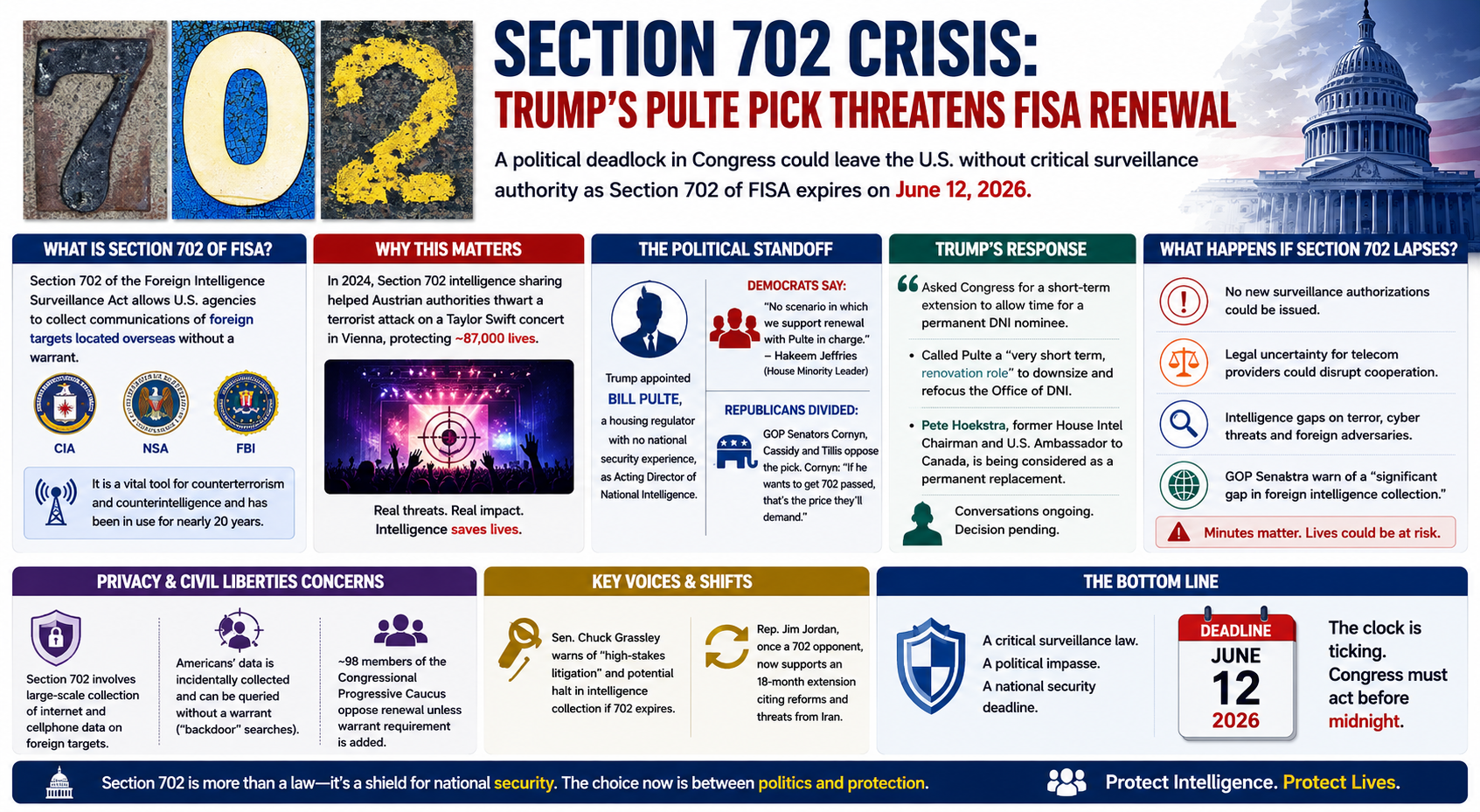
Section 702 of the Foreign Intelligence Surveillance Act allows agencies such as the CIA, the National Security Agency, and the FBI to collect communications from foreign targets overseas without a warrant. That's a sweeping authority, and it has been the backbone of U.S. counterterrorism and counterintelligence operations for nearly two decades.
The statutory authorization expires this Friday. That deadline is today June 12, 2026. Congress had, by most accounts, a workable bipartisan path to a three-year reauthorization. Then the Pulte appointment upended everything.
How the Vienna concert attack shows what is at stake
Senator Chuck Grassley, chairman of the Senate Judiciary Committee, made the stakes explicit in a June 8 floor speech. He cited the 2024 Austrian security services operation that thwarted a terrorist attack on a Taylor Swift concert in Vienna, putting roughly 87,000 lives at risk, crediting Section 702 intelligence sharing as the reason Austrian authorities were able to cancel the concerts and apprehend the plotting terrorists. That's not a hypothetical. It happened. The counterargument from privacy advocates is also real, but Grassley's case is the strongest single piece of evidence the renewal camp has produced this cycle.
Who Is Bill Pulte and Why Is His Appointment Blocking the Vote?
Trump tapped housing official Bill Pulte to replace Tulsi Gabbard on an acting basis as director of national intelligence. Pulte, who also leads the Federal Housing Finance Agency, lacks experience in national security and intelligence matters.
That resume gap is the core problem. Senate Minority Leader Chuck Schumer castigated Pulte for his "record of abusing his office to attack Trump's political enemies," saying "the timing of this announcement could not be worse." House Minority Leader Hakeem Jeffries was blunter, stating there is no scenario in which he would support an extension with Pulte in charge [CBS News, June 10, 2026].
Republicans are not uniformly supportive either
Senators John Cornyn, Bill Cassidy, and Thom Tillis all voiced disapproval of the Pulte pick. Asked whether Trump should withdraw the nomination, Cornyn said: "If he wants to get 702 reauthorization passed, that sounds like the price that they're going to demand." When your own party's senior figures are saying the quiet part aloud, the political math gets difficult fast.
What Has Trump Said About Resolving the Deadlock?
Trump asked Congress on Wednesday for a short-term extension of the law to "provide time for the selection and confirmation" of a permanent director. He has also signaled that Pulte is a temporary appointment. Trump made clear that Pulte will serve a "very short term, a sort of renovation role," to help the Office of the Director of National Intelligence be renovated and downsized.
One name has surfaced as a credible permanent replacement. Pete Hoekstra, Trump's ambassador to Canada and a former chairman of the House Intelligence Committee, has been floated as a possible replacement, with the White House reaching out to Hoekstra and conversations ongoing. Hoekstra would be harder for Democrats to dismiss on experience grounds. Whether that outreach moves fast enough to unlock votes before midnight remains genuinely unclear.
Jim Jordan's reversal signals shifting GOP calculations
Representative Jim Jordan reversed his longstanding opposition to Section 702, saying he plans to support a clean 18-month extension, citing the 56 reforms already embedded in the legislation and the current conflict with Iran as factors that changed his calculus. Jordan voted against renewal in 2024. His flip suggests the White House has been doing the math inside its own caucus, even as the Democratic bloc holds firm.
What Happens if Section 702 Actually Lapses?
The intelligence community's "going dark" warnings are louder this week than at any point in recent memory. Senator Grassley warned that if Title 7 expires, there will be high-stakes litigation and a very real possibility that intelligence collection will cease, at least temporarily, adding that in intelligence gathering, minutes do matter.
The Cato Institute's analysis pushes back, arguing that existing orders, authorizations, and directives issued under Section 702 remain in effect until their stated expiration dates, meaning a lapse would not immediately end currently authorised collection. That is technically accurate. But the legal uncertainty it creates for telecommunications providers, who must decide whether to comply with requests under a lapsed statute, is real and immediate.
Senators Tom Cotton and Chuck Grassley sent a letter to Secretary of State Marco Rubio requesting that the State Department plan for a potential significant gap in foreign intelligence collection and identify all intelligence targets on which the United States may lose valuable intelligence information if Section 702 lapses. When the Republican chairs of the Intelligence and Judiciary committees are writing contingency letters to the Secretary of State, the situation has moved well past posturing.
How Are Privacy Advocates and Democrats Framing Their Opposition?
The civil liberties argument against Section 702 predates Pulte entirely. Under Section 702, the government collects massive amounts of internet and cellphone data on foreign targets, and hundreds of thousands of Americans' information is incidentally collected during that process and then accessed each year without a warrant down from millions of such queries the government ran in past years. Critics refer to these as "backdoor" searches.
Representative Ted Lieu of California, who voted for renewal in 2024, said this year he is a hard no [The Hill, June 2026]. The Congressional Progressive Caucus, with roughly 98 members, voted to have its members oppose Section 702 renewal when it comes to the floor, largely committing that bloc to voting it down. That's a lot of votes to overcome. Even if Pulte is removed, the underlying civil liberties debate doesn't disappear with him.



Comments (0)
Leave a Comment
No comments yet
Be the first to comment