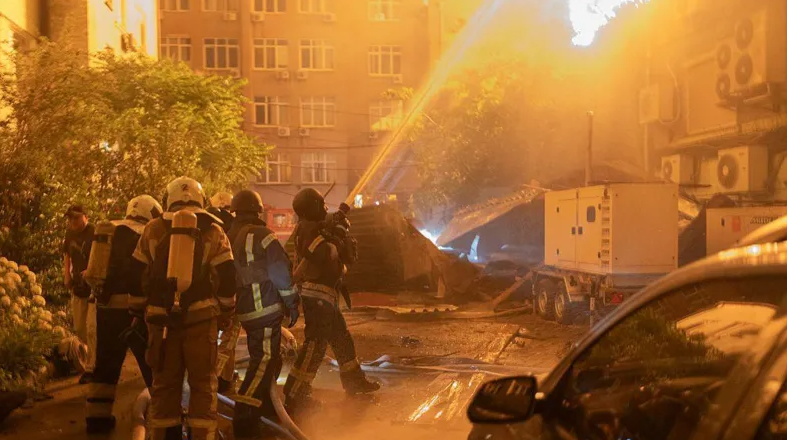
KYIV — Russian forces struck Ukraine's capital with a barrage of ballistic missiles, cruise missiles and drones overnight into Thursday, killing at least eight people and injuring 34 others in one of the most intense assaults on the city in recent weeks. The strikes came hours after President Volodymyr Zelenskyy warned that Moscow was preparing a "massive" attack.
Explosions rattled central and eastern Kyiv for hours as residents rushed to metro stations for shelter. By morning, officials had confirmed damage across 28 locations, most of them residential buildings and civilian infrastructure.
What Happened Overnight in Kyiv
According to Tymur Tkachenko, head of the Kyiv City Military Administration, the attack partially destroyed a nine-story residential building in the Desnianskyi district and sparked fires near homes in two locations in the Pecherskyi district. A fire also broke out near an administrative building in the Solomianskyi district.
Key details from officials include:
- Mayor Vitali Klitschko reported that a large section of a high-rise apartment building collapsed after a direct strike, trapping residents inside.
- Damage was also recorded in the Obolonskyi and Podilskyi districts.
- The regional administration confirmed strikes in five districts surrounding the capital, though no casualties were reported there.
- An ambulance station sustained damage, leaving at least one emergency worker critically injured.
- Ukraine's Air Force issued warnings that ballistic missiles were inbound minutes before the first explosions were heard.
Tkachenko said children were among the casualties and accused Russia of deliberately targeting residential neighborhoods.
Scale and Human Toll
The death toll of eight marks the latest in a string of large-scale strikes on Kyiv this year. Ukrainian authorities have repeatedly documented direct hits on apartment blocks rather than military infrastructure, a pattern that has shaped how Kyiv and its Western partners frame the war diplomatically.
The United Nations Human Rights Monitoring Mission in Ukraine has tracked a rise in civilian casualties tied to long-range weapons through 2026, noting that figures this year are running roughly 20 percent above the same period last year. That trend gives added weight to each new strike, since it feeds directly into ongoing debates in Washington, Brussels and other allied capitals over air defense supplies.
Geopolitical and Diplomatic Implications
NATO and Poland's Response
Poland, a NATO member bordering Ukraine, briefly scrambled fighter jets as a precaution during the attack before standing them down after confirming no airspace violation had occurred. The episode is a familiar one for Warsaw, which has repeatedly activated its air defense posture during major Russian barrages against western and central Ukraine.
The incident underscores a persistent risk calculation for NATO's eastern flank. Even a near miss forces allied governments to weigh how quickly a strike aimed at Ukraine could spill into alliance territory, a scenario that would trigger Article 5 consultations.
Peace Talks at a Standstill
The attack lands at a moment when diplomatic efforts to end the war have stalled. Negotiations involving Washington have not produced a breakthrough in recent months, and neither Moscow nor Kyiv has signaled willingness to shift its core demands. Russian forces have meanwhile pressed into contested territory in the east, including recent advances near Kostyantynivka, a town seen as a gateway to the broader Donbas region.
For Kyiv's foreign backers, attacks of this scale renew pressure to unlock further funding for air defense programs, including NATO's PURL initiative, through which Ukraine can obtain American-made interceptors such as Patriot systems.
Analysis: Why This Attack Matters
Strikes on the capital carry a different diplomatic weight than those on frontline cities. Kyiv is where foreign delegations meet Ukrainian leadership, where embassies operate, and where the political cost of civilian deaths registers most directly with allied publics. A high death toll in the capital tends to accelerate calls in European parliaments for new sanctions packages or expanded weapons transfers, even when it does not shift the underlying military balance.
It also reinforces a strategic logic Moscow has pursued for much of the war: applying pressure on civilian morale and infrastructure while frontline gains remain incremental. Kyiv's own military assessments this year have suggested Ukrainian forces have reclaimed more ground than they have lost, even as Russia's aerial campaign has intensified. That divergence, battlefield stalemate paired with escalating air attacks, is likely to remain the defining pattern of the conflict through the coming months.



Comments (0)
Leave a Comment
No comments yet
Be the first to comment