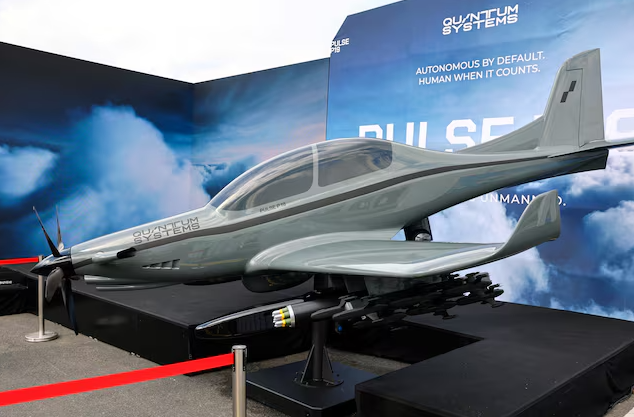
A Munich drone startup that began mapping agricultural fields a decade ago just closed the largest private defense-technology financing in European history. On July 2, 2026, Quantum Systems announced a $1.2 billion Series D round that pushed its post-money valuation to approximately $8 billion. That is more than double the $3.5 billion valuation it held just eight months earlier.
The speed of that climb is not an accident. It reflects a defense investment market that has stopped treating autonomous military systems as a niche category and started treating them as infrastructure.
How the Round Came Together
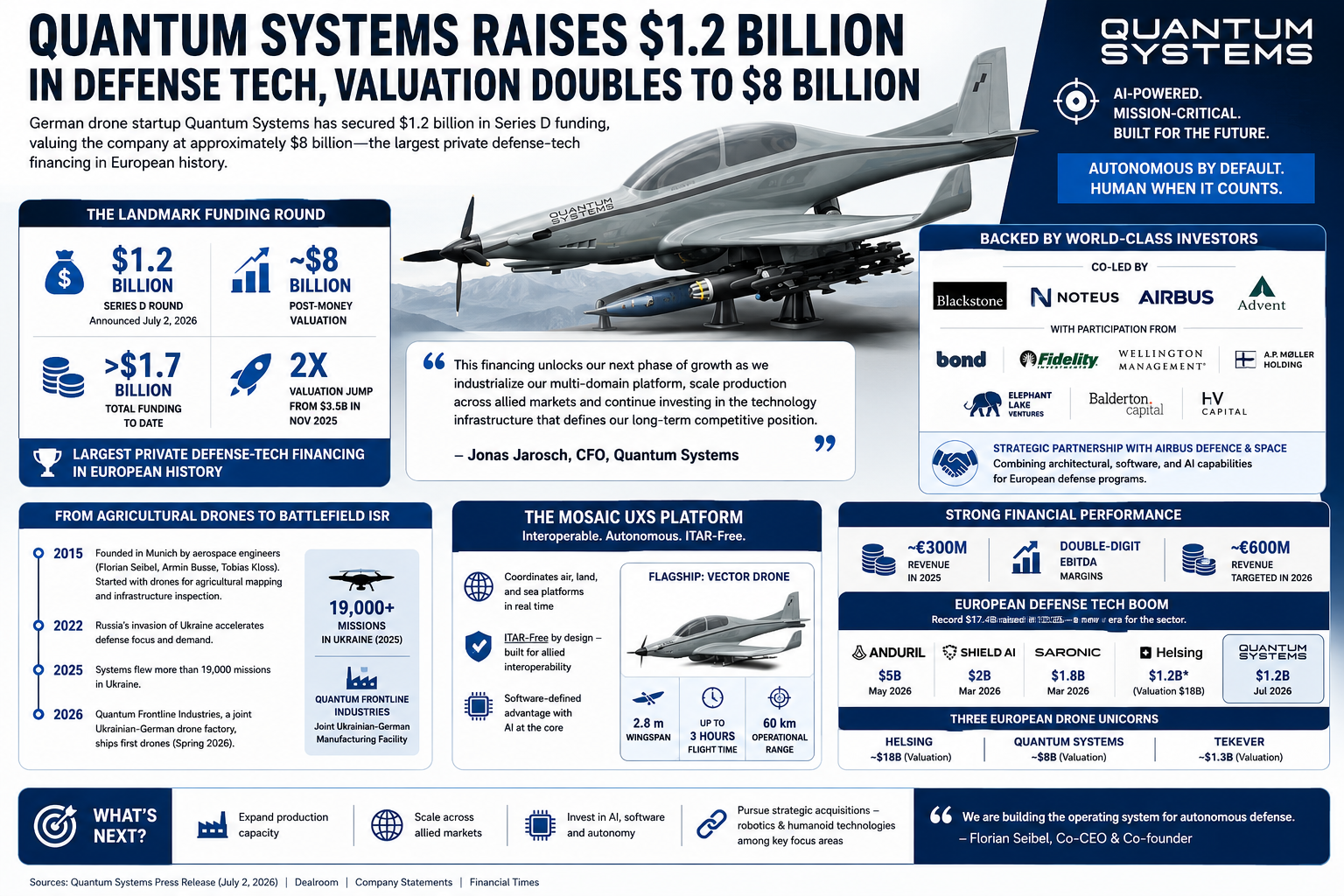
The funding was co-led by Blackstone, Noteus, Airbus, and Advent. Additional participants included Bond, Fidelity Management and Research Company, Wellington Management, A.P. Moller Holding, Elephant Lake Ventures, Balderton Capital, and HV Capital.
That investor mix tells its own story. Blackstone manages over $1.3 trillion in assets and rarely backs defense hardware startups directly. Its presence signals that institutional allocators, not just specialist venture funds, are now treating European autonomous systems companies as infrastructure-grade investments. Airbus Defence and Space's participation deepens an existing strategic partnership, combining architectural, software, and AI capabilities for European defense programs.
Quantum Systems CFO Jonas Jarosch was direct about the plan for the capital: "This financing unlocks our next phase of growth as we industrialize our multi-domain platform, scale production across allied markets and continue investing in the technology infrastructure that defines our long-term competitive position."
Key funding details at a glance:
- Series D amount: $1.2 billion, announced July 2, 2026.
- Post-money valuation: approximately $8 billion.
- Total cumulative funding now exceeds $1.7 billion.
- Round co-led by Blackstone, Noteus, Airbus, and Advent.
- Largest private defense-technology financing in European history.
- Valuation more than doubled from $3.5 billion in November 2025.
From Agricultural Drones to Battlefield ISR
Quantum Systems was founded in 2015 by aerospace engineers Florian Seibel, Armin Busse, and Tobias Kloss. Seibel is a former Bundeswehr helicopter pilot. The company's first products were drones built for commercial applications such as agricultural mapping and infrastructure inspection.
Russia's invasion of Ukraine in 2022 changed the company's trajectory entirely. Demand surged for unmanned aircraft capable of supporting military operations without sacrificing commercial versatility. Quantum Systems moved deeper into defense, and the conflict gave it something most venture-backed hardware startups never get: real combat validation at scale.
Its systems flew more than 19,000 missions in Ukraine during 2025 alone. The company also operates Quantum Frontline Industries, a joint Ukrainian-German drone manufacturing facility that shipped its first drones in spring 2026. That operational track record is a core part of what allows the company to raise at these multiples while staying profitable.
The MOSAIC UXS Platform and Why It Matters
Hardware is not the only thing Quantum Systems is selling. The company is building toward a family of interoperable autonomous systems connected through MOSAIC UXS, its software command ecosystem designed to coordinate air, land, and sea platforms in real time.
MOSAIC UXS is explicitly designed to be ITAR-free. That is a technical design choice with geopolitical weight. US export control laws, specifically the International Traffic in Arms Regulations, allow Washington to restrict allied nations from using US-controlled defense technology at critical moments. A NATO-allied company building interoperable command-and-control software outside that framework answers a question that has followed every European drone startup since 2022: can Europe build autonomous military capability without depending on technology that a third country can restrict?
The flagship product is the Vector drone, a vertical-takeoff-and-landing reconnaissance system with a 2.8-meter wingspan, up to three hours of flight time, and a 60-kilometer operational range, built for intelligence, surveillance, and reconnaissance missions.
The Numbers Behind the Company
Quantum Systems generated approximately 300 million euros in revenue in 2025 with double-digit EBITDA margins. The company is on track to roughly double that to around 600 million euros in 2026. Co-CEO Florian Seibel confirmed the company is already profitable, framing the new capital as execution fuel rather than a survival round.
That profitability separates Quantum Systems from most hardware startups that raise at similar valuations. The company has a product in the field, a working business model, and a software layer it is scaling across multiple domains.
The Stark Defence Question
Seibel co-founded Stark Defence in 2024 as a standalone entity. The reason was structural: regulatory weapons limitations on earlier Quantum Systems investors barred the parent company from manufacturing strike drones. Stark handled that product category separately.
Stark raised 500 million euros in June 2026, led by Sequoia Capital and Founders Fund. The two Munich-based companies together carry a combined valuation exceeding $10 billion. Seibel told the Financial Times that a potential combination between Quantum Systems and Stark makes sense, adding he was never happy that regulatory constraints forced Stark to be built outside Quantum in the first place. Stark's spokesperson denied any active merger plans, but the question is now openly part of the industry conversation.
Where European Defense Tech Stands
Defense tech companies have raised a record $17.4 billion in the first half of 2026 alone, according to Dealroom, far exceeding the $11.2 billion the sector raised across all of 2025.
The biggest raises this year span both sides of the Atlantic:
- Anduril picked up $5 billion in May 2026.
- Shield AI closed a $2 billion round in March 2026.
- Saronic Technologies secured $1.8 billion in March 2026.
- Helsing is set to raise $1.2 billion at an $18 billion valuation.
- Stark Defence secured 500 million euros in June 2026.
Three European drone companies now hold multi-billion-dollar valuations: Quantum Systems at $8 billion, Helsing at a reported $18 billion, and Portugal's Tekever at approximately $1.3 billion. Two of the three largest operate from Munich.
Seibel has also flagged that acquisitions are a priority for the new capital, with robotics and humanoid technologies among the fields the company is evaluating for future expansion.



Comments (0)
Leave a Comment
No comments yet
Be the first to comment