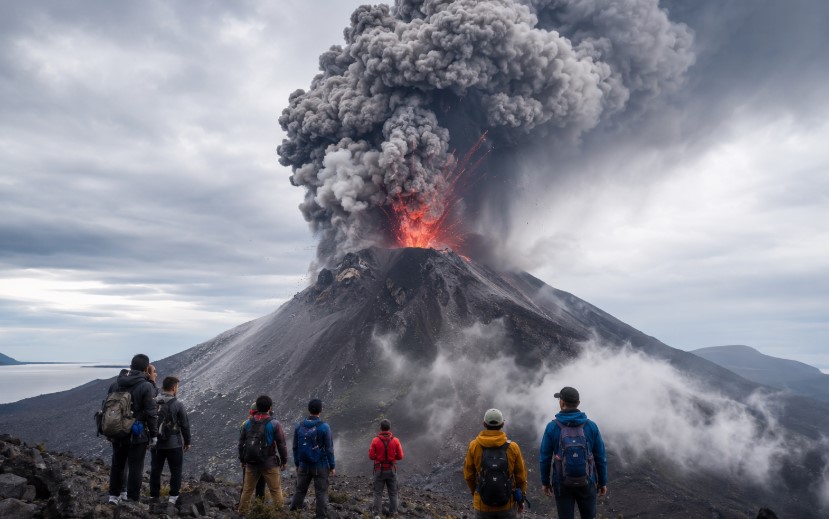
A powerful volcanic eruption on Indonesia's North Maluku island has claimed three lives, raising urgent questions about risk perception, volcano tourism, and enforcement of safety restrictions around active craters.
The Mount Dukono volcano eruption on Friday morning killed three people and injured several others who were hiking on the mountain despite clear official warnings. The victims were part of a 20-member group of Singaporean and Indonesian nationals who had chosen to climb the 1,335-metre peak even as authorities had explicitly restricted access to the area.
The eruption sent an ash column stretching 10 kilometres into the sky and triggered a large-scale rescue operation that continued well into Friday afternoon. Retrieval of the bodies remained incomplete as of the evening, hampered by continued volcanic activity, difficult terrain, and powerful blast waves from the crater.
What Happened on Mount Dukono on Friday
The eruption occurred at 07:41 local time (22:41 GMT Thursday), catching multiple groups of hikers on the mountain during early morning climbs. Indonesian officials confirmed that two Singaporean nationals and one resident of the nearby city of Ternate were killed.
The rest of the 20-member hiking group was eventually located by rescue teams and evacuated from the mountain. Most survivors were transported to hospital for treatment of injuries. Two porters from the group voluntarily stayed behind on the mountain to assist rescue workers in locating the bodies.
Eyewitness accounts suggest the 20-member group was not alone. A local guide who was on the mountain with two private clients at the time of the eruption described a scene of multiple groups near the summit, including some standing at the crater's edge and others approximately 50 metres from the crater filming drone footage.
"I heard deep tremors," the guide told BBC Indonesian. "So I decided to immediately descend with the guests. And in the end, the three of us were safe."
As he descended, he observed that many hikers remained at the summit.
A Volcano That Has Erupted Over 200 Times Since Last Year
Mount Dukono is not dormant. It is not even intermittently active. The volcano has recorded more than 200 eruptions since March of the previous year, making it one of the most persistently active volcanoes in the Indonesian archipelago.
Indonesia's Volcanological Survey currently lists Mount Dukono at alert level two on a four-tier scale, indicating increased activity and requiring caution. Since December 2024, the agency has formally recommended that tourists, climbers, and residents avoid all activities within a 4-kilometre radius of the main crater due to threats from ejected rocks, ash falls, and lava flows.
Despite this, hikers continued to visit.
North Halmahera police chief Erlichson Pasaribu confirmed that the retrieval of the victims' bodies had been repeatedly delayed due to ongoing eruptions, treacherous elevation, and strong blasts emanating from the volcano. As of Friday afternoon, the mountain was still emitting volcanic material from its crater.
Why Did Hikers Ignore the Warnings
Indonesian officials stated that warnings against climbing Mount Dukono had been widely distributed through social media channels and displayed on banners at trail entrances. Yet the restrictions were disregarded.
Indonesia's search and rescue agency Barsanas noted in initial discussions that there may have been "possible negligence by tourism operators or individuals" who proceeded with the climb despite active alerts. The government said it was continuing to gather information to establish a full account of the incident.
The deeper explanation may lie in how digital content shapes risk perception.
Dr Daryono, from the Indonesian Association of Disaster Experts, identified a structural problem in how volcano tourism is portrayed online. "On social media, the public often sees videos of climbers or influencers who successfully ascend and return safely," he told the BBC. "Such content slowly creates a distorted risk perception."
He explained that audiences only encounter stories of people who descended safely and posted dramatic content. The near-misses, the silent risks, the accumulating danger all remain invisible. "The real danger remains and could emerge at any time in the form of ejections of incandescent material, thick ashfall, volcanic gas, or sudden explosive eruptions," he said.
One local guide offered a similar observation from field experience: "When Dukono hasn't erupted for a few days, you have to be careful." He described the Friday eruption as "major" and "very strong," adding that he believed high pressure had been building inside the volcano for several days before the blast.
The Broader Problem of Volcano Tourism in Indonesia
Indonesia sits within the Pacific Ring of Fire, hosting more than 120 active volcanoes. The country has long struggled to balance its appeal as an adventure tourism destination with the very real dangers posed by its geological volatility.
Mount Merapi, Mount Sinabung, and Mount Agung have all produced fatal eruptions in recent years. Each time, post-incident investigations reveal a familiar pattern: warnings issued, warnings ignored, lives lost.
Dr Daryono was direct in his assessment. "This incident once again demonstrated that active volcanoes can never be treated as ordinary tourist destinations. Dukono is a mountain with almost continuous eruptive activity, so any violation of the danger zone carries a fatal risk."
The challenge for Indonesian authorities is not only enforcement but public education. Social media platforms that algorithmically reward dramatic volcano content create an environment where risk normalisation becomes almost inevitable. Influencer culture has turned summit climbs into aspirational content, and the survivorship bias embedded in viral videos makes volcanoes appear safer than they are.
Rescue Operations: Timeline of Response
07:41 local time: Mount Dukono erupts. Multiple groups of hikers are on the mountain.
Morning hours: Rescue teams are alerted and dispatched to the mountain.
Midday: The 20-member hiking group is fully located by rescuers.
Afternoon: Most survivors are evacuated and sent to hospital. Two porters remain to assist body retrieval. The mountain continues to emit volcanic material.
Evening: Body retrieval remains incomplete due to repeated eruptions and difficult terrain.
What Authorities Are Doing Now
Indonesian officials have reiterated the restriction on climbing Mount Dukono and indicated that investigations are underway. The government is assessing whether tourism operators bear legal responsibility for facilitating the climb despite active warnings.
Barsanas stated it was working to establish a complete factual account of the incident. The involvement of Singaporean nationals adds diplomatic dimensions to the tragedy, with both countries' authorities likely coordinating on victim identification and repatriation.
The Volcanological Survey of Indonesia has not yet indicated any change in the alert level, suggesting the mountain remains in a state of elevated but not maximum-level activity.
Key Takeaways
- Three people, including two Singaporean nationals, died in the Mount Dukono volcano eruption on Friday morning.
- The victims were part of a 20-member hiking group that climbed despite active safety restrictions.
- Mount Dukono has erupted more than 200 times since March of the previous year.
- Indonesia's volcano monitoring agency has maintained a no-entry zone of 4 kilometres around the crater since December 2024.
- Expert analysis points to social media-driven distortion of volcanic risk as a key factor in why hikers continue to ignore warnings.
- Rescue operations are ongoing; body retrieval has been delayed by continued eruptions and difficult terrain.
Future Implications
Friday's deaths are likely to trigger a review of how Indonesia enforces exclusion zones around active volcanoes. There are growing calls within the disaster management community for stricter regulations on guided volcano tours, mandatory safety briefings, and platform-level collaboration with social media companies to contextualise risk in viral volcano content.
Whether those conversations will translate into policy changes remains to be seen. What is certain is that the combination of persistent volcanic activity, inadequate enforcement, and distorted public risk perception is a lethal one, and Mount Dukono is far from the only active volcano in Indonesia attracting casual tourists.
Conclusion
The Mount Dukono eruption is both a tragedy and a warning. Three people are dead. Several others were injured. A mountain that has erupted hundreds of times continues to draw hikers who believe the risk applies to someone else.
Indonesia's volcanic landscape is extraordinary. It is also genuinely dangerous. The gap between those two truths is where fatalities occur.



Comments (0)
Leave a Comment
No comments yet
Be the first to comment