"The Idea Is to Incentivise Higher Secondary Education for Girls"
What the Maharashtra Government Is Actually Proposing
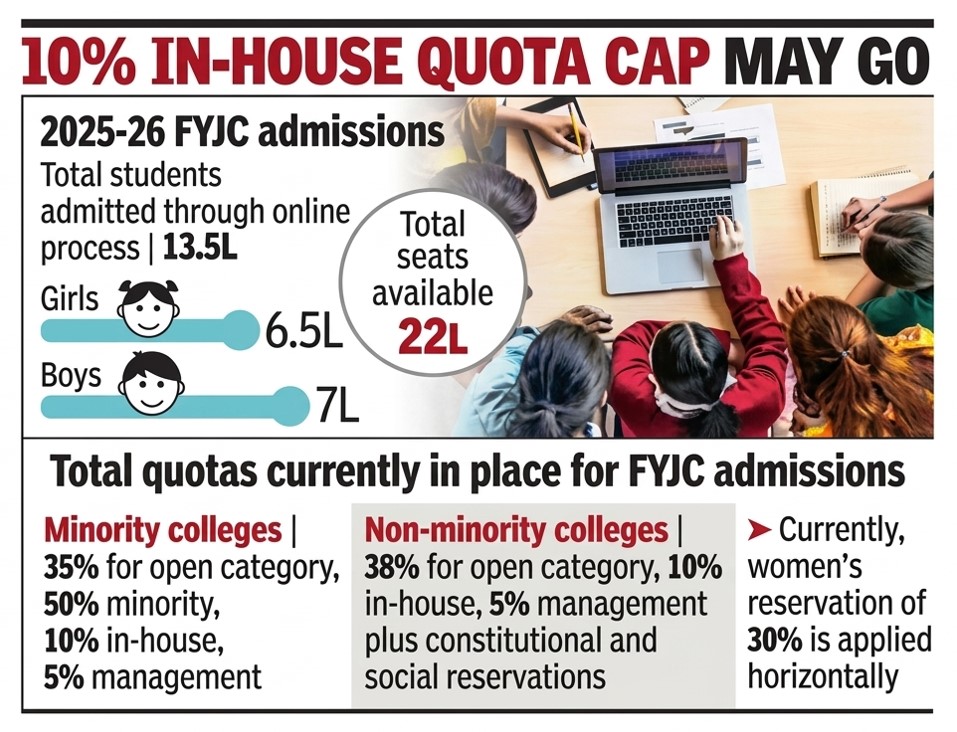
The Maharashtra FYJC girls quota 50% proposal represents the most significant structural shift in Class 11 admission policy in the state in years. Under the current framework, 30% of FYJC seats are reserved for girls across junior colleges in Maharashtra. The School Education Department is now evaluating a proposal to bring that figure up to 50%.
The logic behind the proposal is grounded in a parity argument that extends beyond education. A government official quoted in the Times of India stated: "In many colleges, they probably make up for more than half the total number of students already. When women get 50% representation in local self-government bodies, then they could be given equal representation in institutions. The idea is to incentivise higher secondary education for them."
The second simultaneous proposal would remove the 10% ceiling on in-house quota admissions. Students from schools attached to junior colleges, or from schools run by the same management as a junior college, would be given first preference in a "zero round" of admissions, enabling direct entry without having to compete against the general merit pool. Crucially, the Department plans to expand the definition of "same management" beyond the same premises to include schools and colleges in the same district, and for Mumbai institutions, across the entire Mumbai Metropolitan Region.
"Girls Already Make Up Over 50% in Some Urban Colleges"
The Numbers Beneath the Headline
The data context for this proposal is important to understand accurately.
Of the total 13.5 lakh students admitted to junior colleges across Maharashtra in the last academic year's online process, 48% were girls. The state has a total FYJC seat capacity of approximately 22 lakh, meaning seats are not the limiting factor in aggregate. The issue is geographic distribution.
A Mumbai college principal whose FYJC batches already have 50 to 60 percent girls offered the most precise contextualisation: "Girls already make up for over 50% students in some urban colleges as they outperform boys. This may probably help students from rural areas."
This distinction between urban and rural outcomes is the analytical core of the proposal. In cities like Mumbai, Pune, and Nagpur, girls are not underrepresented in junior colleges. In rural districts, particularly those with limited local college options, the lack of a seat close to home remains a documented reason for dropout after Class 10. The 50% quota, if implemented, functions as a geographic equity tool as much as a gender equity one. It guarantees that in colleges near rural homes, girls will always have access to at least half the available seats.
As the official put it: "The policy, if implemented, will ensure girls do not drop out for not getting a seat in colleges closer to their homes. We wish to make higher secondary education as accessible as possible for them."
The In-House Quota Reform: A Separate but Equally Consequential Change
"It Will Be an Additional Option for Them"
The second proposal under consideration would end the 10% ceiling on in-house quota and allow natural progression for students from schools run by the same management as a junior college.
Under the current system, a student from a school run by a particular trust can claim up to 10% of seats in the associated junior college. The proposal would replace this with an uncapped preference system, where these students enter through a "zero round" before the general admission rounds begin, regardless of their SSC cutoff scores.
The geographic scope of what counts as "same management" is expanding significantly. "For colleges in Mumbai, this could extend to the Mumbai Metropolitan Region," an official confirmed. This means a school in Thane affiliated with the same trust as a college in Andheri could now feed students directly into that college, bypassing the centralised merit process.
The benefit for students is real: a guaranteed, predictable path from Class 10 to Class 11 without the anxiety of cutoff-based competition, similar to how CBSE and ISC schools currently handle internal progression.
The risk, as a college principal pointed out, is also real: "It may reduce seats available for meritorious students from outside." In top-ranked junior colleges where the management also runs popular schools, a large in-house intake in the zero round could significantly compress the general merit pool available to external applicants.
Two Proposals, Two Distinct Beneficiary Groups
Who Gains and Who Faces Adjustment
Analytically, the two proposals serve different populations.
The 50% girls quota primarily benefits female students in rural or semi-urban Maharashtra who currently struggle to access junior colleges close to home due to limited seat availability in nearby institutions. For urban girls who already constitute majority enrolments, the practical impact is minimal.
The in-house quota removal primarily benefits students from schools run by large, multi-institution educational trusts, granting them admission certainty that currently only exists in CBSE and ISC school-to-college pipelines. For students at standalone or independent schools with no management affiliation to any junior college, this change offers nothing and may tighten competition for general merit seats.
One specific group faces a direct impact: students aiming for junior colleges with integrated coaching for IIT-JEE, where competition is fierce and any reservation of seats in earlier rounds reduces the number available for the open merit process. A principal noted this explicitly, flagging that some junior colleges with integrated coaching for IITs may see an impact from the in-house quota change.
What the Government Has and Has Not Committed To
"Implications of an Increase in Reservation Will Have to Be Studied"
Both proposals are under consideration, not confirmed policy. The government's own internal framing makes a clear distinction between the two.
The removal of the in-house quota cap is described as "likely to be implemented." The girls quota increase is described as a proposal whose "implications will have to be studied." The difference in language matters.
The in-house quota change is administratively straightforward and has a precedent in the 2025 cycle, when the definition of same-management eligibility was already being debated. The girls quota increase is a more significant structural intervention, and the government is appropriately cautious about modelling its effects before committing.
With 22 lakh FYJC seats and 13.5 lakh actual admissions last year, there is adequate aggregate capacity across the state. The question the Department is studying is whether that capacity is distributed in the right locations relative to where girls need it most, and whether a formal quota is the most efficient tool for achieving equitable distribution.
Conclusion: Maharashtra FYJC Girls Quota Reform Addresses the Right Problem With the Right Caution
The Maharashtra FYJC girls quota proposal to raise reservation from 30% to 50% is analytically sound in its diagnosis. Rural dropout after Class 10 among girls is a real and documented problem in Maharashtra. Guaranteeing local seat access through a higher quota addresses one of the structural causes of that dropout.
The caution being applied before finalising the policy is equally sound. A state with 22 lakh FYJC seats and 48% female enrolment already does not need a blunt reservation instrument to solve a problem that is primarily geographic rather than systemic. Targeted implementation, possibly through a rural-specific quota increase rather than a universal one, might achieve the same outcome with fewer unintended consequences for urban merit applicants.
Both proposals, if implemented for the 2026-27 academic year, will be visible in the June 2026 FYJC admission process. Students, parents, and school administrators in Maharashtra should monitor the final guidelines from the School Education Department closely as the admission season approaches.




Comments (0)
Leave a Comment
No comments yet
Be the first to comment