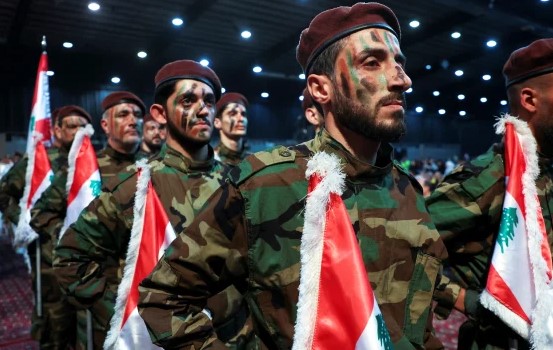
Israel's decision to intensify strikes against Hezbollah signals more than a tactical military escalation. It exposes the fragile architecture of a ceasefire that was never designed to hold, the growing influence of Israel's far-right coalition, and a rapidly shifting regional balance following the death of Iranian Supreme Leader Ayatollah Ali Khamenei. Netanyahu's announcement on Monday is not simply an operational order. It is a strategic recalculation with consequences stretching from Beirut to Washington to Tehran.
What Happened
Israeli forces launched fresh strikes across Lebanon, targeting Hezbollah positions in the Bekaa Valley following Prime Minister Netanyahu's declaration that Israel is at war with Hezbollah and that the military must deal the group a crushing blow. Hezbollah responded with 22 drone and rocket attacks against Israeli military positions. This came despite a 60-day ceasefire extension agreed earlier in May, which had already seen persistent violations. Far-right coalition ministers Bezalel Smotrich and Itamar Ben Gvir publicly demanded the campaign expand into Beirut, raising the stakes of an already volatile confrontation.
Why This Matters Beyond the Headlines
The ceasefire signed on 16 April was always conditional, not comprehensive. Israel retained troops in southern Lebanon, continued near-daily evacuation orders, and more than 400 Lebanese have been killed since the agreement was signed, including paramedics and emergency workers. Over one million people remain displaced. This is not a paused war. It is managed escalation operating under diplomatic cover.
Lebanon's government is attempting to disarm Hezbollah but insists a complete ceasefire must come first. Israel rejects that sequencing. Each side is locked into incompatible timelines, and Washington has so far failed to bridge the gap. The structural contradiction between those two positions is what makes any lasting ceasefire nearly impossible right now.
Political and Strategic Calculations
Netanyahu's decision to escalate serves multiple domestic purposes simultaneously. With far-right ministers demanding a full offensive into Beirut, the announcement functions as a pressure release valve within the coalition. It signals military resolve without committing to open-ended urban warfare that would carry catastrophic political and human costs.
Internationally, the timing is deliberate. Iran is in active negotiations with the United States over a broader peace framework, creating a political vacuum following Khamenei's death. Tehran has explicitly demanded a complete regional ceasefire as a condition for any deal. By escalating now, Israel signals it will not be bound by an Iran-US framework it had no role in designing, and it pressures Washington to choose between moderating its closest regional ally and advancing the diplomatic track with Tehran.
Economic and Security Impact
The humanitarian and economic costs inside Lebanon are severe. With the Bekaa Valley, a central agricultural and economic corridor, now under bombardment, Lebanon's fragile post-conflict recovery is being systematically dismantled. A state already hollowed out by years of financial collapse and political gridlock lacks the institutional capacity to enforce ceasefire terms on its own.
For Israel, the security calculus is more complex than official messaging suggests. Ten soldiers have died since April. Hezbollah retains missile capabilities that continue to threaten northern Israel. A prolonged low-intensity campaign carries its own compounding risks: military exhaustion, international isolation, and the erosion of the ceasefire frameworks Israel itself may need to invoke in a future crisis.
Global Reactions and Diplomatic Signals
Lebanon and Israel are scheduled for further negotiations in Washington next week. Lebanese President Joseph Aoun has demanded full Israeli withdrawal from the south, a position Israel has categorically rejected. The United States is navigating a genuinely difficult balancing act: advancing an Iran peace deal, managing an Israeli coalition drifting rightward, and trying to prevent full-scale regional war from resuming.
Iran's insistence on linking a regional ceasefire to any agreement with Washington creates a direct connection between the Lebanon front and the Iran-US diplomatic track. That linkage is now one of the most consequential variables in Middle East strategy.
What Happens Next
Three scenarios are plausible. Washington negotiations next week could produce a new framework including limited Israeli withdrawal and genuine ceasefire mechanisms. Alternatively, Israel continues a rolling campaign of targeted strikes, suppressing Hezbollah without triggering full-scale conflict and maintaining strategic ambiguity. The third scenario involves a significant escalation triggered by a high-casualty strike or Hezbollah long-range missile use that ruptures diplomatic frameworks entirely.
The most dangerous outcome is not open war. It is a slow-motion collapse of the ceasefire structure that permanently destabilizes Lebanon and allows Hezbollah to rearm under the cover of unresolved negotiations.
Netanyahu's announcement is a window into a conflict that has never truly paused. The ceasefire was a diplomatic instrument, not a peace agreement. What unfolds in the coming weeks will test whether Washington has the leverage to hold its most powerful regional ally to commitments that serve broader stability, or whether Israel's internal political pressures will drive the region toward a more destructive and harder-to-reverse phase.



Comments (0)
Leave a Comment
No comments yet
Be the first to comment