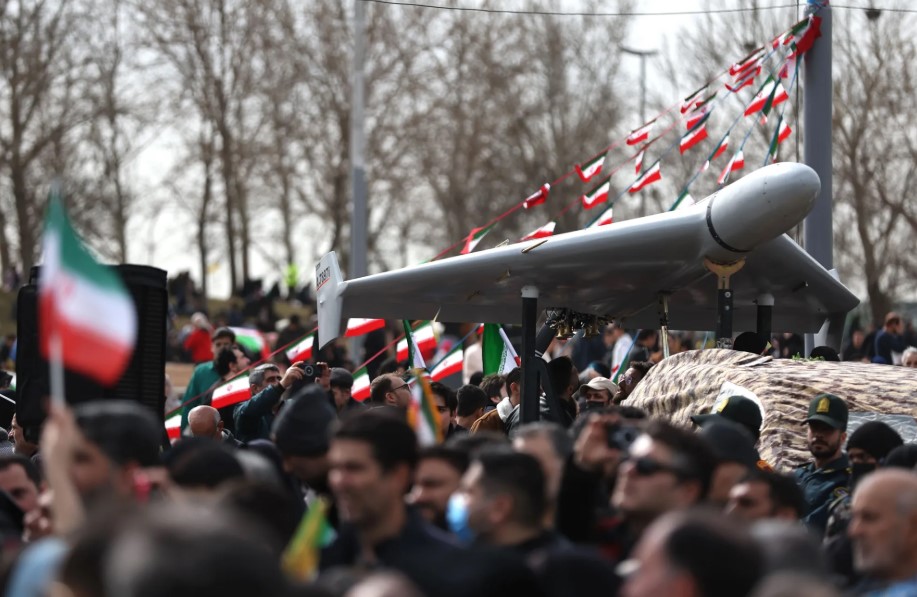
Within hours of the killing of Ali Khamenei, Iran launched the most geographically expansive retaliation in its history. Hundreds of ballistic missiles and thousands of drones struck targets across Israel, the Gulf, and US military installations from Bahrain to Erbil.
This is how the campaign unfolded and what it reveals about Iran’s war doctrine.
A War Measured in Numbers
- 500+ ballistic and naval missiles fired since 28 February
- ~2,000 drones launched in the first week
- 27+ US bases targeted across the Middle East
- 90% drop in missile launch rate by day 10
Operation True Promise IV: Immediate and Calculated
Iran did not pause.
Within hours of the US-Israeli strike that killed Ayatollah Khamenei on 28 February 2026, the Islamic Revolutionary Guard Corps Aerospace Force activated Operation True Promise IV, a pre-planned, multi-wave retaliation. The speed of response sent a clear signal. Iran’s command structure remained intact, and its retaliation strategy had already been mapped out. Over the following days, missiles and drones were launched at Israel and US bases across Bahrain, Qatar, Kuwait, Saudi Arabia, Jordan, Turkey, and the United Arab Emirates.
For the first time, Iran struck all six Gulf Cooperation Council states simultaneously.
“It does not matter how many you launch as long as you maintain a credible threat. One successful drone can shatter a sense of security.”
— Muhanad Seloom, Doha Institute for Graduate Studies
This was not symbolic retaliation. It was a coordinated attempt to impose economic pressure, disrupt military infrastructure, and project regional reach.
Strikes on Israel: Civilian Toll and Escalation
Iran targeted major Israeli population centers including Tel Aviv and Haifa. Between 28 February and 4 March, more than 90 strike attempts were recorded. Around 20 hit civilian areas, killing at least 10 people. The deadliest incident occurred in Beit Shemesh, where a missile struck a synagogue shelter in a residential area. Nine civilians were killed and dozens injured. In Yehud, two workers died after being hit by submunitions from a missile carrying a cluster warhead. The use of cluster munitions raised international alarm. Nearly half of the 300 missiles fired at Israel by day ten carried submunitions capable of dispersing explosives across wide areas. Amnesty International condemned the strikes as a violation of international humanitarian law. Despite heavy interception by Israel’s Iron Dome, David’s Sling, and Arrow systems, several advanced missiles including Khorramshahr, Kheibar Shekan, Emad, Qadr, and Fattah penetrated defenses.
US Bases Under Fire: The Gulf Becomes a Battlefield
Iran expanded the conflict beyond Israel, targeting US military infrastructure across the Middle East. The IRGC claimed attacks on at least 27 bases hosting American forces.
Key Strike Zones
Bahrain
US Navy 5th Fleet headquarters faced repeated missile and drone attacks. Infrastructure at Mina Salman port was hit.
Qatar
Al Udeid Air Base was struck by two ballistic missiles. A drone damaged an early warning radar system. Sixteen people were injured.
United Arab Emirates
Al Dhafra Air Base and Abu Dhabi were hit by a massive opening barrage. A missile strike in the city killed seven and wounded 145.
Kuwait
Ali Al Salem Air Base showed multiple impact sites. Drone strikes targeted ammunition depots and intelligence facilities.
Saudi Arabia
Ras Tanura oil facilities were disrupted, forcing temporary shutdowns. Strikes also hit areas near Riyadh.
Iraq (Erbil)
Missiles and drones hit the airport and US consulate. Additional attacks were carried out by Iranian-backed militias.
US military sources confirmed 13 fatalities across the region.
The attacks extended beyond military targets. Civilian infrastructure, oil facilities, and commercial districts were also hit, amplifying economic disruption.
The Drone Strategy: Cheap, Scalable, Effective
At the core of Iran’s campaign was a simple economic principle. Drones are cheap. Air defense is expensive.
- Shahed drone production cost: $50,000
- Patriot interceptor cost: $4 million
- THAAD interceptor cost: $12 million
Each interception created a massive cost imbalance.
“This is warfare by economics. The defender pays exponentially more than the attacker.”
The Shahed 136 drone, slow but difficult to detect, proved highly effective. Its low altitude and small radar signature allowed many to bypass defenses. Airspace disruptions followed. Dubai International Airport briefly halted operations after a nearby drone-triggered fire. A drone also struck Britain’s Akrotiri base in Cyprus, extending the conflict beyond the Gulf.
From Shock to Slowdown: The Arc of Decline
The opening phase was intense. In the first 24 hours alone, Iran launched 167 missiles and 541 drones at the UAE. By day 15, that number had dropped dramatically to just four missiles and six drones. By day 10, the overall launch rate had fallen by more than 90 percent.
Two explanations emerged:
- US and Israeli strikes successfully destroyed a large portion of Iran’s launch infrastructure
- Iran deliberately reduced usage to conserve resources for a prolonged conflict
Timeline of Escalation
28 February
Operation begins with six waves of strikes across Israel and the Gulf.
1 March
Beit Shemesh strike kills nine. Bahrain’s 5th Fleet headquarters repeatedly targeted.
5 March
Iran claims 500+ missiles and 2,000 drones launched.
7 March
Iran signals conditional restraint toward Gulf states.
13 March
Wave 46 marks the most sustained Iranian direct-fire campaign on record.
Doctrine on Display: Strategy Over Victory
This campaign was not purely about battlefield success. It was about signaling. Iran demonstrated that any attack on its leadership would trigger a region-wide response. The cost would not be contained within its borders but distributed across the Middle East. The strategy reflects asymmetric warfare principles. Instead of direct military parity, Iran targets infrastructure, economies, and psychological stability. Even as the pace of attacks declined, the disruption persisted:
- Airspace closures
- Oil facility shutdowns
- Shipping disruptions in the Strait of Hormuz
- Rising global insurance and energy costs
Conclusion: A Message, Not a Victory
Whether Operation True Promise IV succeeded depends on its objective. If the goal was military dominance, the campaign fell short. Iranian launch systems were heavily degraded, and its naval capabilities weakened. If the objective was political survival and strategic signaling, the outcome appears different. Iran proved it could absorb a leadership decapitation strike and still retaliate at scale. It imposed economic and security costs across the region and reinforced its role as a persistent strategic actor. That message may shape the next phase of the conflict and define the leadership transition under Mojtaba Khamenei.



Comments (0)
Leave a Comment
No comments yet
Be the first to comment