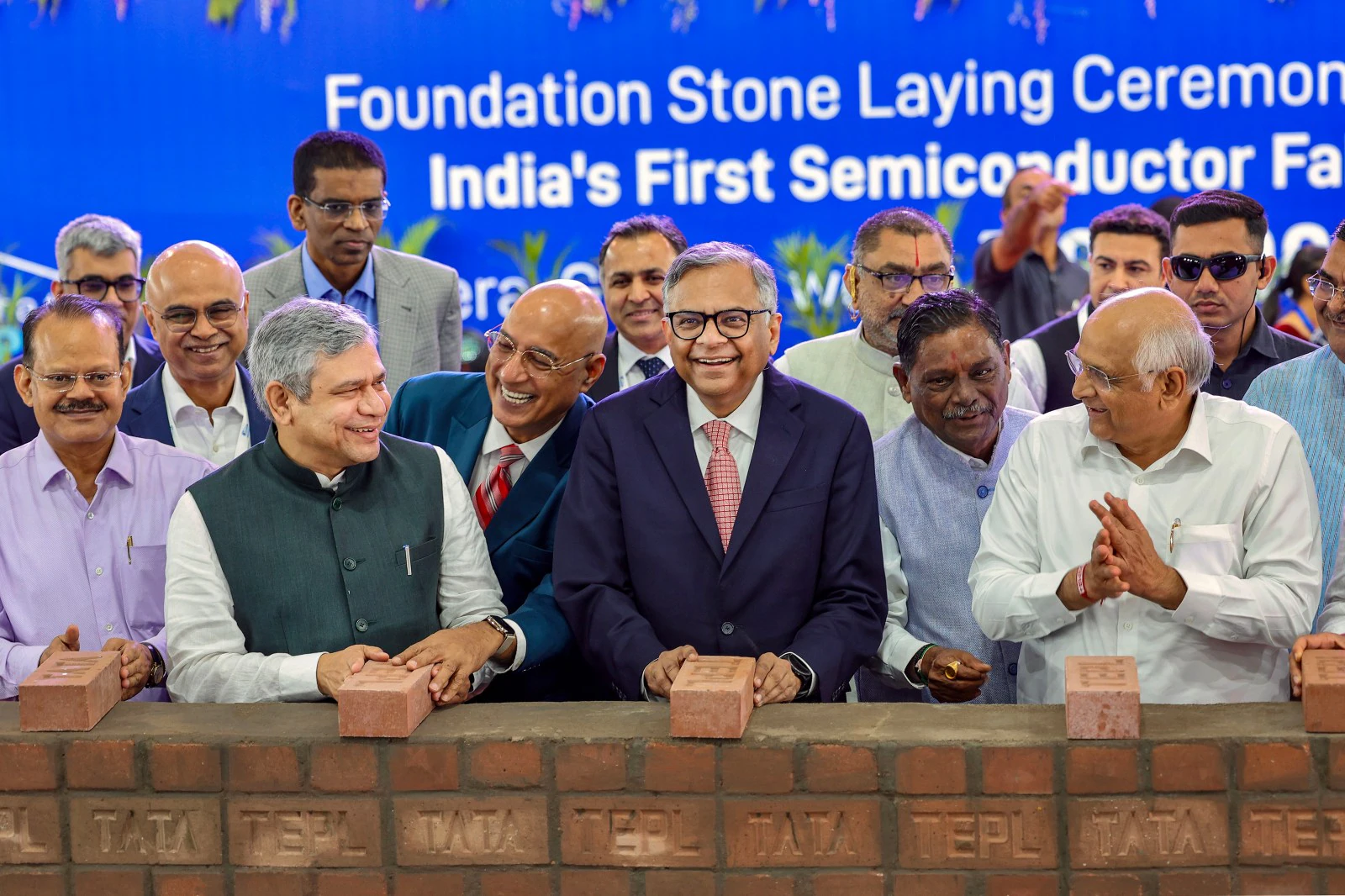
The notification of Tata Semiconductor's fabrication plant at Dholera SEZ is not just industrial news. It is the fruit of a decade of deliberate, patient statecraft.
When the Union Ministry of Commerce and Industry formally notified a Special Economic Zone for Tata Semiconductor Manufacturing Private Limited at Dholera, Gujarat on April 16, 2026, the announcement carried a weight that went far beyond a single factory approval. India had, for the first time in its independent history, set the stage to fabricate its own chips on its own soil. The moment was years arguably decades in the making. And the architecture of that moment bears the unmistakable imprint of Prime Minister Narendra Modi's governance philosophy: long-horizon thinking, structural reform executed with urgency, and a willingness to place ambitious bets on Indian capability.
₹91K Cr - Total investment
21,000 - Jobs created
66 Ha - SEZ footprint
50K - Wafers/month capacity
The Semiconductor Problem India Could No Longer Ignore
India currently imports semiconductors worth approximately $30 billion every year. These chips are the nervous system of everything modern smartphones, automobiles, defence systems, satellites, and medical devices. The 2020 to 2022 global chip shortage, which froze automobile assembly lines from Chennai to Germany and disrupted consumer electronics supply worldwide, exposed a brutal truth: nations that do not manufacture chips are permanently vulnerable to decisions made in Hsinchu, Seoul, and Shanghai.
For India, with geopolitical tensions rising across the Indo-Pacific and a stated ambition to become a $5 trillion economy, continued dependence on imported semiconductors was a strategic liability. PM Modi's government recognised this not as a problem to be managed, but as an opportunity to be seized.
"By 2030, the global semiconductor industry is expected to grow to $1 trillion, and Indian semiconductor demand is expected to cross $110 billion. India's entry into semiconductor manufacturing will significantly de-risk global supply chains." - N Chandrasekaran, Chairman, Tata Sons - Vibrant Gujarat Summit, January 2024
Dholera: A City Built for This Moment
The choice of location is itself a statement of intent. Dholera, part of the Delhi-Mumbai Industrial Corridor and situated in Gujarat, is not a repurposed industrial estate. It is a greenfield smart city designed from scratch with the infrastructure density that semiconductor fabrication demands: ultra-reliable power, water treatment systems, high-speed logistics corridors, and dedicated approval pathways. Locating India's first chip fab here signals that this is not a stopgap measure but an anchor investment meant to catalyse an entire ecosystem around it.
Tata's multi-fab vision for Dholera alone projects over 100,000 skilled jobs over time. With Micron establishing an assembly and testing SEZ in nearby Sanand with an investment of Rs 13,000 crore, and Aequs setting up an electronic components SEZ in Dharwad, Karnataka, a domestic value chain is beginning to take coherent shape for the first time.

The Policy Architecture Behind the Announcement
Announcements are easy. Enabling conditions are hard. What distinguishes this milestone from past ambitions is the systematic policy architecture the Modi government has built underneath it. The India Semiconductor Mission, launched in 2021 with an outlay of Rs 76,000 crore, created the financial scaffolding. The Production Linked Incentive scheme for electronics manufacturing created demand-side credibility. And critically, the government amended the SEZ Rules 2006 through a notification dated June 3, 2025, specifically to address the unique requirements of chip manufacturing.
Key SEZ Reforms That Made Dholera Possible
- Minimum land requirement cut from 50 hectares to 10 hectares, removing a longstanding barrier for capital-intensive projects.
- Flexibility in encumbrance norms, making it easier to assemble land parcels in greenfield zones.
- DTA sales permitted on payment of applicable duties, allowing fabs to serve the domestic market without forfeiting SEZ benefits.
- Free-of-cost supplies included in Net Foreign Exchange calculations, improving the financial viability of the model.
These are not cosmetic tweaks. They address the specific friction points that had historically made India unattractive for semiconductor investment despite competitive talent and market size. The willingness to surgically amend decade-old rules rather than hide behind them reflects a governing maturity that investors notice.
Technology at the Cutting Edge
The Tata facility is being developed in partnership with Taiwan's Powerchip Semiconductor Manufacturing Corporation and will produce chips at nodes including 28nm, 40nm, 55nm, 90nm, and 110nm - covering a broad spectrum of applications from automotive and communications to AI-driven computing. With a capacity of up to 50,000 wafers per month and an AI-enabled factory automation backbone deploying machine learning for efficiency, this is not a token fab. It sits within the cost and capability range of facilities operated by leading global manufacturers.
The focus on AI-enabled chips is particularly far-sighted. Demand for AI accelerators and edge computing chips is growing at a pace that will reshape the global semiconductor map within this decade. By committing to AI-ready fabrication now, India positions itself not merely as a late entrant to chip making, but as an early player in the next generational shift in chip demand.
Strategic Autonomy in a Fractured World
The geopolitical dimension of this announcement deserves more analytical attention than it typically receives. The United States, the European Union, Japan, and South Korea have each launched major domestic chip initiatives over the past three years, driven by the recognition that concentrated semiconductor supply chains are a national security vulnerability. India, which aspires to a seat at the high table of global strategic competition, could not afford to remain a passive consumer of this critical technology.
The Dholera fab, and the broader semiconductor ecosystem being assembled around it, gives India a material stake in global chip supply chains. It means Indian foreign policy no longer has to silently accept conditions set by chip-producing nations in times of scarcity. That is not a small thing.
What This Means Beyond the Factory Floor
India's semiconductor ambition is ultimately about the kind of economy and civilisation the country wants to be in 2047. A nation that designs, fabricates, tests, and packages chips domestically is a nation with depth of capability in defence, in space, in telecom, in healthcare technology, and in the emerging architecture of artificial intelligence. Every chip made at Dholera is a chip whose design, production, and associated intellectual value stays in India.
The five semiconductor and electronics SEZs now approved collectively represent investments exceeding Rs 1 lakh crore and direct employment for approximately 50,000 people, with far larger indirect effects across component suppliers, logistics, skill development institutions, and residential infrastructure. An economic multiplier of this scale, seeded by deliberate policy, is the hallmark of transformational rather than transactional governance.
India's first chip fab at Dholera is not merely a factory. It is proof of a governing thesis: that bold structural reform, patiently executed, can move a civilisation from dependency to capability. The silicon age of India has begun.




Comments (0)
Leave a Comment
No comments yet
Be the first to comment